Jazz @ the Movies Brings Newport Jazz Festival Footage to the Crescent Theater
MOJO celebrated National Jazz Appreciation Month with Jazz @ the Movies at the Crescent Theater, featuring a live set and a classic jazz film.
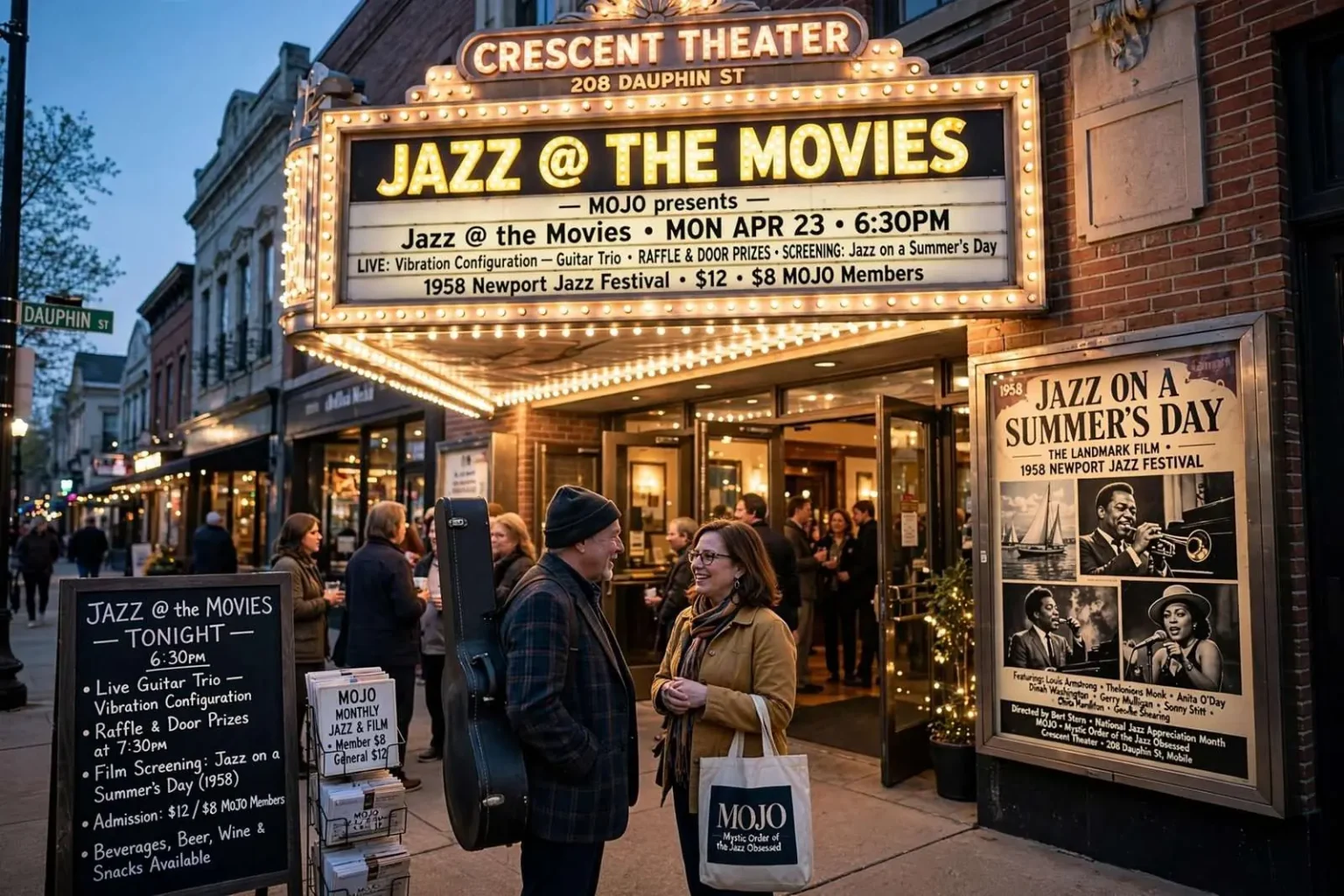
The Mystic Order of the Jazz Obsessed (MOJO) marked National Jazz Appreciation Month with Jazz @ the Movies on Monday, April 23, at 6:30 p.m. at the Crescent Theater, 208 Dauphin St. in downtown Mobile. The evening combined live music, door prizes and a classic jazz film into a single ticket, and it gave the city’s jazz devotees one more reason to gather on Dauphin Street.
Guitar trio Vibration Configuration kicked off the evening with a live set, followed by a raffle for door prizes and a screening of the acclaimed film “Jazz on a Summer’s Day.” The structure — a live act to open, a raffle to keep the room lively, and a film to close — fit MOJO’s signature formula for its monthly gatherings, which pair performance with film, history and socializing around the music.
Admission was $12, or $8 for MOJO members, with beverages, beer, wine and snacks available for purchase. The Crescent Theater, an intimate cinema on Dauphin Street, seats only about 90 people, and seating was first come, first served — an arrangement that rewarded early arrival in a room built for closeness between screen and audience.
“Jazz on a Summer’s Day”: A Landmark Film
The film at the heart of the evening holds a special place in jazz history. Directed by noted photographer Bert Stern, “Jazz on a Summer’s Day” documents the 1958 Newport Jazz Festival in Rhode Island, blending performance footage with impressionistic scenes of the festival weekend — sailboats on the harbor, the crowd, the seaside light. Stern’s background as a photographer shaped the film’s visual approach: less a concert documentary than a feature-length tone poem, with the music driving the images rather than the reverse.
The 1958 festival the film captured is regarded as one of the great editions of the Newport event, and the lineup preserved on film reads like a hall of fame. Thelonious Monk appears in a rare festival appearance, his angular genius on full display; Anita O’Day delivers her famously hip renditions in a film moment that helped define the jazz-vocal image; Dinah Washington brings her commanding voice; Louis Armstrong — by then jazz’s global ambassador — commands the stage with the warmth that made him an American icon.
Alongside them, the film preserves performances by Gerry Mulligan, Sonny Stitt, Chico Hamilton, George Shearing and other jazz greats, spanning the styles the festival booked that summer — swing, bop, cool jazz and blues all sharing the bill. For an audience in Mobile in the 21st century, seeing these performances on the Crescent’s big screen, with the sound of a live guitar trio still ringing in the room, was the kind of pairing the Crescent’s intimate format makes possible.
MOJO and Mobile’s Jazz Community
The Mystic Order of the Jazz Obsessed has long anchored Mobile’s organized jazz scene — a membership organization devoted to the music that runs monthly programs combining live performance, film, food and fellowship. Its gatherings double as social events and as continuing education in jazz history, and the organization’s member pricing for Jazz @ the Movies reflected its role as a club for people who take the music seriously but take their fun seriously too.
April’s designation as National Jazz Appreciation Month — a congressional and Smithsonian-backed observance — gives organizations like MOJO a natural occasion for special programming. The observance was created to celebrate jazz as an American art form and to encourage its study and performance, and cities with deep jazz roots, as Mobile has, typically answer with live events. Jazz @ the Movies was MOJO’s contribution: a night that honored the music’s recorded history while keeping local players on the bandstand.
The Crescent Theater Setting
The Crescent Theater at 208 Dauphin St. occupies a distinctive niche in downtown Mobile’s entertainment landscape. An intimate independent cinema with roughly 90 seats, it built its reputation on a mix of art films, independent releases and special events, and its small scale turns every screening into a communal experience. For a film like “Jazz on a Summer’s Day” — beloved as much for its imagery as its music — the theater’s projection and sound in a compact room suited the material better than a multiplex ever could.
The first-come, first-served seating policy fit the event’s casual, club-like character. MOJO audiences tend to arrive early and stay late, and in a 90-seat room the raffle, the refreshments and the live set all happened within a few steps of every seat. Beverages, beer, wine and snacks available for purchase made the evening feel less like a cinema trip than a private showing hosted for friends.
Dauphin Street itself completes the setting. As downtown Mobile’s main entertainment corridor, it hosts the city’s nightlife, its galleries and a growing roster of music venues, and the Crescent’s programming adds a cinematic strand to the mix.
Vibration Configuration and the Live Component
Opening the evening with live music is a MOJO hallmark, and the booking of Vibration Configuration — a guitar trio — set the tone for the film that followed. A guitar trio, built around the instrument that has shaped jazz from its beginnings through modern times, offers an intimate, conversational sound that suits a small room: melody, harmony and rhythm trading roles in real time, with the audience close enough to hear the strings.
The sequencing mattered as well. Live music first, then the film, gave the evening an arc from the present to the past — from Mobile’s working musicians to the giants preserved at Newport in 1958. The raffle between the two kept the room’s social energy moving, a small ritual that MOJO events use to support the organization and send a few door prizes home with the audience.
For local players, MOJO’s monthly stages carry real value. The organization’s events provide one of the few recurring venues in the area devoted specifically to jazz, giving the city’s jazz musicians an attentive audience and giving fans a reliable calendar. An opening slot at the Crescent — warming the crowd for Louis Armstrong and Thelonious Monk on film — is the kind of gig that connects Mobile’s scene to the music’s broader history.
Newport’s Legacy, Revisited in Mobile
The Newport Jazz Festival, which “Jazz on a Summer’s Day” captured, founded the modern American jazz festival, and the 1958 edition remains a touchstone for the music’s history. The festival drew the music’s leading figures to a Rhode Island seaside town each summer and, through Stern’s film, preserved that moment for audiences everywhere. Few jazz films have enjoyed such a long afterlife; “Jazz on a Summer’s Day” screens regularly at festivals, cinemas and society events decades after its release.
That afterlife explains why a Mobile jazz society would build an evening around it. The film is simultaneously entertainment and history — a concert film, a time capsule and a work of art photography — and it rewards the big-screen, good-sound treatment the Crescent could provide. Paired with a live local trio, a raffle and the society’s membership base, it made for a full evening of jazz appreciation in the month set aside for exactly that purpose.
An Affordable Night of Jazz
The pricing also told a story about MOJO’s mission. Twelve dollars at the door — eight for members — covered a live performance, a raffle and a classic film, with the Crescent’s concessions available throughout. Accessibility has always been part of the jazz society model: keep the door low, keep the room small, keep the programming rich, and let the membership carry the organization.
For those who made it early enough to claim a seat, the evening delivered what the Crescent does best: music and film in a room where the audience and the art share the same air. Jazz @ the Movies closed the loop between Mobile’s living jazz scene and the recorded golden age of the music — one Dauphin Street Monday in National Jazz Appreciation Month, with Monk, Armstrong, O’Day and Washington on the screen and the city’s own players on the stage.
The Musicians on the Screen and the Stage
The names in the film deserve their own accounting, because the 1958 Newport stage assembled them across the stylistic breadth of jazz. Thelonious Monk, the pianist whose compositions became standards and whose playing reshaped the music’s language, appears at a moment when his mainstream recognition was still building. Anita O’Day’s appearance in the film — sung in her crisp, horn-like phrasing and staged with her trademark hat — remains one of the most celebrated sequences in any jazz film. Dinah Washington, the “Queen of the Blues,” brought the vocal power that carried her from gospel roots to pop stardom.
Louis Armstrong’s presence connects the film to jazz’s deepest roots; by 1958 he had been the music’s most recognizable figure for decades, and his festival sets mixed hits with showmanship. Gerry Mulligan’s baritone saxophone, Sonny Stitt’s saxophone virtuosity, Chico Hamilton’s drum-led group sound and George Shearing’s polished quintet rounded out a program that mirrored the festival’s booking philosophy: all of jazz, on one stage, over one weekend.
Bert Stern’s treatment of that material is what elevated the film beyond archival record. As a leading commercial and portrait photographer of the era, Stern brought a visual sophistication rare in music documentaries — handheld intimacy during performances, languid attention to the crowds and the coast, and an editing rhythm that follows the music’s moods. The result is a film that shows what the festival felt like, not merely who played it.
Jazz Appreciation Month on Dauphin Street
The Monday timing of Jazz @ the Movies also reflects how Mobile’s cultural organizations use the calendar. National Jazz Appreciation Month each April fills with observances across the country — school programs, museum exhibits, concerts — and local jazz societies use the occasion to program events that might not fill a weekend slot but suit a dedicated audience on a weeknight. MOJO’s membership model thrives on exactly that kind of programming: reliable, inexpensive, sociable and grounded in the music’s history.
The Crescent’s role in such events rounds out the picture of downtown Mobile’s cultural infrastructure. A city with a 90-seat independent cinema on its main street can host film-and-music pairings, director screenings and society events that larger markets reserve for specialty venues — and the collaboration between MOJO and the Crescent shows how the city’s organizations trade on each other’s strengths. MOJO brought the audience and the programming; the theater brought the room.
For the audience that Monday, the evening’s final accounting was generous. A live guitar trio to open, a raffle in the middle, one of the most admired jazz films ever made to close, drinks and snacks at hand and a seat among ninety kindred spirits on Dauphin Street — all for the price of a modest ticket, with a member’s discount besides. Jazz Appreciation Month, as MOJO practiced it, was less an observance than an invitation.
And the invitation carried the music’s own lesson: that jazz is best experienced in the company of others, whether on a seaside stage in 1958 or in a small theater in Mobile half a century later. Vibration Configuration, the Crescent and MOJO each did their part to make that point on an April Monday — and the film that closed the night made it better than anyone could.