Joe Cain Day at Alabama Music Box: L.F. Knighton Marks Reunion at Packed Pre-Fat Tuesday Show
L.F. Knighton reunited on stage as Mobile's Alabama Music Box marked Joe Cain Day with rock from Vagabond Swing, Cockfight, and the Pine Hill Haints.
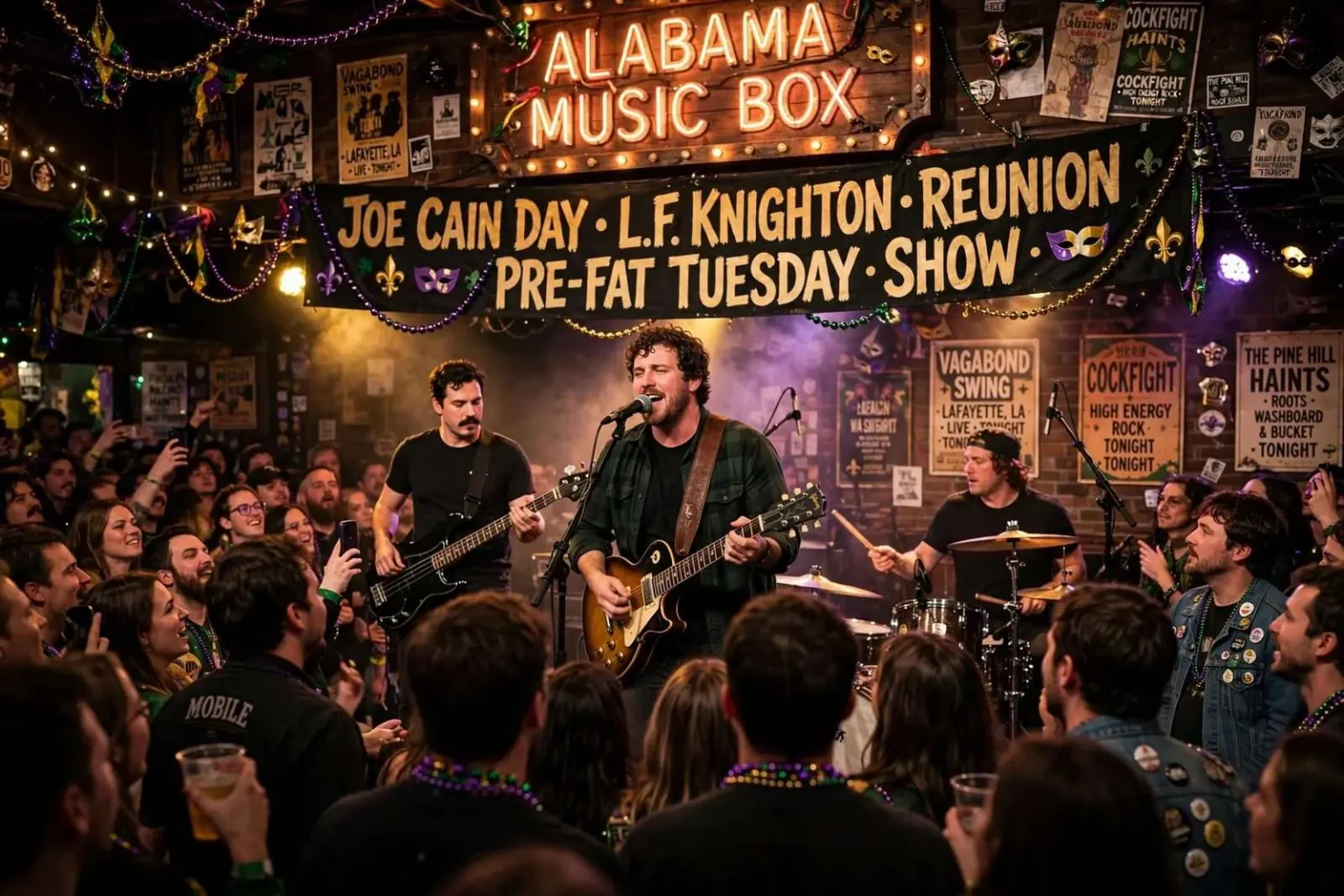
A crowd packed the Alabama Music Box in downtown Mobile for the venue’s Joe Cain Day celebration, a rock-and-roll night featuring a reunited L.F. Knighton and a full bill of regional acts on the eve of Fat Tuesday. The biggest moment of the night came courtesy of the popular Mobile rock trio L.F. Knighton, which performed for the first time in roughly six months. The band stepped back from the stage last summer after a long run of local shows, and frontman Chase Knighton led the trio through its return set before an enthusiastic audience.
Also on the bill was Vagabond Swing, a Lafayette, Louisiana group well known to Gulf Coast crowds, along with Cockfight, whose high-energy set kept the room moving, and The Pine Hill Haints, who drew on their deep roots sound with a washboard-and-bucket rhythm section that suited the region’s musical heritage. For a stretch of hours on one of the busiest weekends of the Mobile calendar, the venue delivered exactly what its regulars have come to expect: loud guitars, a packed floor, and a lineup built entirely from the Gulf Coast’s own scene.
The reunion set carried the night’s emotional weight. L.F. Knighton had been a fixture of Mobile’s local circuit, playing the kind of relentless schedule of club dates that builds a devoted following bar by bar, before going quiet last summer. Word of the one-night return evidently traveled fast, because the room was full well before the band took the stage, and the response from the crowd made clear how many people had been waiting for the chance to see the trio together again.
Chase Knighton fronted the group through a set that leaned on the band’s established sound, and the audience responded as if picking up a conversation interrupted six months earlier rather than starting a new one. Reunion shows on Mardi Gras weekends carry a particular charge in Mobile, when the whole city is already out celebrating and locals are looking for live music between parades and balls. The Alabama Music Box, a staple of downtown Mobile’s live music scene, has made a habit of pairing the holiday with local and touring rock acts, and this year’s Joe Cain Day bill followed that formula to strong effect.
What Joe Cain Day means in Mobile
Joe Cain Day is one of Mobile’s signature Mardi Gras traditions, honoring the 19th-century resident credited with reviving Carnival celebration in the city after the Civil War. Mobile’s Mardi Gras predates New Orleans by years, with masked balls and street celebrations tracing back to the city’s colonial era in the early 1700s, but the Civil War and its aftermath brought the festivities to a halt. It was Joe Cain, a local character with a flair for theater, who restarted the street celebration in 1866, parading through town in a costume drawn from Mobile’s Chickasaw heritage.
That single act grew into a legend, and over the decades Mobile built an entire day of festivities around it. The Joe Cain Procession, held on the Sunday before Fat Tuesday, is one of the most beloved parades of the season, famous for its deliberately unpolished, satirical spirit. The day also brings the Joe Cain Ferries and the mournful charm of the Merry Widows of Joe Cain, women in black who wail at the footsteps of the Cain monument and add the holiday’s most theatrical touch of comedy and pathos. This year’s Tennessee Williams-era figure remains central to how Mobile explains itself to visitors: the city that celebrated Carnival first in America and fought to keep it alive through its darkest years.
Against that backdrop, a Joe Cain Day rock show at a downtown club is a natural fit. The Sunday of Joe Cain weekend draws enormous crowds into the streets around Dauphin Street, the spine of downtown nightlife, and the bars and music venues along it feed off the parade energy before and after the floats pass. For bands, it is one of the best audiences of the year; for fans, it is a chance to hear original music in a season otherwise dominated by brass bands, cover acts, and ballroom entertainment.
The Alabama Music Box and downtown Mobile’s music scene
The Alabama Music Box has spent years as one of the central rooms for original live music in downtown Mobile. Sitting in the heart of the Dauphin Street entertainment district, the venue hosts touring national and regional acts as well as the local bands that form the backbone of the city’s scene, with a stage big enough for full rock lineups and a room that stays close enough to the action to make every show feel loud and immediate. On holiday weekends like Joe Cain Day, when foot traffic downtown is at its peak, the club’s calendar becomes a destination in its own right.
Mobile’s music scene has long drawn strength from the city’s position on the Gulf Coast, sitting between New Orleans and the Florida Panhandle and absorbing sounds from both. Rock, punk, garage, blues, and roots music all have deep local followings, and bands routinely move along a circuit that runs from Mobile through Pensacola, the Alabama and Mississippi Gulf beaches, and out toward Lafayette and New Orleans. A bill like this one, mixing Mobile acts with a Lafayette import, reflects how those connections work in practice.
Vagabond Swing, the Lafayette group on the bill, has built its reputation across that circuit, known to Gulf Coast audiences for a genre-blending live show that pulls from rock, swing, and punk influences. Lafayette sits at the center of south Louisiana’s rich musical culture, and bands from the city grow up surrounded by Cajun, zydeco, and swamp-pop traditions even when they play rock and roll. For Mobile crowds, a Lafayette band on a Mardi Gras weekend bill feels like family visiting from across the state line, and the Vagabond Swing set gave the night its sense of regional occasion.
Cockfight brought the evening’s rawest energy, delivering the kind of short, fast, loud set that keeps a room moving during the changeovers of a long Mardi Gras weekend bill. Loud rock bars thrive on bands like this on holiday nights, when the crowd wants momentum rather than subtlety, and the group’s performance kept the floor busy from the first song to the last.
The Pine Hill Haints closed the loop on the region’s older musical currents. The group’s deep roots sound, performed with a washboard-and-bucket rhythm section, reaches back to the folk, gospel, and old-time traditions that run through Alabama and the greater South. On a night built around electric guitars, the Haints’ stripped-down approach stood out, and the handmade percussion suited a holiday whose own traditions are largely homemade as well. Mobile’s Carnival has always mixed the handmade and the grand, from sewing krewes’ costumes to the washboards and buckets on a club stage.
The business of a Mardi Gras weekend show
For downtown venues, the stretch from Joe Cain Day through Fat Tuesday is the busiest window of the year. Mobile’s Carnival season officially begins each year on Twelfth Night in early January, but the crowds swell dramatically in the final two weeks, when parades roll nightly through downtown and visitors pour in from across the region. Bars and music rooms staff up, book their strongest lineups, and plan for street crowds that can make Dauphin Street nearly impassable on the biggest nights.
Booking a reunion for that window is a calculated move in both directions. The audience is guaranteed to be in town and in the mood to celebrate, which gives a returning band its best shot at a packed room. At the same time, competition for attention is fierce, with parades, balls, and every other bar in the district pulling at the same crowd. That L.F. Knighton drew a full house on Joe Cain Day eve says something about the following the band built during its years of steady local work.
That kind of following is earned the slow way. Gulf Coast original bands typically build audiences through years of club dates, festival slots, and opening slots for touring acts passing through, and Mobile has historically been generous to bands that put in that work. A six-month pause in that schedule is noticeable in a local scene, which makes a reunion set on a holiday weekend less a comeback announcement than a public confirmation that the band and its audience still belong to each other.
Music and Carnival, intertwined
The pairing of Mardi Gras and live music in Mobile goes back generations. Carnival season has always been a musical season, from the brass and string bands that played the early balls to the juke joints and honky-tonks that served the city in the twentieth century. The modern version of that tradition lives in the downtown clubs, where the soundtrack of the final days before Lent is more likely to be distorted guitars than a parade brass section, and the Alabama Music Box’s Joe Cain Day show is a clear example of how the two strands braid together.
For the bands, playing the holiday carries its own meaning. Many local musicians grew up attending Mardi Gras in Mobile, watching parades from the same downtown blocks where they now load their gear into clubs. The Joe Cain Day show places them inside the city’s favorite narrative: that Mobile’s Carnival is a living, local thing, sustained as much by neighborhood crowds and bar stages as by the formal balls of the established mystic societies.
By the time the last set ended, the night had done what Mobile’s best Mardi Gras nights do, folding a hometown band’s return into a celebration the city has been staging for more than a century and a half. L.F. Knighton’s reunion gave the crowd its headline moment, Vagabond Swing and Cockfight kept the energy high, and The Pine Hill Haints connected the loud electric present to the older roots sounds of the region. On the eve of Fat Tuesday, with Joe Cain’s name on the day and a packed room singing along, the Alabama Music Box delivered a distinctly Mobile way to mark the season’s climax.