
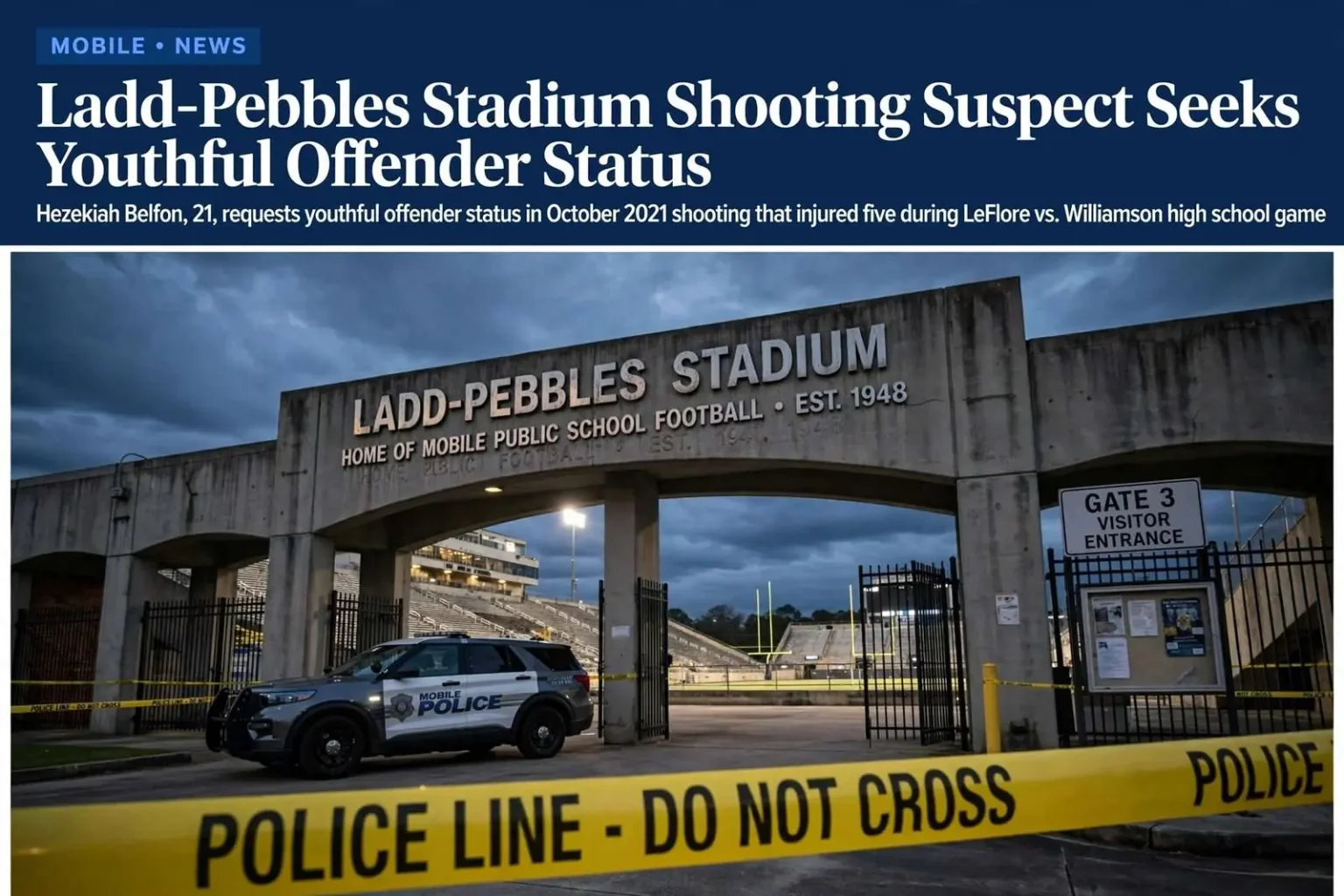
One of the men charged in the October 2021 mass shooting at Ladd-Pebbles Stadium is asking a Mobile County judge to grant him youthful offender status, a legal step that would move his case out of the adult court system. Hezekiah Belfon, now 21, was 19 years old when gunfire erupted at the Mobile stadium during a high school football game, scattering thousands of spectators and touching off one of the most jarring criminal cases in the city’s recent history.
Belfon faces five counts of attempted murder in connection with the incident, which police said was gang-related and left five people injured. The charges stem from the shooting on October 1, 2021, when shots rang out in the stadium stands during the fourth quarter of a matchup between LeFlore and Williamson, sending players and fans rushing for the exits in scenes that circulated widely on social media and drew national attention to the Port City.
His request was set to be reviewed at his arraignment hearing on May 4, 2023, in Mobile County Circuit Court. The ruling on youthful offender status would determine whether his case proceeds in open adult proceedings or behind closed doors under Alabama’s alternative system for young defendants.
What youthful offender status means under Alabama law
Under Alabama law, defendants who were under the age of 21 when an alleged offense occurred may petition the court for youthful offender status. The designation is not automatic. A judge reviews the petition and weighs factors including the nature of the alleged offense, the defendant’s prior record, the interests of justice and the prospect for rehabilitation before deciding whether to grant it.
If granted, the proceedings are closed to the public and the press, and any sentence imposed is handled through the juvenile-style youthful offender system rather than standard adult sentencing. That system gives judges broader flexibility in crafting dispositions focused on supervision, treatment and rehabilitation, and it generally seals the court record from public view.
Prosecutors can contest the request, and judges are not required to explain a denial in detail. In high-profile cases, the question of youthful offender status often becomes a flash point in its own right, because granting it closes a case that the community has followed closely from the start.
Belfon was among several people charged in connection with the stadium shooting, which investigators linked to a dispute between rival groups. Police said the five people wounded in the gunfire survived their injuries, and no one was killed, a fact that officials and community leaders repeatedly cited as remarkable given the crowds present when the shots were fired.
The shooting that shook the Mobile community
Ladd-Pebbles Stadium, the longtime home field for many Mobile public high school football programs, was packed with spectators on the night of the shooting. Video recorded by spectators showed fans pouring onto the field and out of the gates as shots continued, and emergency crews from Mobile Police and Mobile Fire-Rescue converged on the facility to treat and transport the wounded.
In the days that followed, city and school officials confronted hard questions about security at large public events. Mobile County Public School System leaders reviewed safety protocols for athletic events, and discussions followed about metal detectors, bag checks, staffing levels and coordination between school resource officers and city police at games hosted at the stadium.
The shooting also accelerated a wider conversation about youth violence in Mobile, one that clergy, neighborhood associations and city officials continued in town halls and community meetings in the months afterward. Advocates pressed for a combination of enforcement and prevention, arguing that policing alone could not address the conditions that draw young people into disputes that escalate to gunfire.
Ladd-Pebbles itself has long been one of the most storied sports venues on the Gulf Coast. Opened in 1948, the stadium has hosted high school football, college games, and professional events over the decades, and it carried the Senior Bowl all-star game for more than half a century before that event moved to other venues in the city. Its role as the traditional Friday night stage for Mobile’s public school teams made the violence there feel, for many residents, like an intrusion on a civic institution.
How the case moves through the courts
Belfon’s path through the court system illustrates the fork that Alabama law places in front of young adult defendants charged with serious crimes. Because he was 19 at the time of the alleged offense, he fell within the age window that allows a youthful offender petition. Had the alleged offense occurred after his 21st birthday, no such request would be possible, and the case would proceed entirely in the adult system.
The arraignment hearing on May 4, 2023, was the setting where the request was scheduled to be reviewed. An arraignment is typically the point at which a defendant formally answers the charges, and in this case it carried the added significance of the youthful offender determination hanging over the proceedings.
The stakes for Belfon are substantial. Five counts of attempted murder in the adult system carry potential penalties measured in decades, while a youthful offender disposition is limited to far shorter terms and emphasizes rehabilitation. For the victims and the wider community, a closed proceeding would mean the full accounting of what happened at the stadium would remain out of public view, a trade-off Alabama legislators have debated repeatedly over the years.
The case remains part of the broader legal aftermath of the October 2021 shooting, in which multiple defendants faced charges arising from the same night of violence. Prosecutors have worked through the cases one by one, and each defendant’s age and circumstances determine which track the law allows.
What comes next
Whatever the judge decides on youthful offender status, the decision will shape how much of the case unfolds in public. An adult prosecution would proceed with open hearings and a public record, while a youthful offender designation would move the matter into confidentiality from that point forward.
For Mobile, the case stands as a reminder of the October 2021 night when gunfire at a high school football game injured five people and echoed far beyond the stadium walls. The heightened security discussions it prompted around large public events, from metal detectors to police presence at games, continue to shape how the city plans for crowds at athletic venues across Mobile County.
Security changes and community response after the shooting
In the aftermath of the stadium shooting, Mobile police increased patrols and security presence at public school athletic events, and school system administrators worked with stadium operators to tighten entry procedures. District officials emphasized that the safety of students, families and fans would drive decisions about how games are staged, and coaches across the city reported heightened attention to who enters the gates on Friday nights.
The incident also landed at a sensitive moment for the stadium itself, which has faced recurring discussions in recent years about its condition, its bookings and its long-term role in Mobile’s sports landscape. Community leaders noted that whatever the future holds for the venue, the events of October 1, 2021, became a defining moment in its modern history and a reference point for every subsequent debate about event security in the city.
Area pastors and neighborhood leaders organized vigils and prayer gatherings in the weeks after the shooting, calling on young people to reject retaliatory violence and urging adults to mentor teenagers who might otherwise be pulled into street conflicts. Officials with the Mobile Police Department repeated their standing request for witnesses to come forward, noting that cooperation from the community is often the decisive factor in bringing serious cases to resolution.
The legal questions raised by Belfon’s petition extend beyond one defendant. Defense attorneys across Alabama have long argued that the youthful offender statute gives young adults a genuine second chance and reflects the science of adolescent brain development, while victims’ advocates counter that the public deserves transparency when alleged offenses involve mass violence in a crowded public place. Judges in Mobile County have faced both arguments repeatedly as petitions have followed high-profile cases involving defendants just short of the age cutoff.
For the five people wounded that night, the court process represents the formal accounting of an event that upended their lives in seconds. Their recoveries, along with the memories of the spectators who fled the stands, remain part of the backdrop as the Mobile County court system weighs how the case against one of the young men charged should move forward — in the open adult system, or behind the closed doors that youthful offender status would provide. City officials have said the lessons of that night continue to guide planning for every large gathering that follows.


