Leroy High Band Builds Momentum Behind New Leadership Ahead of 2026 Season
The Leroy High School Band enters the 2026 marching season with a new student leadership team and its halftime show, "Sunshine State of Mind."
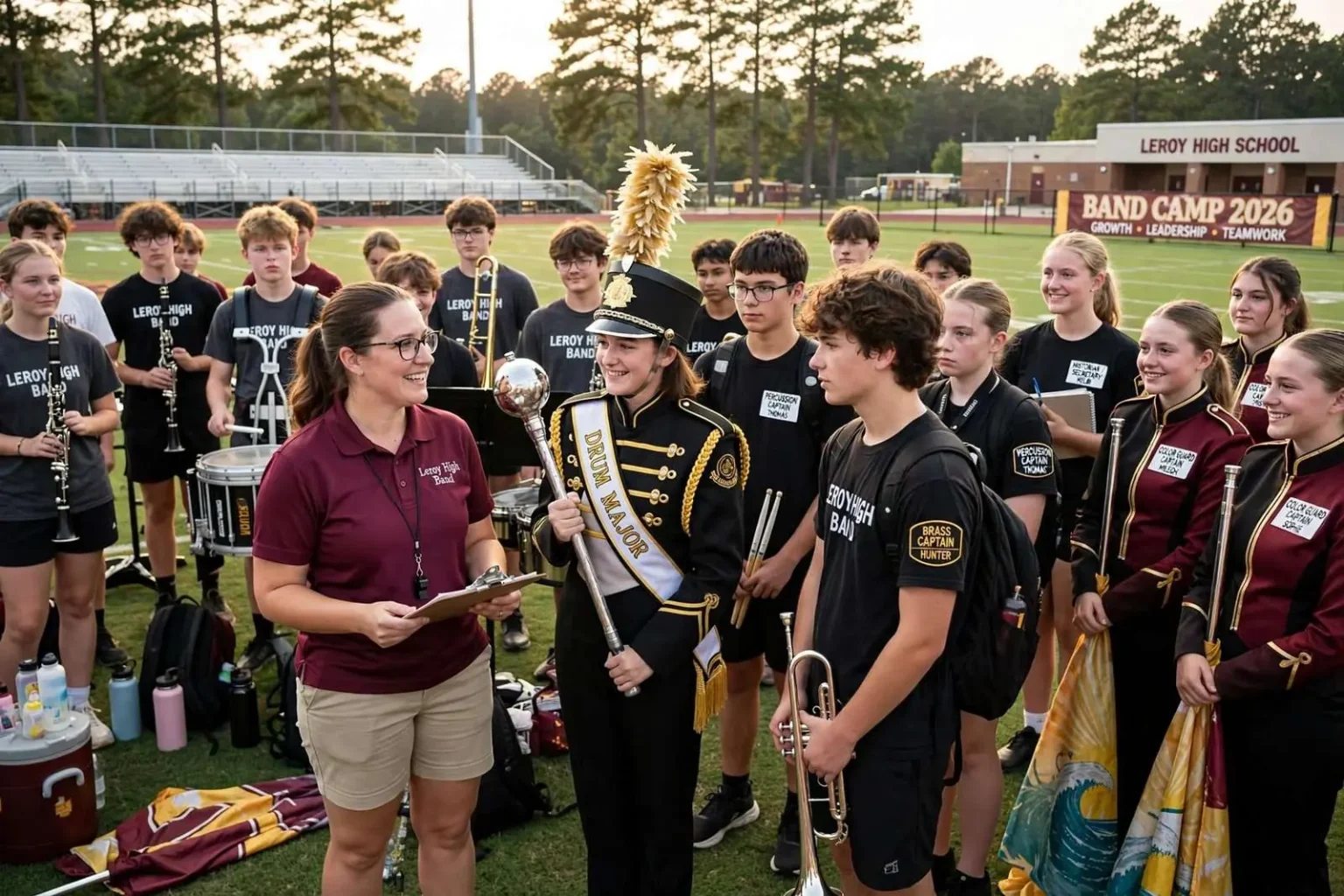
The Leroy High School Band is heading into the 2026 marching season with momentum after a band camp that band director Mallarie Mosley says emphasized growth, leadership and teamwork. This year’s camp marked a notable milestone for the program: 18 of the band’s 29 members are first-year participants, and the group is being led by an entirely new student leadership team. Despite the influx of newcomers, Mosley said the band has handled the transition well. “Every member of the band has stepped up in meaningful ways, supporting one another while growing as musicians and leaders,” Mosley said. “Their commitment, perseverance and willingness to learn have built a strong foundation for the upcoming season.”
Band camp is the proving ground for any marching program. In the late-summer heat of southwest Alabama, members spend long days learning to march in step, memorize music and master the fundamentals of their instruments before the first football game even arrives. For a program the size of Leroy’s, those weeks carry extra weight: with fewer than three dozen students on the roster, every musician matters, and every rehearsal counts twice.
That arithmetic explains why this camp stood out. A roster in which more than six in ten members are brand new represents both a challenge and an opportunity. The learning curve is steep, since first-year marchers must absorb everything from carrying an instrument at attention to reading field coordinates, but a large incoming class also resets a program’s culture and sets its trajectory for years to come.
A New Generation Takes the Field
Programs like Leroy’s depend on a steady pipeline. In small Washington County communities, the school band is often one of the few large student organizations, drawing members who started music in earlier grades alongside others picking up an instrument for the first time. When a wave of beginners arrives at once, the veterans effectively become teachers, and the directors become architects of a new foundation.
Mosley said the transition has gone smoothly because of how members have supported one another. Experienced marchers have been paired with newcomers as they learn drill and music, a common structure in rural programs where full-time staff is limited. Peer instruction keeps the pace moving during camp and builds the sense of ownership that carries a band through a long fall schedule.
The new-look roster will make its public debut when the band takes the field this fall. Until then, camp work continues: sectionals to sharpen individual technique, full-band rehearsals to pull the show together, and conditioning to prepare members for the physical demands of marching season in the Gulf Coast heat.
New Student Leaders
Leading the band this year are drum major and band captain Anna Kate Teet, first lieutenant and brass captain Hunter Williams, second lieutenant and percussion captain Thomas Cummings, woodwind captain Tristan Teet, historian and secretary Kelbi Sullivan, and color guard captains Mileigh Rester and Sophie Platt.
The drum major sets the tempo in performance and the tone in practice, conducting the band from the podium and serving as the bridge between students and staff. As band captain, Teet will also help coordinate day-to-day logistics, from rehearsal setup to uniform checkouts on Friday nights.
The lieutenant and captain structure divides responsibility by section. Williams will oversee the brass, Cummings the percussion and pit, and Tristan Teet the woodwinds, the sections that make up the heart of the marching band’s sound. Kelbi Sullivan’s work as historian and secretary keeps the program’s records, photographs and communications organized, tasks that take on added importance as the band documents a rebuilding year.
This Year’s Halftime Show
The band will debut its 2026 halftime show, titled “Sunshine State of Mind,” featuring the songs “Welcome to Paradise,” “Surfin’ U.S.A.,” “Ocean Eyes” and “Walking on Sunshine.”
The set list leans into a coastal theme familiar to listeners across the Gulf Coast, blending a rock anthem, surf-pop classics and a contemporary ballad into a single program. Programming familiar melodies is a deliberate strategy for young bands: crowds recognize the tunes, students stay engaged, and the arrangements sit within reach of a roster full of first-year players still building endurance on their instruments.
A halftime show runs roughly eight to ten minutes from first step-off to the final set, which means every member must memorize music and coordinates while keeping proper spacing and timing across the field. For an ensemble dominated by newcomers, the show’s structure, four short selections with distinct moods, gives the group natural checkpoints to hit as the season progresses.
From Camp to Friday Nights
The Leroy High School Band, based in Washington County, is preparing to carry that momentum from camp into performances throughout the fall football season. Friday night appearances are the program’s main stage: the band plays in the stands, performs its halftime show between the halves, and provides the soundtrack for the community’s weekly gathering under the lights.
In Alabama, marching bands also look toward the wider circuit of festivals and performance assessments each fall, where programs are evaluated on music and marching fundamentals. For a young band, those events are less about trophies than about benchmarks, offering proof of how far a group has come since the first day of camp and a measuring stick against programs from across the region.
The season ahead will test the foundation Mosley described. Every week brings new drill to clean, new crowds to play for, and the steady accumulation of experience that turns first-year members into veterans. By the time next summer’s camp arrives, the 18 newcomers of 2026 will be the experienced core of a program that just rebuilt itself.
The Band and Its Community
Leroy is a small community in eastern Washington County, and its high school sits at the center of community life. In towns of this size, the school band is more than an extracurricular activity. It is a public presence at ballgames, parades and civic events, and a point of pride that generations of local families share.
That visibility makes the program’s leadership development matter beyond the band room. Students who serve as drum majors, section captains and officers learn to plan, communicate and take responsibility for others, skills they carry into college, careers and service back home.
Support from families and local businesses typically underwrites the practical costs of a marching band, from instruments and repairs to uniforms, travel and show design. Booster efforts and fundraisers keep the program accessible to any student who wants to participate, which is one reason a roster welcoming 18 first-year members is worth celebrating rather than worrying over.
For now, the focus returns to the field. The leadership team is in place, the show is taking shape and the music is in the stands. The band’s 29 members, 11 returning and 18 brand new, will step off together this fall on a foundation their director says is already strong. With “Sunshine State of Mind,” the program has a show built for the Gulf Coast and a season built around growth.
What Band Camp Demands
The work behind a marching season begins weeks before classes do. At camp, students split their time between music rehearsals and movement fundamentals, learning the posture, foot timing and horn angles that give a band its unified look. Directors typically break the ensemble into sections so brass, woodwinds, percussion and guard can refine their own parts before everyone comes together on the field.
For first-year members, the biggest adjustment is often physical. Marching a full show means carrying an instrument for extended stretches in heavy heat, staying hydrated and building the stamina to perform eight to ten minutes of continuous movement. Veterans know the routine; newcomers learn it quickly, usually with the encouragement of the section leaders assigned to them.
Camp also sets the program’s standards for the year. Attendance expectations, rehearsal etiquette and the habit of constructive peer feedback are all established in those early weeks. When a band is as young as Leroy’s, those habits matter even more, because nearly the entire roster is learning the culture for the first time at once.
Looking Ahead to the Fall
The 2026 season will unfold week by week through the fall, with the halftime show as the centerpiece of each game night. Repetition is the engine of improvement in marching band: each performance exposes details to clean, and each week of practice refines the visual and musical picture the audience sees from the bleachers.
Community response will be worth watching as the new roster develops. Band programs in Washington County towns have long histories, and the fastest way for a young band to win over a crowd is with familiar songs played with confidence. “Sunshine State of Mind” is built for exactly that, pairing recognizable hits with a theme that fits the region.
Mosley’s message from camp, that every member has stepped up and supported one another, points to a program prioritizing growth over perfection in a transition year. If the foundation holds through the fall, the 2026 season will be remembered as the year Leroy’s band reloaded rather than rebuilt, and the 2027 season will begin with a full core of experienced marchers ready to raise the ceiling even higher.