Little Feat’s Bill Payne Talks and Plays at Mobile’s 92ZEW Ahead of Soul Kitchen Show
Little Feat co-founder Bill Payne joined 92ZEW's Lee Ann Waterrs before the band's Mobile show, explaining "Fat Man in the Bathtub" and playing live.
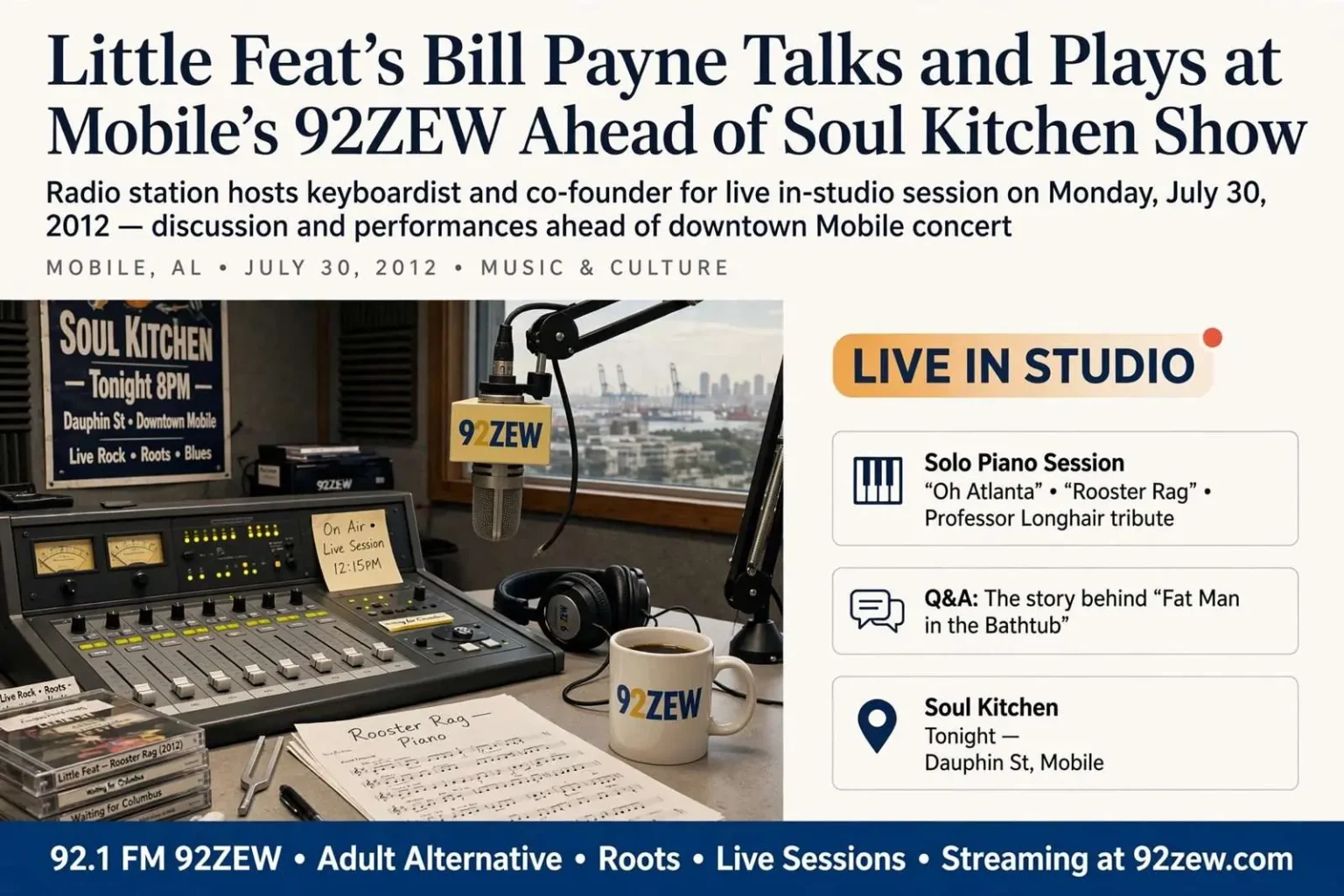
Bill Payne, keyboardist and co-founder of rock veterans Little Feat, stopped by the studios of Mobile radio station 92ZEW on Monday, July 30, 2012, ahead of the band’s show at the Soul Kitchen in downtown Mobile. In a conversation with host Lee Ann Waterrs, Payne dug into one of the band’s best-loved songs — and sat down at the keys for a set of live performances that turned a routine radio interview into a mini-concert for listeners along the Gulf Coast.
The visit gave Mobile fans a rare, close-up look at one of rock’s most respected sidemen and bandleaders. Payne co-founded Little Feat in Los Angeles in 1969 alongside singer and guitarist Lowell George, and across more than four decades he has been the band’s constant — the pianist and organist whose blend of boogie-woogie, New Orleans rhythm and blues, and gospel-tinged rock helped define the group’s unmistakable sound. When the band’s classic albums are recounted, from their early blues-rock records through the funky, Southern-soaked material that made them a touring institution, Payne’s keyboards are woven through all of it.
Among the highlights of the 92ZEW session was his answer to a long-running fan question: exactly who is the “Fat Man in the Bathtub”? The song, a fixture of the Little Feat catalog since its early days, has invited decades of speculation about its imagery and meaning, and Payne’s take on the question offered listeners the kind of first-hand insight only a founding member can provide. Rather than offering a single tidy explanation, his discussion of the song touched on the collaborative way Little Feat’s material came together in the early 1970s, when Lowell George’s songwriting and the band’s collective instincts produced some of the most enduring songs of the era.
Live from the studio
The interview’s musical segment set it apart. Payne also performed in-studio versions of “Oh Atlanta” and “Rooster Rag,” the title track of Little Feat’s then-new album. Hearing a founding member run through the band’s material alone at the keyboard strips the songs down to their foundations — the piano figures, rhythmic feels, and harmonic moves that a full six-piece arrangement usually wraps in guitars, horns, and vocals. For listeners who knew the records, the solo versions offered a master class in where the songs actually come from.
“Rooster Rag” carried particular weight that summer. The album, released as the band continued an active touring and recording life well into its fifth decade, represented a late-career creative surge for a group that could have rested on its catalog. Payne sitting down to play its title track on the eve of the Mobile show gave the local audience a preview of what the Soul Kitchen performance would deliver, and a sense of a band still invested in new material rather than merely trading on nostalgia.
Payne also ranged beyond the band’s catalog with material tied to New Orleans great Professor Longhair and even a piece by Chopin. The pairing was less incongruous than it might seem. Professor Longhair’s rolling, rhumba-inflected piano style is one of the foundational influences on Little Feat’s whole approach — the connection between the Crescent City and the band’s Louisiana-adjacent funk has always run deep — and Payne has long made those New Orleans piano traditions part of his own vocabulary. The Chopin selection, meanwhile, revealed the classical training and harmonic sophistication underneath the roadhouse groove, the kind of range that has kept Payne in demand as a session player across genres for decades.
A touring institution passes through Mobile
The visit paired two fixtures of the Gulf Coast music scene. 92ZEW, broadcasting at 92.1 FM, has long welcomed traveling acts for interviews and stripped-down sessions as they move through the region, and its studio sessions have become a signature of the station’s identity — a chance for listeners to hear national artists in something close to a living-room setting. The station’s format, built around adult alternative and roots-leaning rock, makes it a natural first stop for legacy acts and songwriters passing through Mobile on their way to or from larger Southeastern markets.
The Soul Kitchen, meanwhile, has been a dependable downtown Mobile stop for national touring bands. Sitting on Dauphin Street in the heart of the city’s entertainment district, the venue built its reputation on booking working bands across rock, jam, blues, and Americana — acts big enough to draw a crowd but sized for a club stage. Its shows routinely draw fans from across the Gulf Coast, including Pensacola, Biloxi, and New Orleans, all within easy driving distance. For Little Feat, whose live reputation has always outweighed its chart history, a room like the Soul Kitchen is a natural fit: close enough to the audience that the band’s extended grooves and instrumental interplay can land with full force.
For Little Feat, formed in Los Angeles more than four decades earlier, the swing through town came as the band carried “Rooster Rag” on the road. Few American bands can claim a touring history as long and as devoted — through lineup changes, the death of founder Lowell George in 1979, a breakup, and a rebirth in the late 1980s, the band rebuilt itself around its catalog and its reputation as a premier live act. Payne and percussionist Sam Clayton, along with the other longtime members, carried the band’s flag into its fifth decade, and the 2012 summer routing brought them through the Gulf Coast yet again.
The Little Feat legacy
Understanding the excitement around a Mobile stop requires understanding what Little Feat means to musicians and serious rock fans. The band’s 1970s run — albums blending rock, funk, blues, country, and New Orleans R&B, capped by the live landmark “Waiting for Columbus” — made them a cult institution whose influence spread far beyond their record sales. Covers of “Willin’,” “Dixie Chicken,” and “Fat Man in the Bathtub” by other artists, and the band’s fingerprints on Southern rock and jam-band generations that followed, kept the catalog alive even in years when the band itself was inactive.
Payne’s role in that story extends well beyond Little Feat. As a keyboardist, he has appeared on recordings by a long list of major artists, and his reputation as a session player and collaborator has made him one of the most respected pianists in rock. Fans who came to the 92ZEW session were hearing not just a band member promoting a new record, but a working musician whose résumé spans the history of American roots-rock — and whose playing on that Monday afternoon carried the same authority live.
Why stops like this matter to Mobile
The Monday visit also illustrated how a mid-sized market keeps itself on the touring map. Mobile sits between New Orleans and the Florida panhandle, close enough to both that national acts could easily skip it. Stations like 92ZEW and venues like the Soul Kitchen are the infrastructure that prevents that — offering bands a radio appearance to promote the show, a well-run room to play, and an audience that shows up. When a band that has been touring for four decades still includes Mobile on the itinerary, it is because those pieces are in place.
The station session format carries its own rewards for artists. A midday interview and a few songs at the keyboard cost a touring band little energy, reach thousands of listeners who might buy tickets that same day, and build a relationship with a local station that will keep the artist’s music in rotation. For 92ZEW, hosting a figure of Payne’s stature reinforces the station’s credibility with both listeners and booking agents; for the artist, it is one of the most efficient hours of promotion a tour can include.
For listeners, the session delivered the dual pleasure of insight and music: the story behind “Fat Man in the Bathtub” from a man who was in the band when it was written, fresh performances of “Oh Atlanta” and “Rooster Rag,” a nod to Professor Longhair, and a passage of Chopin — the whole conversation moving easily between rock history, piano technique, and the night’s show ahead. Few promotional stops offer that much, and fewer still come with a founding member willing to sit down and play as though the studio were a stage.
By the time Payne left the 92ZEW studios, the groundwork was laid for the evening at the Soul Kitchen. Fans who had heard the session arrived knowing what “Rooster Rag” sounded like stripped to the bones; those who had not got the full revelation live. Either way, the July 2012 visit reaffirmed a simple truth of the Gulf Coast music scene: the region’s love of roots, funk, and New Orleans-spiced rock and roll runs deep, and the bands that helped write that history — like Little Feat — know they will find a warm room when they come to Mobile.