Man charged with murder in death of Rebecca Hamilton in Monroe County
Juan Fischer was charged with murder in the death of 22-year-old Rebecca Hamilton in Excel, Alabama; investigators believe domestic violence was a factor.
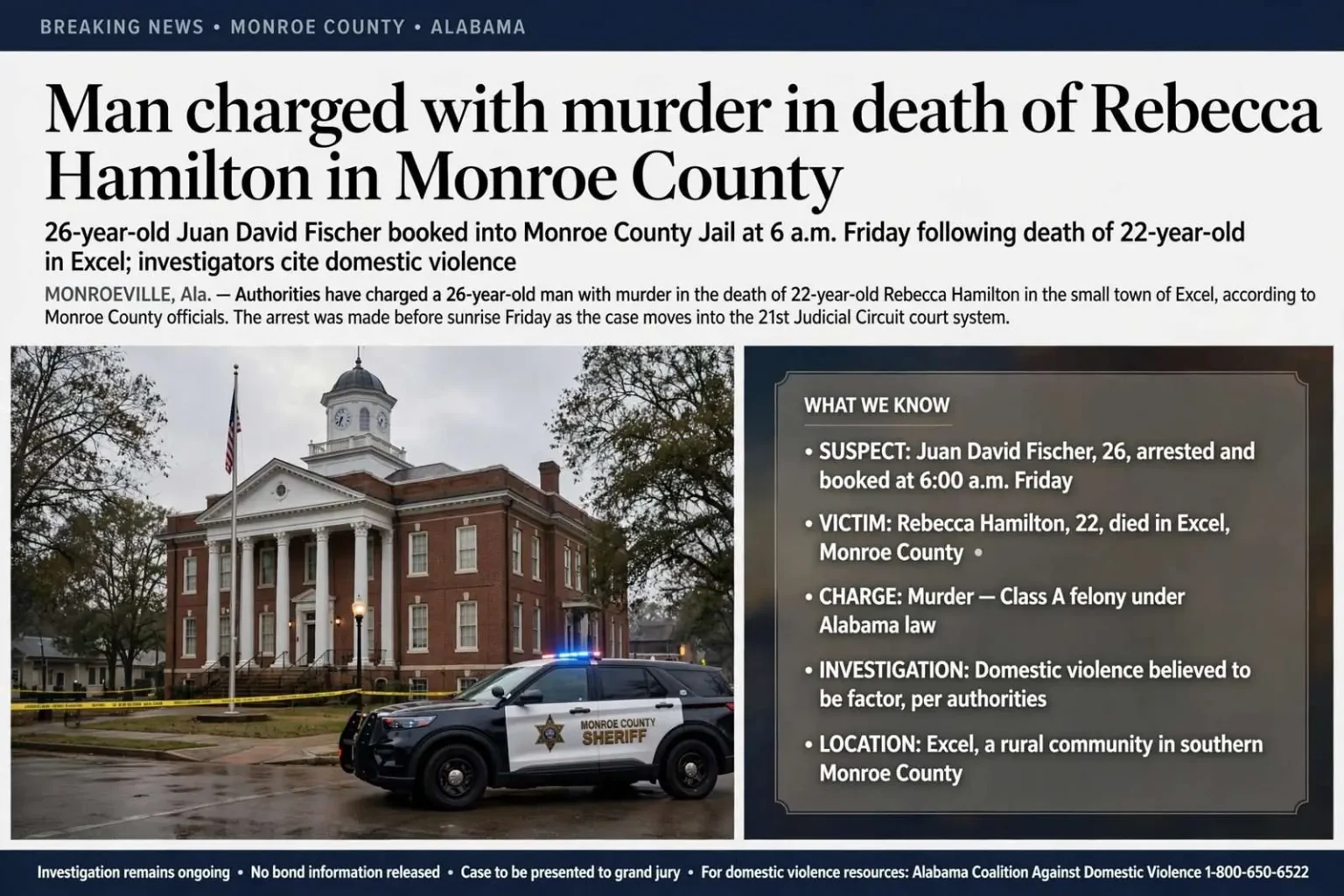
Authorities in Monroe County have charged a 26-year-old man with murder in the death of 22-year-old Rebecca Hamilton, and jail records show the suspect was in custody before sunrise Friday. Juan David Fischer was booked into the Monroe County Jail at 6 a.m. Friday, according to a jail clerk, after being arrested in connection with the death of Hamilton in the town of Excel. The case, which began as a death investigation in one of Monroe County’s smaller communities, has now moved into the criminal justice system, where a murder charge carries some of the most serious potential consequences in Alabama law.
News of the charge came after investigators spent time gathering evidence and speaking with those familiar with the circumstances. An investigator familiar with the case said authorities believe domestic violence led to the death — a detail that places the case within a category of fatalities that law enforcement agencies and victim advocates across Alabama have worked for years to reduce. Officials did not immediately release additional details about the events leading up to Hamilton’s death, and the investigation remained active as the charge was announced.
An Arrest in the Early Morning Hours
The booking at 6 a.m. Friday marked the formal start of Fischer’s passage through the county’s criminal process. A jail clerk confirmed the booking time, which is recorded when a suspect is processed into the facility in Monroeville, the Monroe County seat. No other information was immediately available when the booking was confirmed, a common situation in the hours after an arrest, when investigators are still assembling case files and prosecutors have yet to file supporting documents beyond the charging instrument itself.
In Alabama, once a suspect is booked on a murder charge, the case typically moves quickly through several early steps. A magistrate or district judge will schedule an initial appearance, where the charge is read and bond is addressed. Murder is a capital offense under Alabama law when committed under certain aggravated circumstances, and even in its standard form it is a Class A felony punishable by decades in prison. Prosecutors in the 21st Judicial Circuit, which covers Monroe County, will review the evidence assembled by investigators before the case proceeds to a grand jury.
Excel: A Small Town in Rural Monroe County
Excel is a small town in the southern part of Monroe County, a rural stretch of southwest Alabama between the Alabama River communities of Monroeville and the Washington County line to the south. The town, like others across the county, is a close-knit community where many residents know one another, and violent deaths are rare events that tend to resonate deeply with neighbors, school communities, and local churches. News of a homicide charge involving a young woman and a young man from the area spread quickly through the community as word of the early morning arrest circulated.
Monroe County itself is perhaps best known across Alabama as the home of Monroeville and the literary legacy of Harper Lee and Truman Capote, but its courthouse also handles the full range of criminal dockets for a rural county of roughly 19,000 residents. Cases of violent crime there are handled by the district attorney’s office, with support from the Monroe County Sheriff’s Office and municipal police departments depending on where an offense occurs. Because the death occurred in Excel, the investigation drew on resources from across the county as authorities worked to establish the facts of what happened.
Domestic Violence and the Law in Alabama
The investigator’s statement that domestic violence is believed to have led to Hamilton’s death underscores a problem that touches communities of every size in Alabama and across the country. Domestic violence fatalities often follow patterns that researchers and law enforcement have documented for decades: a history of escalating abuse, prior contact with police, and relationships that ended or were in the process of ending. The Alabama Law Enforcement Agency and local sheriffs track such cases, and courts in the state have expanded protective order mechanisms over the years to give victims additional legal tools before violence reaches a fatal stage.
Alabama law treats violence within a household or dating relationship as an aggravating factor rather than a mitigating one. The state’s domestic violence statutes create enhanced charges for assaults committed against someone with whom the offender has or had a dating relationship, a child in common, or a household member. When such violence results in death, prosecutors may pursue murder charges, and the domestic violence context can influence charging decisions, sentencing recommendations, and the conditions of any bond that a judge might set.
For families of victims, the weeks after a fatal domestic violence case are often filled with legal proceedings that unfold alongside grief. In Monroe County, as elsewhere, victim service officers with the sheriff’s office and prosecutors’ offices guide family members through appearances and hearings, while nonprofit advocates help with funeral costs, counseling referrals, and safety planning for others who may be affected. Rural counties often have fewer such resources than urban centers, which makes the role of local churches, schools, and community organizations especially significant in the aftermath of a killing.
What Comes Next in the Case
Fischer will remain in the Monroe County Jail as his case moves forward, unless a judge later sets bond that he is able to meet. Under Alabama law, defendants charged with murder may be held without bond in certain circumstances, or released on bond under conditions designed to protect the community and any potential witnesses. Court records in the coming days and weeks are expected to show the filing of formal documents, the appointment of defense counsel, and scheduling orders that set the pace of the case.
Rural Alabama murder cases frequently take many months, and sometimes more than a year, to move from arrest to trial. Investigators continue to gather evidence in the interim, including digital records, forensic results, and statements from those who knew the victim and the accused. Any additional charges, or modifications to the existing charge, would come through the district attorney’s office as the review of the evidence continues.
For now, the community in Excel and across Monroe County is left to absorb the loss of a 22-year-old woman whose death has already led to a murder charge. Family members and friends of Hamilton will likely find support in the community gatherings that rural Alabama communities have long relied upon in times of loss, even as the legal system begins the slow work of adjudicating the charge against the man who is now in custody.
The Broader Picture in Southwest Alabama
Homicides involving intimate partners remain a persistent concern for public safety officials throughout southwest Alabama, where the distance between small towns and the scarcity of specialized services can leave warning signs unaddressed until it is too late. Statewide, advocates have pushed for greater funding for crisis lines, shelters, and rural outreach, and prosecutors have increasingly coordinated with domestic violence resource centers when building cases. Each fatal case renews attention to how early intervention might change the outcome, and Monroe County’s experience is part of that wider pattern rather than an isolated event.
The early stages of this case will be watched closely by residents of Excel and the surrounding communities, both because of the ages of those involved and because of what the charge represents: the formal judgment by investigators that a young woman’s death was not an accident or an unexplained tragedy, but an act of violence within a domestic context. The distinction matters legally and practically, shaping how the case is prosecuted and how resources are directed toward those left behind.
As proceedings begin in the Monroeville courthouse, the basic facts established so far remain unchanged: Rebecca Hamilton, 22, died in Excel; Juan David Fischer, 26, was arrested and booked into the Monroe County Jail at 6 a.m. Friday on a murder charge; and an investigator has said the evidence points to domestic violence as the cause. Everything beyond that — the grand jury’s review, any trial date, and the final disposition of the case — will unfold in the months ahead in a courthouse that has handled the county’s most serious cases for generations, in a community still coming to terms with the loss of one of its own.
Residents who wish to support the family or learn more about domestic violence services in rural southwest Alabama can contact county victim service officers or statewide crisis resources, which operate around the clock and can connect callers with local advocacy groups. Law enforcement officials have also urged anyone with information relevant to an active investigation to come forward, since even small details can matter in the earliest days of a murder case. As with every case that begins with an early morning booking, the next chapters will be written not by rumor, but by the evidence, the court filings, and the slow machinery of justice at work in rural Alabama.