Five Years in Prison for McIntosh Man in 2024 Elder Abuse Case Tied to House Fire
A McIntosh man who pleaded guilty to harming two older visitors during a December 2024 attack that also involved fires at a family home will serve five years in prison, followed by five years of probation.
McINTOSH, Ala. — A McIntosh man who admitted to harming two elderly visitors during a violent December 2024 episode that also involved fires at a camper and a family home in rural Washington County will spend five years behind bars, under a sentence handed down in circuit court on Nov. 16, 2026.
The McIntosh elder abuse case ended with guilty pleas to two counts of second-degree elder abuse, the most serious charges remaining after a grand jury indictment that had also included first-degree arson. Court records show the judge imposed a 20-year term on each count, with the two terms running at the same time, and then split that sentence so that five years will be served in confinement and the following five years under supervised probation.
The man was given credit for 702 days he had already spent in custody, a figure that lines up with the stretch of time between his arrest in mid-December 2024 and the November 2026 sentencing date.
What the sentence means in practice
Alabama law gives judges several tools for structuring a prison term, and the outcome in this case uses two of them at once. Running sentences concurrently means the two 20-year terms overlap rather than stack, so the total underlying sentence is 20 years instead of 40.
The split sentence is the second tool. Under Alabama’s split-sentence provisions, a judge may impose a full prison term on paper while ordering that only a portion be served in custody, with the balance suspended in favor of probation. In this case the confinement portion is five years and the probation portion is another five years. The remaining time on the 20-year term acts as a backstop: if a person on probation violates the conditions set by the court, a judge can revoke that probation and order additional time to be served.
The 702 days of jail credit will be applied against the five-year confinement portion. Credit for time served is standard in Alabama and reflects days a defendant has already spent locked up while a case moved through the courts.
Restitution and the arson count
Beyond prison and probation, the sentencing order requires the defendant to pay restitution, with the amount still to be set, as well as court costs and fees. Restitution in Alabama criminal cases is intended to repay victims for losses tied directly to the crime, which can include medical bills, damaged property and similar out-of-pocket costs.
The order also addresses the first-degree arson charge from the original indictment. According to the sentencing order, that count is to be dismissed once restitution has been paid, if any restitution is in fact claimed. In other words, the arson charge was not tried, and the defendant has not been convicted of it; its dismissal is tied to the financial terms of the sentence.
First-degree arson is a Class A felony in Alabama, the same felony class as some of the most serious offenses in the state’s criminal code, and it generally involves intentionally damaging an occupied building by fire or explosion. Resolving that count through restitution rather than trial is one of several outcomes that can come out of plea negotiations between prosecutors and defense attorneys.
A December night on John Johnston Road
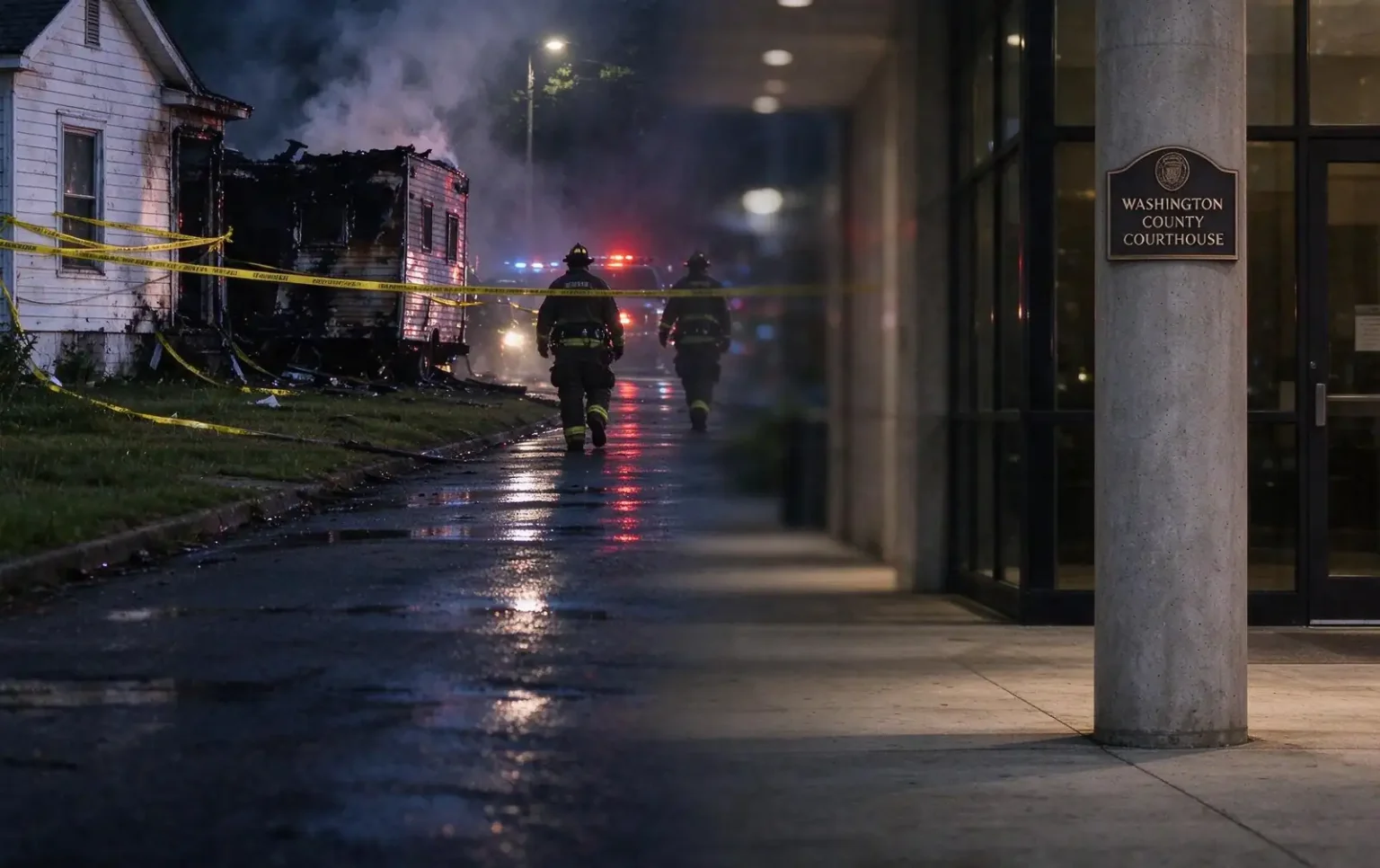
The case traces back to Dec. 14, 2024. That day, authorities in Washington County were called to John Johnston Road in McIntosh after reports that two fires were burning. Investigators with the Washington County Sheriff’s Office later determined that the defendant had set fire to his own camper and to the home of an 87-year-old relative while she was still inside the house.
The woman was hurt but survived, according to the sheriff’s office.
Two other people were also at the property: a man, 84, and a woman, 80, who had traveled in from out of town for a visit. Authorities said the defendant knocked both of them to the ground and then began attacking the man. Each of the two visitors needed treatment for injuries afterward. These assaults on the two older visitors formed the basis for the two elder-abuse counts to which the defendant eventually pleaded guilty.
After the attack, the defendant ran from the property, but deputies caught up with him not far from the residence. He was booked into the Washington County Jail, where bond was initially set at $150,000.
From arrest to indictment to plea
Felony cases in Alabama usually move from arrest to a grand jury, which decides whether there is enough evidence to formally charge someone. A Washington County grand jury took up this case during its spring 2025 term and returned a three-count indictment, charging him with two counts of second-degree elder abuse along with one count of first-degree arson.
Roughly a year and a half later, the case concluded with the guilty pleas and the Nov. 16 sentencing. Washington County’s circuit court sits in Chatom, the county seat, where felony matters from across the county, including McIntosh, are handled.
How Alabama defines elder abuse
Alabama treats crimes against older residents as their own category under state law. The state’s elder abuse statutes apply to victims who are 60 or older and divide the offense into degrees based largely on how serious the harm was and the intent behind it.
Second-degree elder abuse, the charge in this case, is a Class B felony in Alabama. A Class B felony carries a possible prison sentence of 2 to 20 years, so the 20-year term imposed on each count sits at the top of that range before the split was applied. First-degree elder abuse, by comparison, is a Class A felony, and third-degree elder abuse is a Class C felony.
Lawmakers created the separate elder-abuse offenses so that attacks, neglect and exploitation aimed at older adults could be charged in a way that reflects the particular vulnerability of that population. Prosecutors can bring those charges in addition to, or instead of, more general assault charges, depending on the facts.
About McIntosh and Washington County
McIntosh is a small town in southeastern Washington County, near the Tombigbee River and north of Mobile. The surrounding area is largely rural, with homes spread out along county roads and a long-standing industrial presence tied to the river corridor. Washington County itself is one of the more sparsely populated counties in southwest Alabama, and its sheriff’s office covers a wide territory of forests, farmland and small communities.
In places like this, emergencies at a single home can draw a response from deputies, volunteer fire departments and ambulance crews coming from some distance away, which is part of why reports of two fires at once prompted a significant response in December 2024.
Protecting older adults: warning signs and where to turn
Cases involving harm to older people often come to light only because someone outside the household notices a problem. Public health and aging agencies, including the federal Administration for Community Living and the National Center on Elder Abuse, encourage neighbors, relatives and friends to watch for signs such as:
- Unexplained bruises, burns, cuts or other injuries, especially ones that appear more than once.
- Sudden changes in mood, withdrawal from activities or fearfulness around a particular person.
- Poor hygiene, missing medications or an unsafe living situation.
- Unusual changes in bank accounts, unpaid bills or missing belongings.
- A caregiver or relative who refuses to let others visit or speak with the older person alone.
In Alabama, concerns about abuse, neglect or exploitation of an adult can be reported to the Alabama Department of Human Resources, which runs the state’s Adult Protective Services program. DHR maintains a toll-free adult abuse hotline at 1-800-458-7214, and reports can also be made through a county DHR office. Anyone who believes an older person is in immediate danger should call 911 first.
Alabama also allows older adults, or people acting on their behalf, to seek protection orders in certain elder-abuse situations, a step that can be taken through the courts separately from any criminal case.
Fire safety reminders for rural homes
Although the fires in this case were intentionally set, the episode is a reminder of how quickly flames can endanger someone inside a home, particularly an older resident who may move more slowly. The U.S. Fire Administration and the National Fire Protection Association recommend that every home have working smoke alarms on every level and outside sleeping areas, that alarms be tested monthly, and that households plan and practice two ways out of every room.
Many local fire departments and the American Red Cross offer free smoke alarm installation for residents who need help, and older adults who live alone can benefit from having a neighbor or relative check in regularly, especially during the winter months when heating-related fires are more common.
What comes next
With the sentence imposed, the defendant will serve the confinement portion in the custody of the Alabama Department of Corrections, with his 702 days of credit applied. Once that period ends, he will begin five years of supervised probation, during which he must follow conditions set by the court. Any violation could expose him to more of the underlying 20-year term.
The court still has to determine the amount of restitution, if any is claimed. The dismissal of the remaining first-degree arson count is tied to that payment under the terms of the sentencing order.
For the older residents who were hurt that night, the sentence brings the criminal case close to an end nearly two years after the fires and assaults on John Johnston Road.