

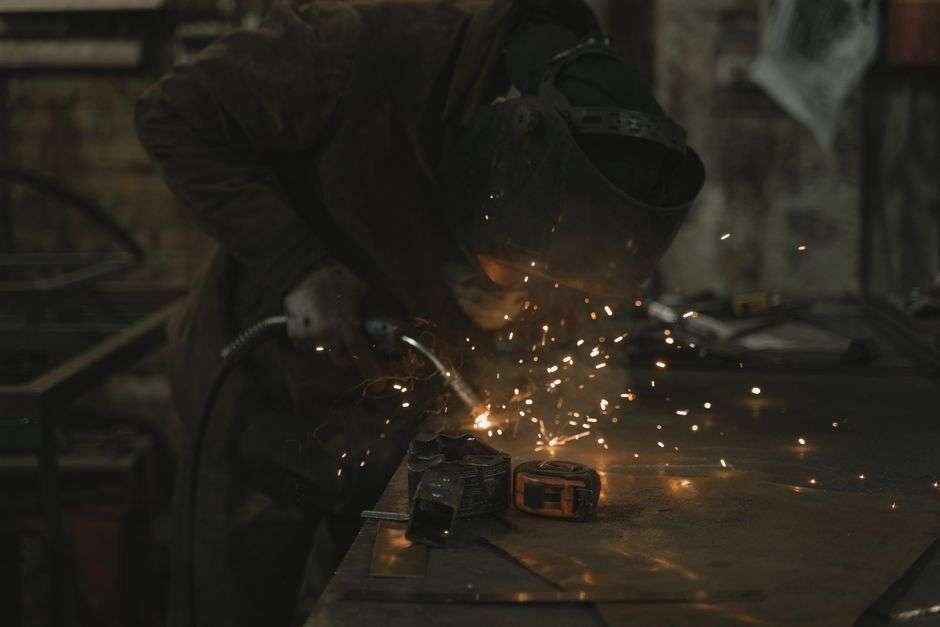
The signs hanging over some of Fairhope’s best-known businesses — the Dragonfly, the Bone & Barrel, The Balcony on Church Street — share a common maker. So do the entrance markers for subdivisions like Deer Crest, River Station and Bay Branch Estates, and roughly 300 custom fire pits burning in backyards across the Gulf Coast. All of them came out of Alabama Iron Works, a Commercial Park Drive shop where an engineer-turned-metal-artist has spent 13 years proving that “village blacksmith” and “high-tech fabricator” can describe the same business.
Jim Trainer, a native of Bangor, Maine, founded Alabama Iron Works in 2011 after roughly 35 years designing components for the shipbuilding industry, including stints at Northrop Grumman and Austal. Today his three-man crew cuts, welds and powder-coats everything from truckloads of aluminum condominium railings to a delicate hummingbird figurine snapped off by an accident.
A fire pit born on game day
Trainer’s leap into business started, improbably, with football. He had already lived in most corners of the country — including nearly a decade on Whidbey Island in Washington’s Puget Sound — when he took a job at Bender Shipyard in Mobile and caught his first look at the Eastern Shore almost two decades ago. “It was a beautiful place, and it was laid back without a lot of traffic,” he says, “and it seemed to be very affordable, too.”
He soon absorbed a local truth: around here, football is a big deal. Setting up for a game-day gathering of friends one busy fall Saturday, he had the idea of building fire pits customized with team colors and mascots. The University of Alabama’s iconic script A came off the drawing board first; Auburn followed. And as he predicted, guests at parties wanted one for themselves.
He has sold around 300 fire pits since — some bearing herons, fish or palm trees, others incorporating family names, favorite hobbies or company logos. Each is a one-off: designed in CAD, cut on a plasma table, and finished by hand. “A fire pit is sort of a one-off thing,” he says. “It’s not something you can put into production because each one is different, and I have to spend a lot of time on the artwork. So I had to look for bigger markets.”
From fire pits to everything else
The business grew outward from there. Alabama Iron Works now fabricates railings, ornamental gates and spiral staircases in stainless steel, aluminum, copper and brass — a materials range few small shops can match — and has delivered truckloads of aluminum railings for a condominium project on Biloxi’s scenic strip.
At the same time, the shop still plays the role Jim half-jokes about: the village blacksmith. Customers bring in cast-iron urns, snapped figurines and heirloom art objects for repair. Spring Hill College brought in a three-tiered fountain about eight feet tall; his crew welded it, arranged for powder coating at a local partner firm, and sent it home. “At times, I feel like I’m running the village blacksmith shop, too,” he says with a quiet laugh.
“I like to say that I’m a metal artist,” Trainer says, “but on the other hand I might just say I’m a metal fabricator.” A look around the shop confirms both are true.
The shipbuilder’s discipline
Trainer’s approach to durability comes straight from his shipbuilding foundation. He entered the trade through an apprenticeship program that taught him many facets of design and production, and he carried that engineering rigor into metal art: precision CAD work, clean welds, and finishes chosen to survive Gulf Coast salt air. The powder coating partnership with a local firm gives his outdoor pieces both their good looks and their durability — a sign that still looks sharp after years over a downtown doorway is an advertisement for the shop that made it.
Signs as signature
Of everything Alabama Iron Works builds, signage has become Trainer’s favorite. Each project begins with a conversation — sometimes no more than a rough sketch on a napkin, sometimes a detailed brief — and moves through questions and counter-questions until the design matches what the customer actually wants. Then comes the craft: cutting the steel, shaping the lettering, choosing the finish.
The results hang across Fairhope’s downtown and at subdivision entrances throughout the Eastern Shore, and Trainer admits to feeling pride when he passes his own handiwork. For a business that began with a football-themed fire pit idea at a game-day gathering, that kind of civic visibility is the best advertising there is.
Engineering as art
What distinguishes Trainer’s work from mass-market metal decor is the engineering underneath it. Structural decisions — spans, mounts, weld points, drainage — are invisible in a finished sign or railing, but they determine whether a piece hangs straight for 20 years or sags in five. An engineer’s habits also show in how he prices and plans: every custom piece is quoted from real drawings, not guesswork.
That discipline has built something rare: a small shop trusted equally by a subdivision association needing an entrance sign and a college needing a fountain restored. Trainer credits the customers. “I’m fortunate to have a strong, loyal customer base that not only supports me but also recommends me to their friends,” he says. “I hoped it would work, and it’s taken a long time to get here.”
The result is a Fairhope business that is easy to walk past and hard to miss — in the shape of the signs, gates and railings that give the town its look, and in the fire pits glowing in backyards on autumn Saturday nights.