Miflin Road Lane Closure in Foley Runs Weekdays Until Dec. 4 as Crews Build New Turn Lanes
Drivers on Miflin Road in Foley will find one lane closed on weekdays between the Foley Beach Express and Frank Cole Lane while crews build turn lanes through Dec. 4. The work is part of a wider push to improve traffic flow along the growing corridor.
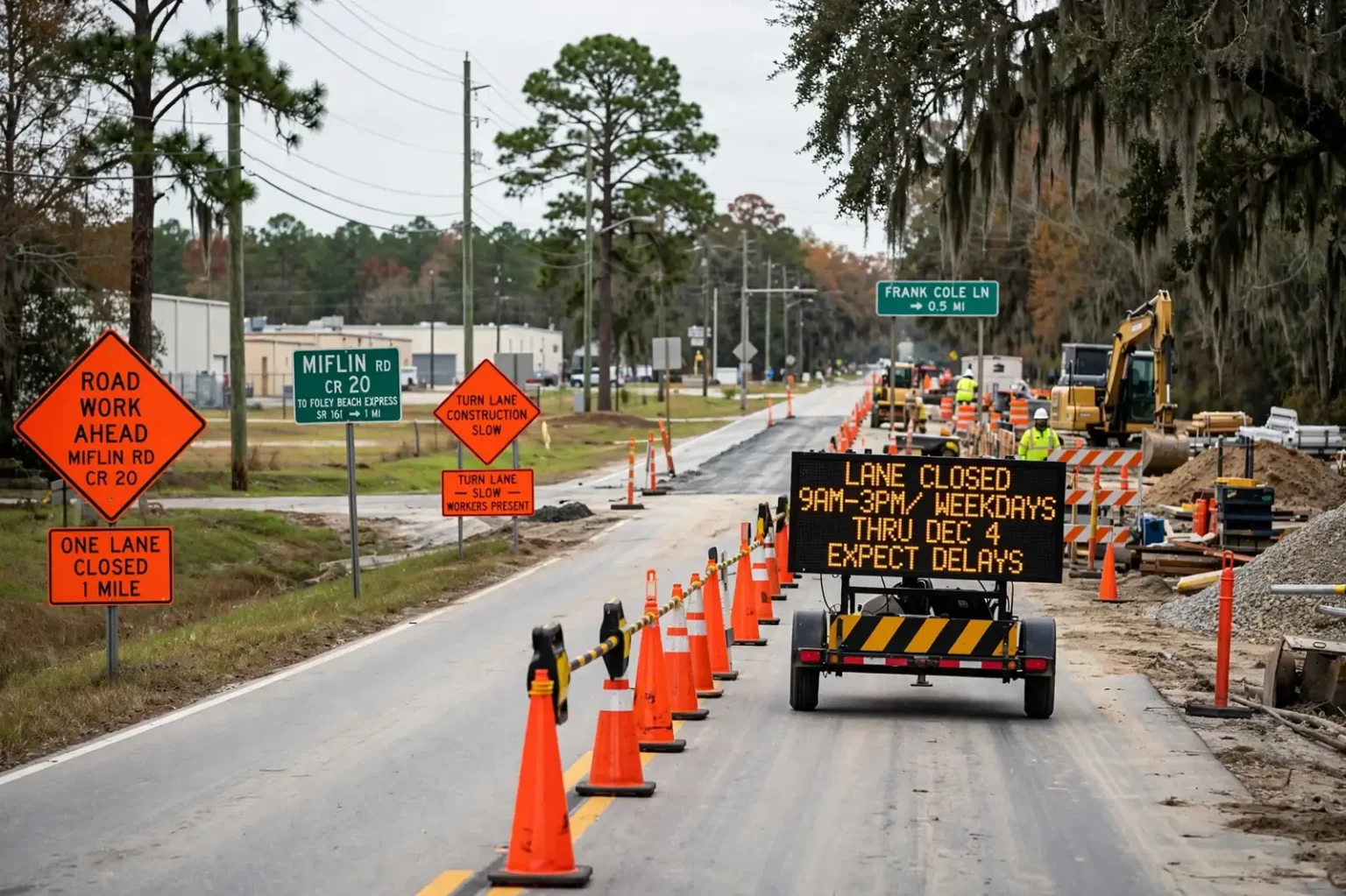
FOLEY, Ala. — A Miflin Road lane closure that began Thursday, Nov. 12, will slow weekday traffic on a busy east Foley corridor into early December as crews build new turn lanes and finish other roadway improvements.
The closure affects Miflin Road, also known as County Road 20, between the Foley Beach Express (SR 161) and Frank Cole Lane. One lane will be blocked on weekdays from 9 a.m. to 3 p.m., and the work is scheduled to wrap up on Friday, Dec. 4.
What drivers need to know
- Road: Miflin Road (County Road 20)
- Limits: Between the Foley Beach Express (SR 161) and Frank Cole Lane
- Hours: Monday through Friday, 9 a.m. to 3 p.m.
- Dates: Thursday, Nov. 12, through Friday, Dec. 4
- Purpose: Construction of turn lanes and related roadway improvements
- Traffic impact: One lane closed during work hours; expect delays
City officials have asked motorists to slow down and stay alert in the work zone, to watch for workers and heavy equipment, and to build extra time into their trips. Because the restriction is limited to midday weekday hours, drivers who can shift their travel to early morning, late afternoon or weekends may be able to avoid the closure entirely.
Road stays open to through traffic
Miflin Road will not be shut down completely at any point during the project. City officials said through traffic will continue to move along the corridor, although individual lanes may be restricted from time to time. The city’s engineering staff told the council that closures would be kept limited so that drivers, residents and businesses can continue to reach destinations along the road.
For people who live or work along this stretch, that means driveways and side streets should remain reachable, though turning in and out may take a little more patience while crews are present.
Why turn lanes matter
Turn lanes are one of the most common tools traffic engineers use on roads that are seeing more cars. When a driver waiting to turn left or right has to stop in a through lane, every vehicle behind that driver must stop too. On a busy road, that can create backups and raise the risk of rear-end collisions.
Dedicated turn lanes give turning vehicles a place to slow down and wait outside the main flow of traffic. The result is generally smoother traffic, fewer sudden stops and fewer conflicts between vehicles. On a corridor like Miflin Road, which connects residential areas with major routes including the Foley Beach Express, those gains can be meaningful for daily commuters.
A separate project closer to Alabama 59
The turn lane work near the Foley Beach Express is a short-term, localized project, but it is overlapping with other upgrades the city has lined up for Miflin Road. Those efforts are separate and independent from the current lane closure.
The Foley City Council has already approved the first phase of the Miflin Road Access Management Plan. That phase authorizes construction of a median on Miflin Road between Alabama 59 and Juniper Street. City records show that Riviera Utilities will add street lights along the new median under the same capital improvement effort. City staff have estimated that the lighting work could take as long as four months to complete.
What access management means
Access management is a planning approach that controls where and how vehicles can enter, leave and cross a roadway. Common techniques include raised medians, consolidated driveways, designated turning locations and carefully spaced traffic signals. By reducing the number of places where vehicles can turn across traffic, these designs cut down on the points where crashes can occur and help traffic move more predictably.
Medians are a central feature of many access management plans. They separate opposing lanes of traffic, can provide a refuge for pedestrians crossing a wide road, and channel left turns to specific openings or intersections. Adding street lighting along a median improves visibility at night for both drivers and people on foot.
The utility’s role
Riviera Utilities is the public utility that provides electric service and other utility services in the Foley area. Because it owns and maintains much of the local electrical infrastructure, it is a natural partner for street lighting along city corridors. Installing lighting along a new median typically involves setting poles or fixtures, running underground or overhead power lines, and connecting the lights to the grid, all of which must be coordinated with road construction so crews are not working on top of one another.
How the council approves projects like this
Capital projects such as the Miflin Road median move forward through votes of the Foley City Council, which reviews plans, cost estimates and contracts presented by city staff. Large corridor plans are often broken into phases so the city can fund and build them in manageable pieces, evaluate the results and adjust later phases as needed. The phase approved for the stretch between Alabama 59 and Juniper Street is the first step in that process.
Smarter signals for Foley
The corridor improvements also tie into a broader effort to coordinate traffic signals across Foley. New signals will be connected to the Alabama Department of Transportation’s Regional Traffic Operations Program, known as RTOP. That system already links more than 20 traffic lights in Foley along Alabama 59, U.S. 98 and Alabama 161.
RTOP relies on traffic cameras, radar and cellular communications equipment to connect signals to one another and to adjust their timing based on how much traffic is actually on the road. Instead of operating on fixed cycles regardless of conditions, coordinated signals can respond to changing volumes, which helps reduce unnecessary stops and wait times.
Coordinated signal systems offer benefits beyond shorter waits. When lights along a corridor are timed to work together, vehicles can travel in platoons through a series of green lights, which reduces stop-and-go driving. That can mean less fuel burned, lower emissions and fewer of the abrupt stops that lead to rear-end crashes. Because traffic engineers can monitor and adjust the system remotely, timing can also be changed to handle special events, crashes or seasonal surges in visitors.
The mayor told council members that the city began working with ALDOT on signal coordination more than a year ago, as one piece of a citywide campaign to keep vehicles moving more smoothly. He described the progress as incremental, noting that each additional step helps address a familiar complaint from drivers: sitting at a red light when no cross traffic is present. He called the effort a positive development for the city.
Growth driving the changes
Foley is one of the fastest-growing cities in south Baldwin County. Its location along Alabama 59 and U.S. 98, between Interstate 10 to the north and the beaches of Gulf Shores and Orange Beach to the south, puts it at the center of a busy regional travel network. The Foley Beach Express provides an alternative route toward Orange Beach and the coast and carries heavy traffic, especially during tourist season.
New neighborhoods, shopping centers and attractions have brought more residents and visitors to the area in recent years, and roads that once handled light rural traffic now serve a much larger population. City officials have said broader corridor upgrades will accompany that growth. The current Miflin Road work, the access management plan and the signal coordination program are all pieces of that larger picture.
Tips for getting through the work zone
Work zones can be hazardous for both drivers and the crews who build and maintain roads. Traffic safety guidance for motorists passing through construction areas includes these reminders:
- Slow down and follow posted speed limits and any instructions from flaggers.
- Stay focused and put the phone away; work zones can change from day to day.
- Leave extra space between your vehicle and the one ahead, since sudden stops are common.
- Merge early and smoothly when a lane closure is ahead rather than forcing your way in at the last moment.
- Watch for workers, trucks and equipment entering or leaving the roadway.
- Be patient. Crews are working to finish the job and reopen lanes as quickly and safely as possible.
Looking ahead
If the schedule holds, the lane restriction between the Foley Beach Express and Frank Cole Lane will end on Friday, Dec. 4. The separate median and lighting work between Alabama 59 and Juniper Street is expected to take longer, with the lighting portion alone estimated at up to four months.
Drivers who use Miflin Road regularly can expect continued construction activity along parts of the corridor in the months ahead as Foley works to keep its roads in step with its growth. Updates on schedules and any changes to lane restrictions are typically shared by the City of Foley.