Mobile and Fairhope Shine in Amazon Prime Time Loop Romance ‘The Map of Tiny Perfect Things’
Mobile and Fairhope Alabama serve as filming locations for 'The Map of Tiny Perfect Things,' a teen time loop romance streaming on Amazon Prime.
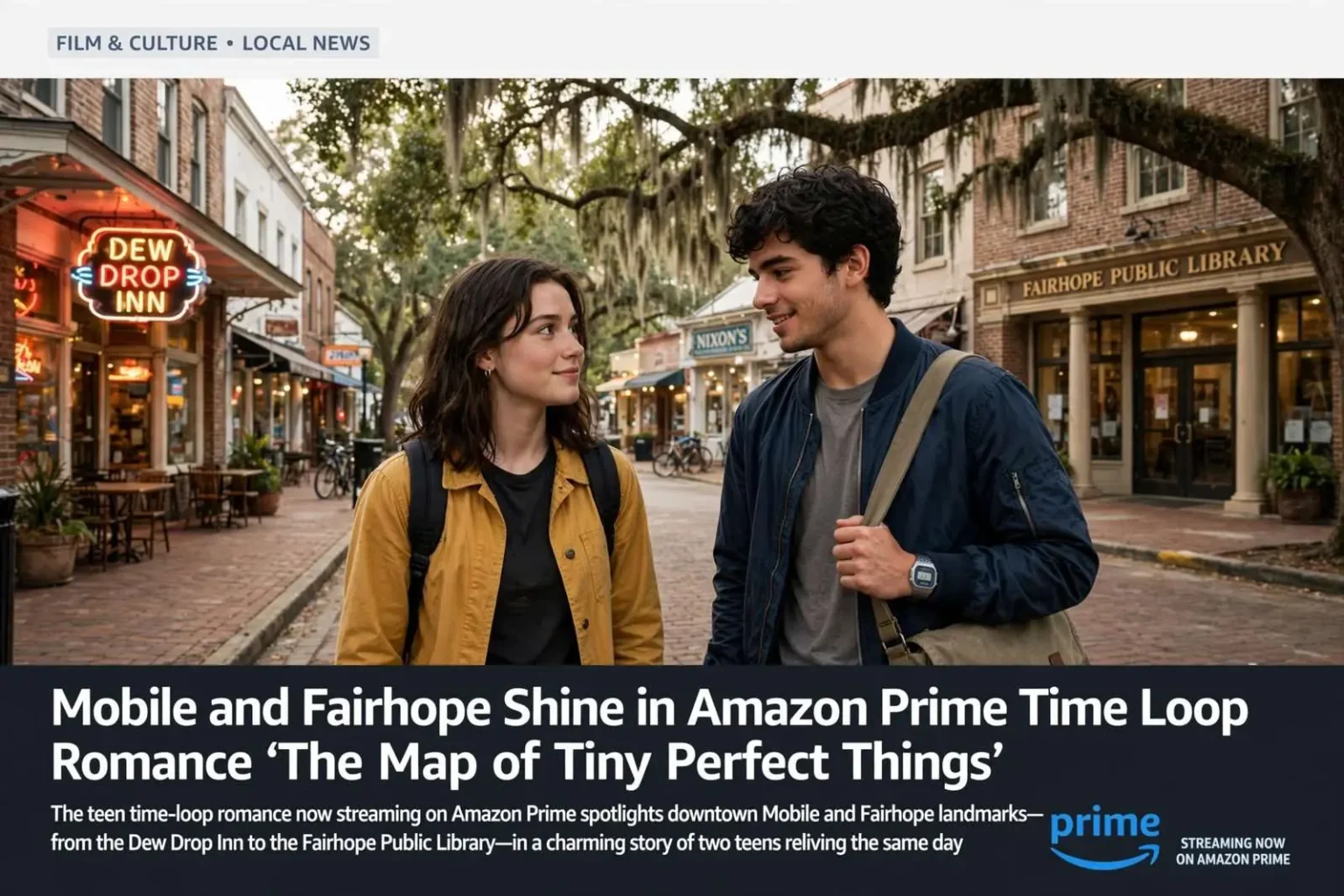
The streets of downtown Mobile and Fairhope take center stage in “The Map of Tiny Perfect Things,” a teen time loop romance now streaming on Amazon Prime. The film, which features recognizable local landmarks from the Dew Drop Inn to the Fairhope Public Library, offers Mobile-area viewers a chance to play spot-the-location while enjoying a charming young adult story.
The film follows Mark and Margaret, played by Kathryn Newton (“Big Little Lies”) and Kyle Allen (“American Horror Story”), two teenagers trapped in the same repeating day. As they work together to break free from the time loop, they begin to question whether they actually want to move forward at all.
The premise puts an unusual demand on a filming location. Because the story replays the same day over and over, the same streets, storefronts and school corridors appear again and again on screen, photographed from different angles and in different moods. A community that hosts a time loop movie ends up with more screen time per block than almost any other kind of production can offer — and Mobile and Fairhope got the full treatment.
Mobile landmarks take the spotlight
Mobile’s presence in the film is unmistakable. The Dew Drop Inn, Nixon’s, and Innova Arts appear prominently as the characters meet and spend time together. In one memorable sequence, Mark and Margaret drive an excavator through downtown Mobile, with the iconic World Headquarters sign visible in the background.
Downtown Fairhope and its public library feature heavily in the film’s elaborately choreographed opening scene, where Mark navigates his neighborhood with the precision of someone who has lived the same morning roughly 1,000 times. The sequence works like an extended establishing shot for the whole film, introducing viewers to brick sidewalks, shaded streets and small-town storefronts that Fairhope residents will recognize immediately.
For local audiences, the spotting game starts early. The producers filmed in real locations rather than back-lot substitutes, which means the Midtown diner booths, the corner shops and the waterfront vistas on screen are the same ones area residents pass every week. That authenticity is hard to fake, and it gives the film a texture that studio sets rarely match.
A charming take on the time loop genre
The production, which filmed in Mobile and Fairhope before being halted by COVID-19 near the end of shooting, represents another chapter in the area’s growing reputation as a film destination. A halt that close to the finish line is among the more painful versions of the industry-wide shutdown — sets were standing, crews were hired and most of the footage was in the can when production stopped, leaving the film’s completion dependent on when work could safely resume.
Local crew members, from costumers to photographers to extras, contributed to the production, along with producer Scott Lumpkin. Films of this scale put hundreds of people to work during a shoot — not just the crew proper but the carpenters, drivers, caterers and locations staff who support them — and the spending ripples outward to hotels, restaurants and rental houses across the area.
Critics have noted the film’s strong sense of place. Writing for rogerebert.com, reviewer Roxana Hadadi described the setting as having the feel of a small American town with quaint shops along the main strip. The film blends elements of classic time loop stories with young adult sensibilities, offering a refreshing take on the genre.
Unlike many teen romances, the characters’ connection grows out of shared curiosity rather than spectacle. Mark and Margaret spend their looping day mapping the small moments — the perfect catch, the chance encounter, the oddly timed small kindness — that most people walk past, and the film’s romance builds from that attention to the world around them. The structure rewards viewers who like their love stories built on conversation and observation, and it gives the directors room for the kind of carefully staged physical comedy that a repeating day makes possible.
The time loop itself has a long lineage in American film, from comedies that treat the repetition as farce to dramas that treat it as a metaphor for grief, habit or second chances. “The Map of Tiny Perfect Things” sits closer to the hopeful end of that spectrum: its loop is a puzzle, and solving it requires the two leads to pay attention — to the day, to the town around them and eventually to each other.
Young adult audiences have made the genre a reliable draw on streaming platforms, and the film arrived with the advantage of a cast led by two performers with television followings. Newton’s profile was already rising through her television work, and Allen’s background in dance informed the physical precision the role demands — a character who has practiced the same day thousands of times moves through the world like a choreographer.
Mobile Bay as a film destination
The production is part of a broader run of film and television work along the central Gulf Coast, where communities have courted productions with a combination of locations, crew depth and cooperative local governments. The region offers filmmakers something scarce: authentic small-town and mid-size city architecture, waterfront scenery within a short drive, and a climate that extends the shooting season deep into the fall and winter.
Each completed production strengthens the pipeline. Crew members who cut their teeth on one shoot are available for the next, and the region’s growing base of experienced hands makes it easier for producers to plan work here instead of importing everyone from out of state. Location scouting photos from Mobile and Fairhope circulate in industry circles long before cameras arrive, and a well-received film keeps those images in view.
The economic logic is simple. A production rents locations, hires locally and fills hotel rooms for weeks at a time, and it leaves behind goodwill that makes the next permit easier to pull. Cities that host repeat productions build institutional knowledge — film offices learn what producers need, and residents learn what a film crew on the block looks like.
Watching at home
For now, the film’s run is on screens rather than in theaters. Streaming on Amazon Prime puts it in front of a national audience that may never have heard of Fairhope, and every frame functions as a postcard for the area — the kind of exposure tourism officials usually pay for and cannot manufacture.
Area viewers get something different out of it: the pleasure of recognition. Watching a familiar diner booth or library reading room appear in a national release carries its own small thrill, and it is common for local audiences to rewatch such films with family, pointing out each location as it appears.
“The Map of Tiny Perfect Things” is available now on Amazon Prime. For Mobile Bay residents, it is a pleasant young adult romance with a clever structure — and a rare chance to see two of the area’s most distinctive downtowns playing themselves on the world’s streaming stage.
The shoot itself left memories around the two downtowns long before the release date. Film crews blocking a street for a scene are a spectacle anywhere, and residents of Mobile and Fairhope spent the production trading sightings of cameras, lights and trailers along their usual routes. For the duration of filming, ordinary corners became sets, and neighbors became unofficial location scouts, watching from porches and sidewalks as the same few blocks were shot from every angle.
That kind of community familiarity is a two-way street. Productions that are welcomed by the neighborhoods they film in tend to come back, and the relationships built between location managers and property owners carry into future projects. A homeowner whose front porch appears in a released film becomes part of the region’s informal portfolio of filming sites.
The pandemic shutdown that interrupted the shoot was a reminder of how fragile the production calendar is. When filming stopped across the industry in early 2020, projects at every stage were left waiting — some resumed after long delays with new safety protocols, added testing and adjusted schedules, and others never restarted. That “The Map of Tiny Perfect Things” made it to completion and release at all puts it among the luckier productions of its year.
Streaming releases have also changed what a “local film” means. In the theatrical era, a modest young adult romance might have played a handful of markets and disappeared; on a global platform, the same film can be seen by tens of millions of households, and the locations in it travel much farther than any roadshow could take them. For a community building a case as a filming destination, that reach is the real payoff.
The film’s release also gives local audiences a reason to look again at the places it used. The Dew Drop Inn and the Fairhope Public Library were landmarks before Hollywood arrived, and they will be landmarks after; a movie’s version of them is a snapshot of one season, not a definition. But for as long as the film is streaming, the ordinary routines of two downtowns will be playing out on screens around the world — which is, in the spirit of the film itself, a rather perfect thing.