
Mobile Auto Shops Report Spike in Catalytic Converter Thefts Targeting Churches, Fleets and Delivery Vans
Mobile repair shops report a surge in catalytic converter thefts hitting churches and fleets, with the Mobile County Sheriff's Office citing a resale.
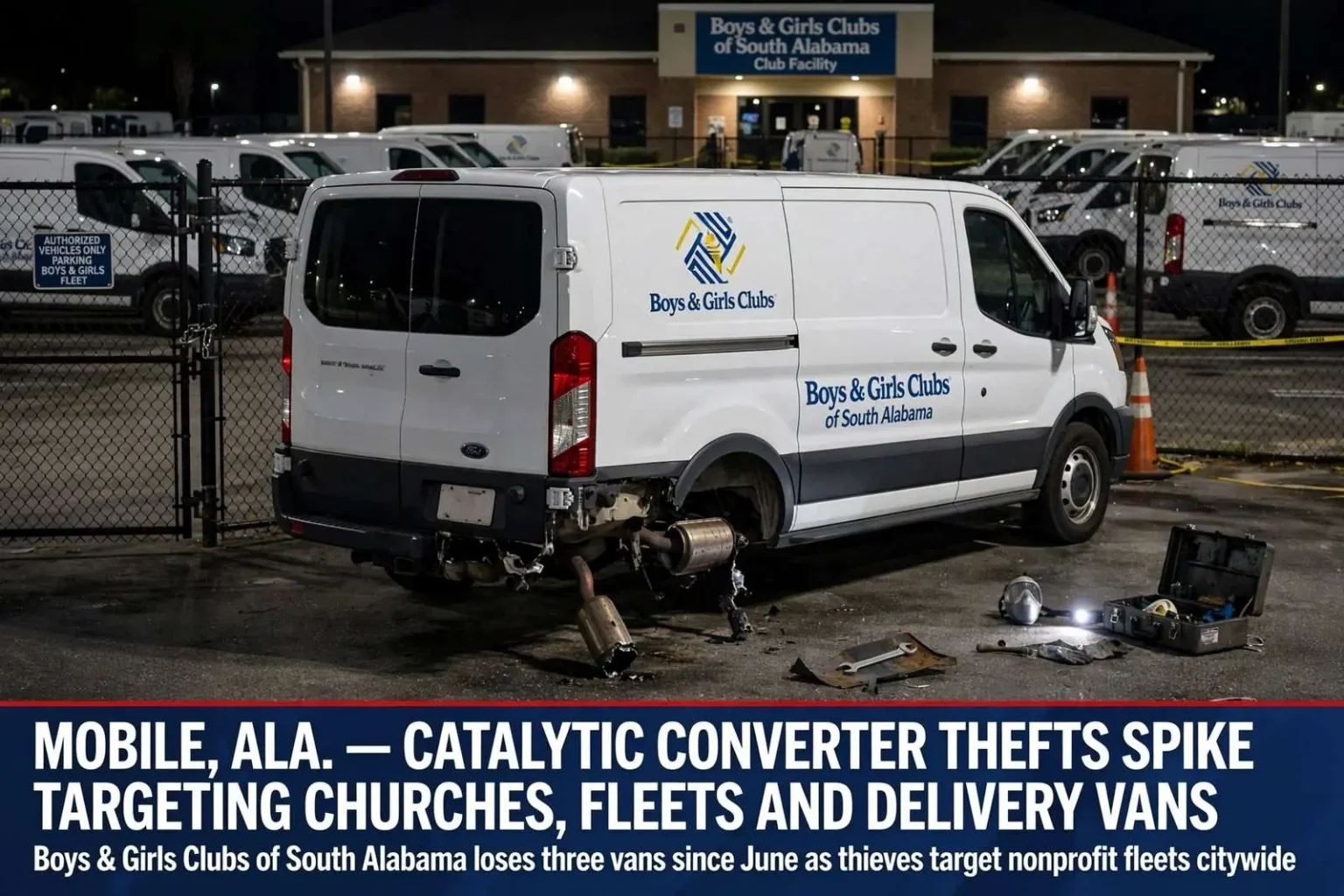
MOBILE, Ala. — Auto repair shops across Mobile are reporting a spike in catalytic converter thefts, a wave of undercarriage theft that has reached churches, business fleets and delivery vans across the city — and now the Boys & Girls Clubs of South Alabama. The nonprofit said catalytic converters were removed from three of its vans between June and October, including a third theft in early October caught on the organization’s own surveillance video. Each strike costs the club roughly $1,200 to replace, and each one leaves children without a ride.
The catalytic converter, an emissions control device bolted into a vehicle’s exhaust system, contains small amounts of precious metals that thieves can sell to recyclers. A converter can be cut from beneath a vehicle with a battery-powered saw in a minute or two, which is why the crime tends to happen in parking lots and overnight in fleets that sit still for hours. Police say the devices are stolen for the value of their metal content, and the black-market payout is a fraction of what replacement costs the victim.
The math is what makes the crime so damaging to organizations. The Boys & Girls Clubs’ fleet is only seven vans, used to shuttle children from schools to clubs across the city, and every downtime stretch means slower pickup routes and less capacity for after-school programs. Three vans struck in a single season is a direct hit to the organization’s daily operations, not just its maintenance budget.
Boys & Girls Clubs Vans Hit Three Times
CEO Tim Wills said each stolen converter costs the organization about $1,200 to replace, and one van was taken from a fenced, locked area. That detail is the part that stings most for the organization: a fenced and locked enclosure is supposed to be the fleet’s protected space, and it was not enough to stop a thief with a saw and a few minutes of cover.
“While someone is out here making a cheap buck, it has a real cost to young people in our community,” Wills said, calling the thefts “a direct hit towards kids.” The club’s vans are the connective tissue of its after-school model, carrying children from dozens of schools to club locations and back across Mobile’s sprawling street grid.
Wills added that COVID-related parts delays were stretching repair timelines further. Supply chain problems that began during the pandemic have made replacement converters and exhaust components slower to source, which means a van that loses a converter may sit out of service longer than it would have a few years ago. For a fleet with no spare vehicles to absorb the load, the lost time translates directly into fewer children served.
The third theft, in early October, was captured on the club’s surveillance video. Footage has been shared with Mobile Police, who confirmed that converter thefts are a city-wide problem and told the club they would step up patrols in the area. The video may prove valuable in identifying a suspect, since converter thieves often strike multiple vehicles in the same area before moving on.
Why Converters Are Targeted
The precious metals inside a catalytic converter — platinum, palladium and rhodium — are the reason the crime persists. Those metals coat the ceramic honeycomb inside the device, where they trigger the chemical reactions that turn harmful exhaust gases into less harmful ones. Market prices for all three metals have been high in recent years, and that value flows downstream to whoever sells a stolen unit to a less-than-scrupulous recycler.
Thieves favor certain kinds of vehicles. Trucks and SUVs ride higher off the ground, which means a thief does not need a jack to slide underneath with a saw. Fleet vehicles, delivery vans, church buses and shuttle vans share the same vulnerability: they park in predictable places, sit still for long stretches and are numerous enough that one visit to a lot can yield several converters. That is precisely the profile of the Boys & Girls Clubs’ vans, and of the church and business fleets Mobile repair shops say have been coming in with the same damage.
Mobile police confirmed the thefts are a city-wide problem rather than the work of a single crew working one neighborhood. The devices contain precious metals thieves can sell, and the ease of the crime — no broken window, no alarm, no confrontation — means it repeats until a thief is caught or the market for stolen converters dries up. Investigators have told victims that surveillance video and witnesses are the most useful tools in building a case, because few other evidence trails exist.
What the Thefts Cost Beyond the Parts
For the club, $1,200 per converter is only the beginning of the bill. Exhaust systems sometimes suffer additional damage when a converter is cut away, and labor adds to the total. The harder cost to measure is operational: when a van is in the shop, routes have to be redrawn, pickups run late and some children wait longer to reach the after-school programs that keep them safe and on track academically in the hours between the final bell and the end of the workday.
The Boys & Girls Clubs of South Alabama serves children across Mobile with programs built around dependable daily transportation. The organization’s seven vans tie schools to club facilities across the city, and the schedule only works when every vehicle is available. Three converters stolen in five months forced repeated improvisation in an operation that has little room for it.
Churches and other nonprofits in the area face the same exposure. Congregation buses and ministry vans often sit through the week in church parking lots and are pressed into service on weekends, making them a natural target for overnight thieves. Repair shops in the city say the pattern of victims coming through their bays — churches, small businesses, delivery operators and nonprofits — is the signature of the current wave.
How Owners Are Fighting Back
Protection options exist, though none is foolproof. Aftermarket shields and cages that bolt around the converter make cutting through them slower and noisier, which is often enough to send a thief to an easier target. Etching a vehicle identification number onto the converter helps police trace a recovered unit to its owner. Parking fleet vehicles nose-in against walls, in lit enclosures with cameras covering the undercarriage approach, removes the easy access thieves rely on.
Motion-activated lighting and cameras have proven their worth in this case — the club’s own video caught the most recent theft in progress. Police encourage fleet operators to review where vehicles park overnight, since the difference between a converter stolen and a converter saved is often a few feet of distance or a few extra seconds of noise and light.
Mobile Police told the club they would step up patrols in the area, and officers encourage any business or organization that suffers a converter theft to report it promptly, even when the dollar loss seems minor. Each report builds the map that shows where the wave is moving, and each piece of video adds to the record investigators can use to identify suspects who typically strike the same areas repeatedly.
The View From the Club
For Wills and the club’s staff, the thefts are personal precisely because they are impersonal. The thief who slides under a van sees scrap metal; the club sees the loss of a school pickup route for children whose families count on it. “While someone is out here making a cheap buck, it has a real cost to young people in our community,” Wills said — a summary of what converter theft costs a city when the victims are the organizations that serve it.
The club has continued running its routes through the repairs, leaning on the vans that remain in service. With parts delays stretching timelines, the organization is planning around the gaps the same way it plans around every other challenge: by putting the children’s schedule first and repairing the fleet as quickly as the supply chain allows. The hope among fleet operators across Mobile is that stepped-up patrols and alert surveillance owners can do what the fences and locks could not — make this wave too risky for the thieves riding it.
The Supply Chain Squeeze
The COVID-related parts delays Wills described have hit exhaust components especially hard. Catalytic converters and the piping around them depend on semiconductor-free but labor-intensive manufacturing, and pandemic-era shutdowns left automakers and aftermarket suppliers alike working through backlogs. A repair that once took a day can now take weeks while a shop waits for the right unit to arrive, and for nonprofit fleets, the wait is measured in missed routes rather than missed commutes.
The shortage has a second, unintended effect: it raises the street value of converters, both new and stolen. When legitimate buyers struggle to source units, the black market becomes more attractive to recyclers willing to look the other way. That dynamic feeds the theft wave, and it is part of why the crime has remained persistent even as police have stepped up attention to it.
A City-Wide Problem With Local Victims
The pattern Mobile Police describe — a city-wide problem rather than a single neighborhood’s nuisance — matches what cities across the Gulf Coast and the country have seen. Converter theft rose nationally during the pandemic years, and the metal values that drive it have kept the crime alive since. The victims, meanwhile, are rarely the kind of operations that can absorb the loss: churches, small fleets, nonprofits and individual owners who wake up to a roaring exhaust and a repair bill.
For Mobile, the club’s experience puts a local face on the trend and shows what stepped-up attention can accomplish. Police patrols in the areas where fleets park, prompt reporting by victims and usable surveillance video are the three levers the city can pull while the market that drives the crime plays out. Organizations like the Boys & Girls Clubs of South Alabama, which already operate on thin margins and tight schedules, are counting on all three.


