
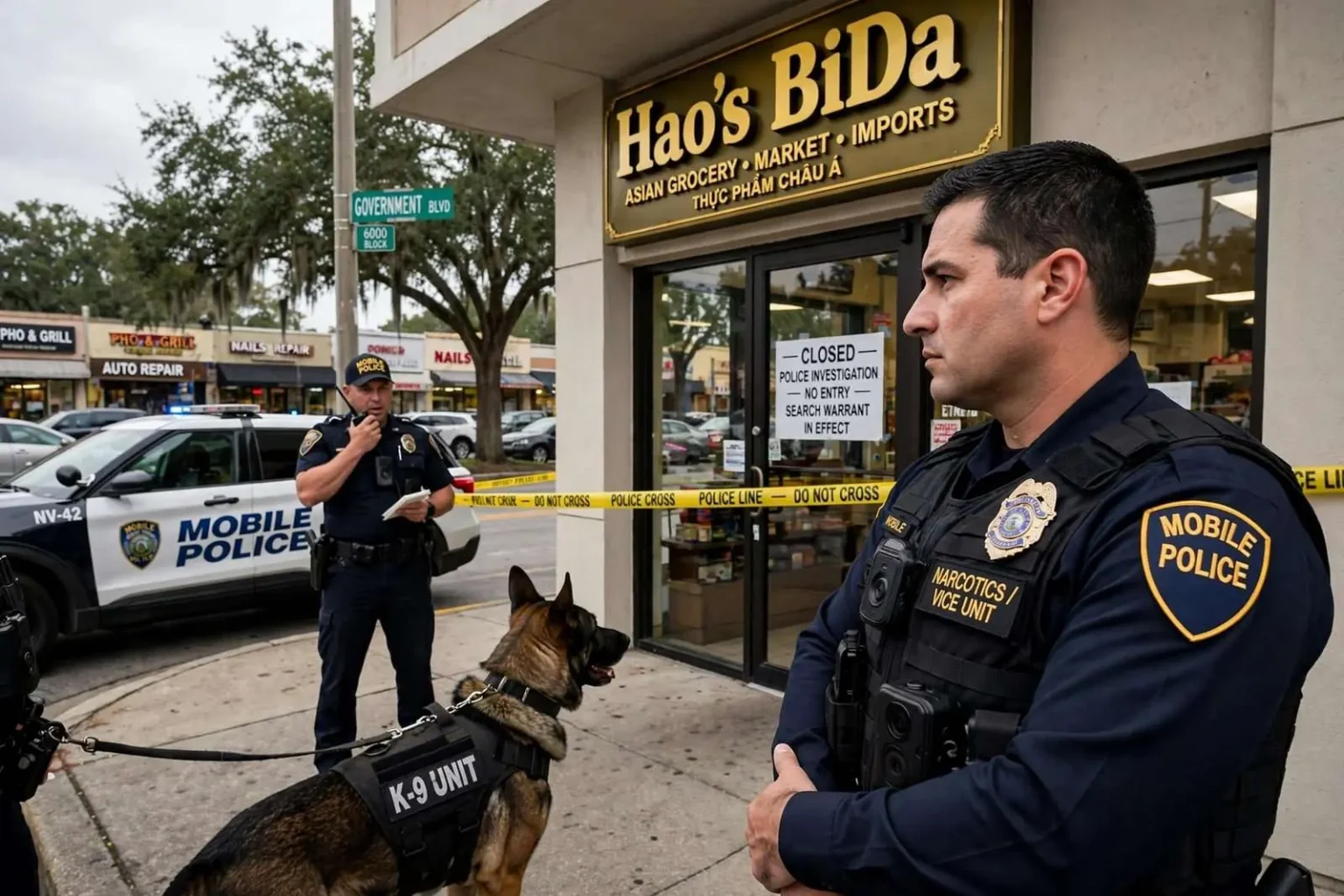
Mobile police say a local business owner has been charged with trafficking marijuana after officers searched his Government Boulevard shop and his apartment. The arrest followed an investigation by the department’s Narcotics/Vice Unit, which targets street-level and mid-level drug distribution across the city.
According to the Mobile Police Department, the Narcotics/Vice Unit and K-9 Unit executed search warrants at Hao’s BiDa on Government Boulevard — where owner Truong Truong, 42, was arrested — and at Charleston Apartments, where he lives. The K-9 Unit’s role in the operation reflected the department’s standard practice of using trained detection dogs to locate concealed narcotics during searches of businesses and residences.
What officers seized, police say, was substantial. Investigators confiscated roughly 30 pounds of vacuum-sealed marijuana with an estimated street value of about $45,000. The vacuum sealing, authorities noted in describing the case, is a packaging method commonly associated with distribution rather than personal use, because it masks odor and prepares product for transport and sale in quantity.
In addition to the drugs, investigators reported seizing three firearms, an assortment of ammunition and $15,380 in cash. The firearms and currency are typical targets of narcotics warrants, since Alabama law and federal statutes allow prosecutors to pursue additional charges — and asset forfeiture actions — when drugs, guns and proceeds are found together.
The two locations searched
Government Boulevard is one of west Mobile’s busiest commercial corridors, a stretch of shops and restaurants that runs between the Spring Hill area and the city’s western edge toward Tillman’s Corner. A business operating there draws steady foot traffic, and police did not say how long they believe the shop may have been connected to the activity described in the warrants.
The second warrant took officers to Charleston Apartments, the suspect’s place of residence. Executing warrants at both a business and a home in a single operation is a common tactic in narcotics investigations, designed to prevent the removal of evidence from one location while officers search the other.
The charges and what comes next
Truong was booked on trafficking charges as the investigation continues. Under Alabama law, marijuana trafficking is a felony that hinges on weight thresholds — possession of large quantities carries mandatory minimum prison sentences and substantial fines, placing the offense among the most serious drug charges in the state’s courts.
Prosecutors with the Mobile County District Attorney’s Office will review the case file as it moves toward formal proceedings, and additional charges are possible depending on what the investigation develops. Police did not release details about whether others may be involved, describing the case as ongoing.
The case illustrates how the department’s specialized units work in practice. Narcotics investigations typically build over weeks or months, with officers gathering information from tips, surveillance and controlled purchases before seeking search warrants from a judge. The warrants in this case authorized the coordinated searches that followed.
Trafficking laws in Alabama explained
Alabama’s trafficking statute is weight-based, and the thresholds are deliberately low. Possession of just over two pounds of marijuana meets the trafficking threshold under state law, which means a seizure of roughly 30 pounds places a case well beyond the minimum and into the range where mandatory minimum sentences of years — and fines that can reach into the hundreds of thousands of dollars — apply upon conviction.
The law treats large-quantity possession as evidence of intent to distribute, regardless of what a defendant says the drugs were for. That is why the packaging matters in cases like this one: vacuum-sealed, bulk quantities are the classic profile of a distribution operation rather than a personal stash, and prosecutors use that profile to support trafficking charges at the charging stage and at trial.
The cash seizure of $15,380 adds a separate dimension. Asset forfeiture laws allow law enforcement to pursue money and property connected to drug activity through civil proceedings that run parallel to the criminal case. The three firearms, meanwhile, can support enhanced penalties if they were found in proximity to the drugs, and federal partners sometimes take an interest in cases that involve guns and distribution-scale quantities.
How investigations like this unfold
Nothing in a coordinated search like this happens quickly. Narcotics and vice investigators typically develop a case over time, working from citizen tips, complaints from business owners, informants and surveillance. Officers document patterns of activity, establish probable cause in an affidavit and present it to a judge, who decides whether to issue the search warrants.
Only then does the operational side begin. Units stage near both locations, the K-9 team is positioned to sweep the premises, and officers execute the warrants in quick succession so evidence cannot be moved between the business and the residence. Searches of this scale can take hours, with investigators cataloging and photographing each item before it is logged into evidence.
The Mobile Police Department encourages anyone with information about drug activity to come forward, either through its investigators or through CrimeStoppers, which accepts anonymous tips. Department officials have repeatedly noted that community information is what seeds many of the narcotics cases the unit ultimately builds and executes.
What the arrest means for the neighborhood
For the businesses and residents along Government Boulevard, the operation is a visible reminder of the police work happening behind the scenes in commercial corridors that most people see only in passing. Large seizures remove product from the local market and, officials say, disrupt the supply chains that feed smaller-scale sales in surrounding neighborhoods.
The case now moves through the court system, where the charges will be resolved on the evidence. Until then, police describe the investigation as active — and anyone with information relevant to the case is asked to contact Mobile police or leave an anonymous tip with CrimeStoppers.
The businesses that share the corridor
Government Boulevard serves as a daily artery for west Mobile, lined with storefronts, national chains, Vietnamese and Asian restaurants, auto shops and medical offices. Commercial corridors like this one depend on steady traffic and a sense of safety, which is why narcotics operations that end in arrests along busy retail stretches tend to draw close attention from neighboring shop owners and regular customers alike.
The Boulevard also connects some of Mobile’s most established neighborhoods to the rest of the city, feeding traffic toward major east-west routes and the interstate. Investigators did not describe any risk to the public during the operation, and the warrants were carried out as a planned enforcement action rather than a response to any immediate threat.
Understanding the numbers in the case
Thirty pounds of marijuana, packaged in vacuum-sealed batches, is not an amount consistent with casual possession. At a street value estimated by police at about $45,000, the seizure represents a commercial quantity — the kind of volume associated with organized supply rather than neighborhood-level sales, and the kind that narcotics units prioritize when they decide where to devote investigative resources.
The firearms and ammunition seized alongside the drugs will be examined as part of the evidence process, and the cash will be held while the legal proceedings move forward. Officers follow strict protocols for documenting seizures, with each item photographed, weighed, counted and entered into a chain of custody that must hold up in court.
What happens after booking
After arrest, a suspect is booked into Mobile County’s jail facility, where the charges are formally recorded and a bail amount is set under the county’s schedule. An initial appearance before a district judge follows, where the defendant learns the charges and counsel is addressed. From there, felony cases are presented to a grand jury, which decides whether to indict.
Trafficking cases built on executed search warrants tend to move on the strength of the physical evidence — the drugs, the money, the packaging and the locations themselves. Defense counsel will examine every step of the investigation, including how probable cause was established and how the warrants were executed, which is standard practice in any contested drug prosecution.
For the Mobile Police Department, the case closes nothing more than the first chapter. Investigators continue to develop leads about where the drugs originated and where they were headed, and department officials note that arrests of this kind often lead to additional enforcement actions as the picture of a distribution network comes into focus.
Anyone with information about the case, or about drug activity in their neighborhood, can contact the Mobile Police Department directly or reach CrimeStoppers anonymously. Tips that once seemed minor — a stream of late-night visitors, unusual traffic at a storefront, discarded packaging — are often the beginnings of the cases that end in seizures like this one.
The investigation remains ongoing, and police say additional details may be released as it develops.


