Mobile Celebrates Black History Month with Art Show and Weekly Movie Nights
Mobile Parks and Recreation honored Black History Month with '28 Days of Black Life' at Connie Hudson Center plus weekly movie nights in February.
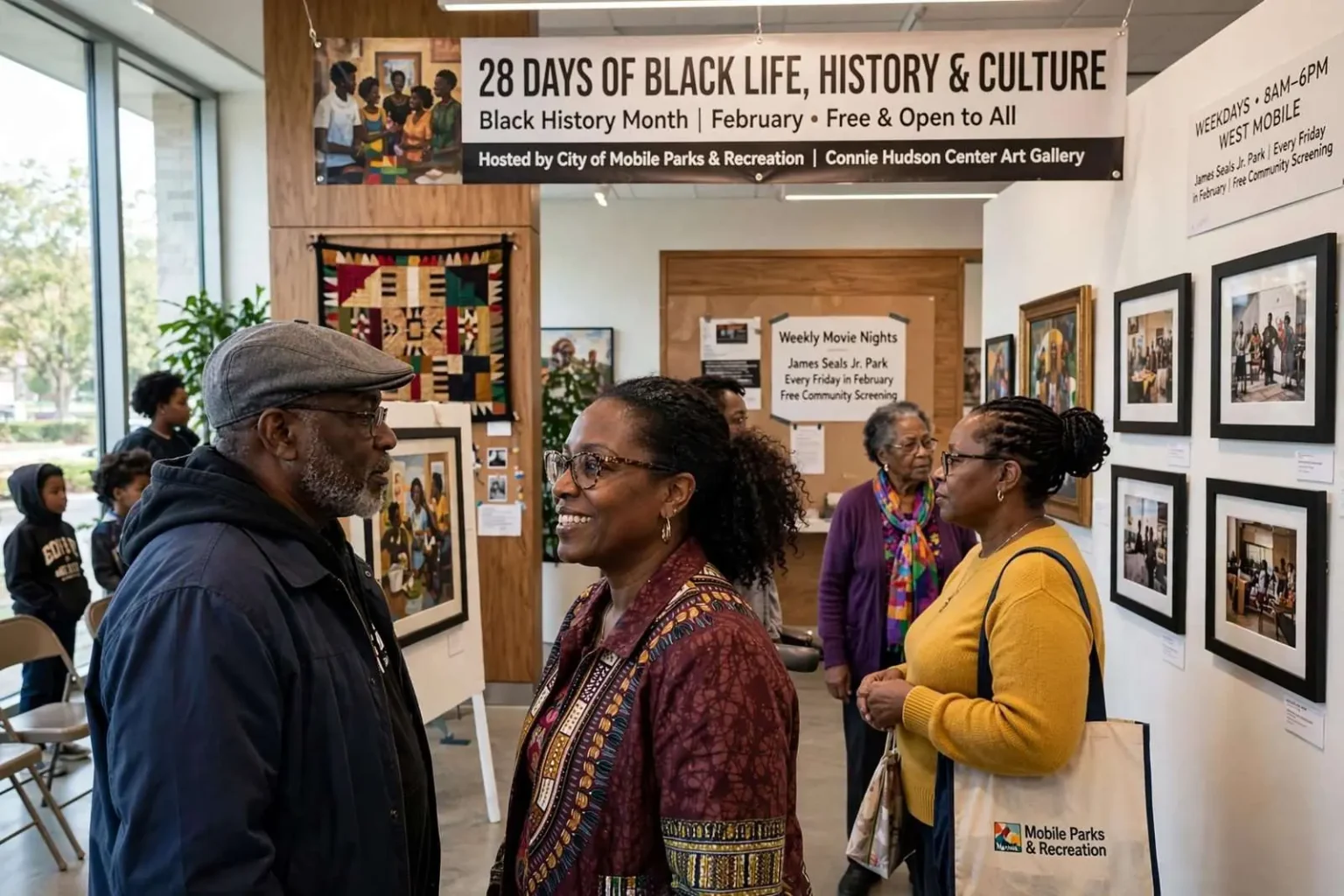
The City of Mobile’s Parks and Recreation Department marked Black History Month with a full slate of programming throughout February, including a monthlong art showcase and weekly community movie nights that gave residents free ways to celebrate Black history and culture close to home.
The centerpiece of the celebration was “28 Days of Black Life, History and Culture,” an art exhibition hosted at the Connie Hudson Center Art Gallery. The showcase was open to the public on weekdays from 8 a.m. to 6 p.m., giving residents ample opportunity to view the work throughout the month, whether on a lunch break or during an afternoon visit to the west Mobile facility.
The exhibition’s title nodded to the span of February itself, and to the idea that Black history in Mobile is not a single narrative but a daily, lived experience — in art, in neighborhoods, and in the civic life of a city whose Black community has shaped nearly every aspect of its history.
Weekly Movie Nights at James Seals Jr. Park
In addition to the gallery exhibit, the department hosted a movie night once a week during February at the James Seals Jr. Park and Recreation Center. The screenings gave families a free, welcoming way to gather during the coldest stretch of the Gulf Coast winter while honoring Black history and culture on screen.
Weekly movie nights have become a staple of the recreation center’s community programming, and dedicating the February series to Black History Month gave the events added purpose. Families, seniors, and neighbors gathered in the recreation center’s space for films that celebrated Black stories, with the casual setting encouraging conversation and connection between screenings.
James Seals Jr. Park, located in the Toulminville area of west Mobile, has long served as a neighborhood anchor, offering athletic fields, playgrounds, and a busy recreation center that hosts youth programs, senior activities, and community events throughout the year. A February film series gave residents a reason to visit during a season when outdoor programming typically slows.
A Community Tradition
Parks and Recreation has long played a central role in Mobile’s community life, operating recreation centers and galleries across the city. Pairing visual art with film gave the month’s observance a place for both quiet reflection and shared celebration — two ways of engaging with history that complemented each other across the month.
Residents who missed individual screenings could still catch the art show, which ran every weekday through the end of February at the Connie Hudson Center in west Mobile. The extended hours and monthlong run made the exhibition one of the most accessible heritage events of the season, open to anyone whose schedule allowed a weekday visit.
The Connie Hudson Center and Mobile’s Gallery Scene
The Connie Hudson Mobile Regional Senior Community Center, on Hillcrest Road in west Mobile, is one of the city’s flagship municipal facilities, combining senior services, fitness spaces, meeting rooms, and a public art gallery that rotates exhibitions through the year. Its gallery has become an important venue for local and regional artists, and heritage-focused shows like the Black History Month exhibition draw visitors who might not otherwise set foot in a commercial gallery.
Hosting the exhibition at the Hudson Center also placed the art before a daily audience of seniors who use the center’s services, weaving the observance into the routine life of the facility rather than confining it to a one-night opening. City officials have emphasized that municipal galleries serve that dual role — supporting working artists while bringing art into the everyday spaces where residents already go.
Black History in Mobile: A Deep Root
Mobile’s connection to Black history runs deeper than in nearly any other American city. The Port City was a center of the domestic slave trade in the decades before the Civil War, and in 1860 the Clotilda — the last known slave ship to arrive on American shores — smuggled 110 captive Africans up the Mobile River into the area, decades after the import of enslaved people was outlawed. Many of those Africans and their descendants founded Africatown just north of downtown, a community whose story has gained international attention in recent years as researchers located and studied the wreck of the Clotilda in the Mobile-Tensaw Delta.
The city’s Black community also produced transformative figures and institutions: Mobile was the hometown of baseball Hall of Famer Hank Aaron, who grew up in the Toulminville neighborhood not far from James Seals Jr. Park. Mobile’s Mardi Gras traditions include the pioneering Black mystic societies — the Order of Doves, organized in 1894 and recognized as one of the oldest Black carnival organizations in the country — whose celebrations helped shape the city’s iconic carnival season alongside its older established groups.
That heritage is part of why municipal observances of Black History Month carry particular weight in Mobile. The city’s parks, streets, and institutions are themselves historical artifacts — from Africatown to the Hank Aaron Stadium site to the neighborhoods that produced generations of Black civic leaders, artists, educators, and athletes. Programming that brings Black history into neighborhood recreation centers connects those grand narratives to daily life.
The Role of Parks and Recreation in Public Life
Mobile’s Parks and Recreation Department operates dozens of parks, playgrounds, recreation centers, and special-use facilities across the city, from sprawling regional parks to neighborhood centers like Seals. Its portfolio spans youth athletics, senior services, aquatics, after-school programs, and cultural programming, making it one of the municipal departments residents interact with most directly.
Cultural events like the February observance reflect a broader understanding among city leaders that recreation departments do more than manage ballfields. They are among the few city agencies with regular contact across every neighborhood and age group, which makes them natural hosts for commemorations, health fairs, voter engagement, and community conversations that might otherwise never reach some corners of the city.
Black History Month itself dates to 1926, when historian Carter G. Woodson’s organization designated a week in February for the study of Black American life; the observance expanded to a full month in 1976 during the nation’s bicentennial. February was chosen for its connection to the birthdays of Abraham Lincoln and Frederick Douglass, anchors of early Black American commemoration.
Free and Open to All
Both components of the observance were free, underscoring the city’s intent to make the celebration accessible regardless of income. The weekday gallery hours accommodated visitors throughout the month, while the weekly movie nights offered an evening gathering point for families — a combination that let residents participate in whatever way fit their schedules.
City recreation leaders have long noted that free family programming fills a real gap on the Gulf Coast, particularly in winter months when options are limited and household budgets are stretched after the holidays. A warm room, a film, and a crowd of neighbors costs families nothing and builds the kind of community trust that municipal facilities are meant to foster.
What the Programs Meant for the Neighborhoods
For west Mobile, the pairing of the Hudson Center gallery show with the Seals Park film series brought the observance to two distinct audiences: the seniors and weekday visitors who pass through the regional senior center, and the families and young people who fill the Toulminville-area recreation center after school and on evenings. Together, the venues extended the celebration across much of the city rather than concentrating it downtown.
Residents who attended the gallery exhibition encountered work reflecting Black life and history — the kind of local, community-rooted art that rarely appears in commercial venues. The weekday hours invited repeat visits, and teachers, families, and community groups were able to use the show as an educational resource throughout February.
A Model for Civic Celebration
The department’s approach — pairing a monthlong visual art exhibition with a recurring weekly event — has become a template other cities use for heritage observances. The gallery provides continuity and depth, while the weekly gatherings provide energy and attendance; neither alone reaches as broadly as the two together.
Mobile’s February observance also benefited from the city’s recent investments in its recreation infrastructure, with the Hudson Center standing as one of the newest major municipal facilities in the region. Combining senior services with a public gallery under one roof reflects the multi-purpose philosophy that now guides how the city builds community facilities.
Looking Ahead
City officials have indicated that heritage and cultural programming will remain a fixture of the Parks and Recreation calendar, with Black History Month each February joining the department’s broader slate of seasonal events. For neighborhoods like Toulminville and west Mobile, the observances offer both celebration and connection — a reminder that the history being honored was made in the very communities where the events are held.
The 28 Days of Black Life, History and Culture exhibition and the weekly movie nights concluded at the end of February, closing out a month in which the city’s recreation system served once again as a gathering place for reflection, education, and community. For residents, the message was straightforward: Black history in Mobile is not confined to museums or textbooks, but is celebrated in the neighborhood centers and galleries where the community lives.