University of South Alabama Mobile County
Grant Brings State-of-the-Art Child Abuse Screening Tools to Mobile Clinic
An $11,000 grant funded new imaging equipment at USA's Midtown Pediatrics Clinic, upgrading child abuse screening capability across the region.
A Two-Decade-Old Tool Retired
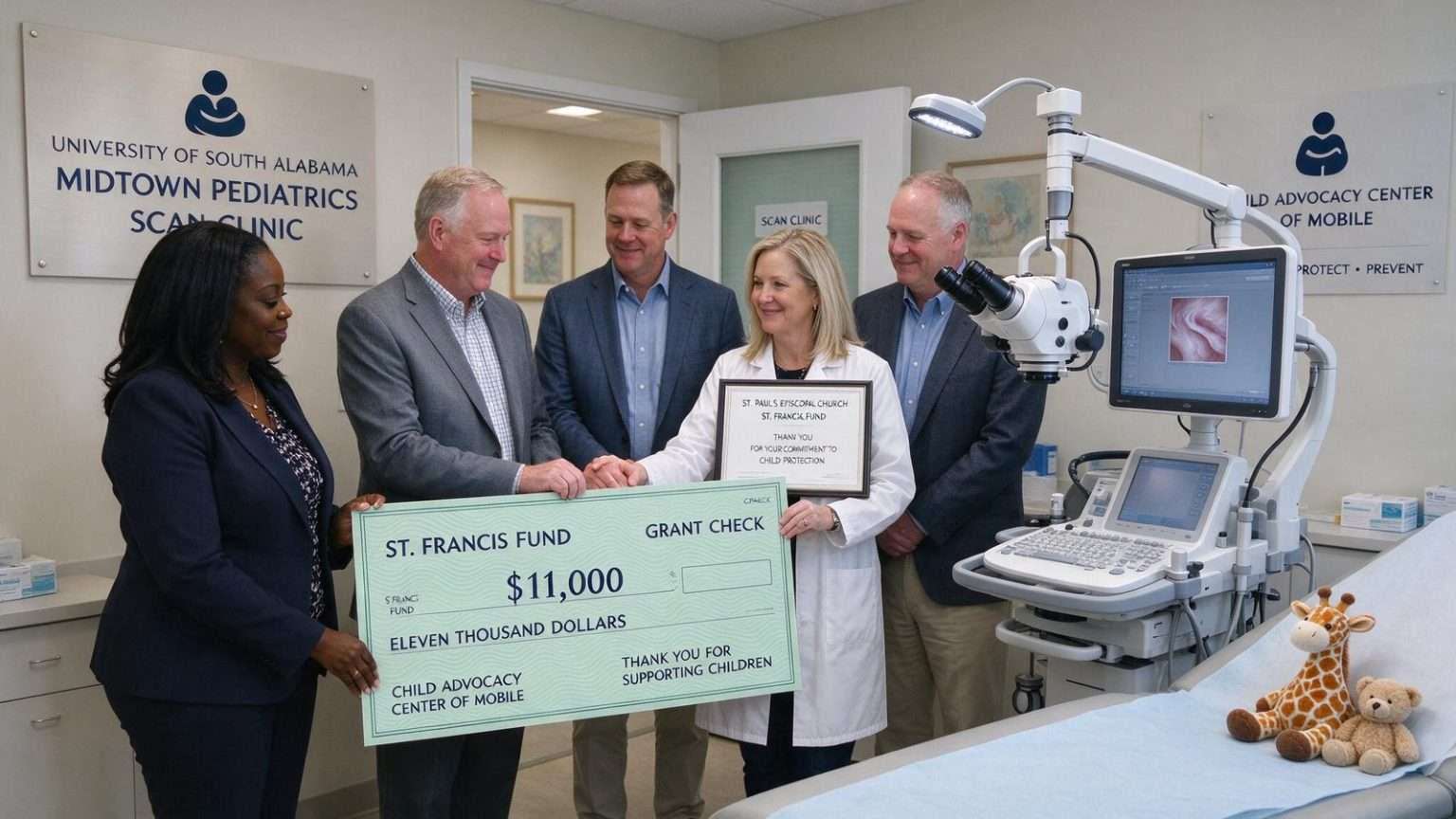
The University of South Alabama’s Midtown Pediatrics Clinic became home to what officials describe as the most advanced child abuse screening equipment in the state this week, thanks to an $11,000 grant from the St. Francis Fund at St. Paul’s Episcopal Church. The purchase replaced a piece of diagnostic equipment that had served the region’s most sensitive medical exams since the first Bush administration.
The Child Advocacy Center of Mobile used the grant to purchase new imaging equipment for the university’s Screening for Child Abuse and Neglect Clinic, replacing a colposcope that had been in service since 1992, when it was originally purchased through a U.S. Department of Justice grant. Two decades is an extraordinary service life for precision optics, and the clinic had kept the older device running well past the point where its maker’s parts were easy to find.
Pat Guyton, executive director of the Child Advocacy Center, said the old device had become increasingly unreliable as replacement bulbs grew harder to find. For a clinic whose exam schedule cannot be predicted — cases arrive with law enforcement referrals and child welfare reports, on no one’s calendar — the risk of the machine failing mid-exam had become a real operational concern.
The new digital equipment can magnify tissue up to 75 times, giving physicians the ability to spot injuries invisible to the naked eye. That magnification, paired with a modern light source, changes what an exam can document: injuries that once might have gone unrecorded because they could not be seen clearly can now be captured, measured and preserved at the moment of discovery.
Dr. Jessica Kirk, clinical director of the SCAN Clinic, said the added light source and magnification can reveal microscopic injuries that could prove important to a child’s case, information she said the human eye alone simply cannot capture. In forensic medicine, that distinction is not academic — the difference between seeing an injury and documenting it can shape how a case proceeds through the courts.
The device also allows doctors to photograph findings during an exam, with images automatically saved for medical and legal records. The automation matters for evidence: images that once depended on someone remembering to save and file them now enter a secure record in real time, preserving the chain of custody that prosecutors depend on months or years later.
Kirk is one of only three doctors in Alabama certified in child abuse pediatrics by the American Board of Pediatrics; the other two practice at the University of Alabama at Birmingham. She performs between 100 and 150 exams using the clinic’s colposcope each year — and each of those exams represents a child whose case required medical documentation that ordinary pediatric practice is not equipped to provide.
Child abuse pediatrics is a distinct medical subspecialty, and the certification behind Kirk’s title requires years of focused training beyond a pediatric residency. Physicians in the field learn to distinguish accidental injuries from inflicted ones, to conduct exams that are medically thorough and emotionally manageable for a child, and to testify about their findings in proceedings where the facts they document carry enormous consequences for children and families alike.
The SCAN Clinic’s work sits at a junction few people see. When a report of abuse or neglect arrives, the child may be examined here, interviewed by trained specialists down the hall at the Child Advocacy Center, and their case staffed by a team that includes law enforcement, child welfare workers and prosecutors. The medical exam is one thread of a coordinated response — and its quality affects every other thread.
Guyton said the clinic’s reach extends well beyond Mobile County, serving surrounding counties in south Alabama that lack similar specialized resources. Families from rural counties across the region may travel hours for an exam that cannot be performed closer to home, and the equipment that makes those exams definitive is, in practical terms, regional infrastructure.
Partners Behind the Purchase
Representatives from the Child Advocacy Center, St. Paul’s Episcopal Church, the St. Francis Fund and USA’s pediatrics program gathered at the clinic this week to mark the equipment’s arrival, calling it a milestone for how the region investigates and responds to suspected abuse and neglect cases. The partnership reflects how such services are actually built in Alabama: a hospital providing clinical expertise, a nonprofit coordinating the response, and a congregation’s charitable fund bridging the funding gap that public budgets leave open.
The St. Francis Fund’s grant illustrates the role small foundations play in medical equipment that neither insurance reimbursement nor hospital capital budgets cover neatly. An $11,000 device serving a few hundred specialized exams a year is too small for a capital campaign and too important for a wish list — exactly the scale at which a parish-level fund can change what a clinic is able to do.
St. Paul’s Episcopal Church, a longtime Midtown Mobile congregation, sits minutes from the pediatric clinic it helped equip, a proximity that gives the grant a neighborhood character. The church’s outreach has long targeted needs close to its doorstep, and child protection services in its own part of the city fit that pattern.
The upgrade comes as advocates across the region push to expand resources for identifying and responding to child abuse, a field that has evolved considerably since the clinic’s original colposcope arrived in 1992. The child advocacy center model — one roof where a child can be interviewed, examined and supported without being shuttled between offices — has become the national standard, and southwest Alabama’s centers have built that model on aging equipment, dedicated staff and community funding.
Digital imaging adds capabilities the 1992 device never had. Images can be reviewed remotely by specialists elsewhere in the state or the country, giving a rural county’s case access to expert interpretation without a second trip; they can be compared over time in follow-up care; and their quality no longer depends on film processing or a bulb on its last hours. For courts, digitally captured images with a secure chain of record are easier to admit and harder to dispute.
The human dimension of the equipment is easy to miss in the specifications. A child brought for a forensic exam has often already been interviewed multiple times by adults with different jobs to do; the medical exam is designed to be the last unnecessary question a child answers, and a definitive one — one that either documents what happened or reliably rules it out — serves the child by ending uncertainty quickly. Better optics, in that sense, are not about medicine alone but about sparing children repeated intrusion.
For the region’s investigators, prosecutors and caseworkers, the milestone the partners marked was practical: the most sensitive exams in south Alabama would now rest on the best equipment in the state, operated by one of three physicians certified to use it. What began as a Justice Department purchase in 1992, kept alive through ingenuity for two decades, had been handed to a new generation of technology — and the children whose cases pass through Midtown would be documented by it.
A colposcope, for those who have never sat behind one, is essentially a stereoscopic microscope on a stand, designed for close examination of body tissue under intense light. In general medical use it serves cancer screening and gynecological care; in a child abuse clinic, its role is forensic — capturing, at high magnification and in controlled light, the physical evidence that an exam must either find or rule out. The instrument’s value is measured in what it can see and what it can prove.
Training across disciplines is part of what makes the Mobile operation work. The clinicians who staff abuse exams coordinate with forensic interviewers whose questioning follows strict protocols, with child welfare workers making safety decisions, and with law enforcement officers building cases — each profession holding a different piece of the same child’s situation. Equipment upgrades in the medical piece ripple outward, giving every other professional in the chain a firmer factual footing.
The volume of exams the clinic handles — between 100 and 150 a year on the colposcope, before counting the other evaluations the SCAN Clinic conducts — represents only the cases that reached medical attention. Advocates in the field note that reported cases understate the problem, which is why capacity and quality at centers like Mobile’s matter: when a case does surface, the response it receives shapes whether the system works for that child.
The state’s thin supply of certified specialists underscores the clinic’s role. With only three child abuse pediatricians across all of Alabama — one in Mobile, two in Birmingham — every rural county between the two cities depends on those few practices. An equipment upgrade in Midtown Mobile, in that light, is not a local amenity but a piece of statewide capacity.
The gathering of the partners this week doubled as a small lesson in how such systems endure. A Justice Department grant seeded the clinic’s capability in 1992; a hospital sustained it; a child advocacy organization shepherded it; a church fund renewed it. Each link covered a gap the others could not, and the child who walks into the SCAN Clinic this year will benefit from all of them at once.