Mobile Closing All Community Centers Monday for Staff Training
All City of Mobile Community Centers will close Monday, Aug. 17, for mandatory staff training and reopen Tuesday under normal hours.
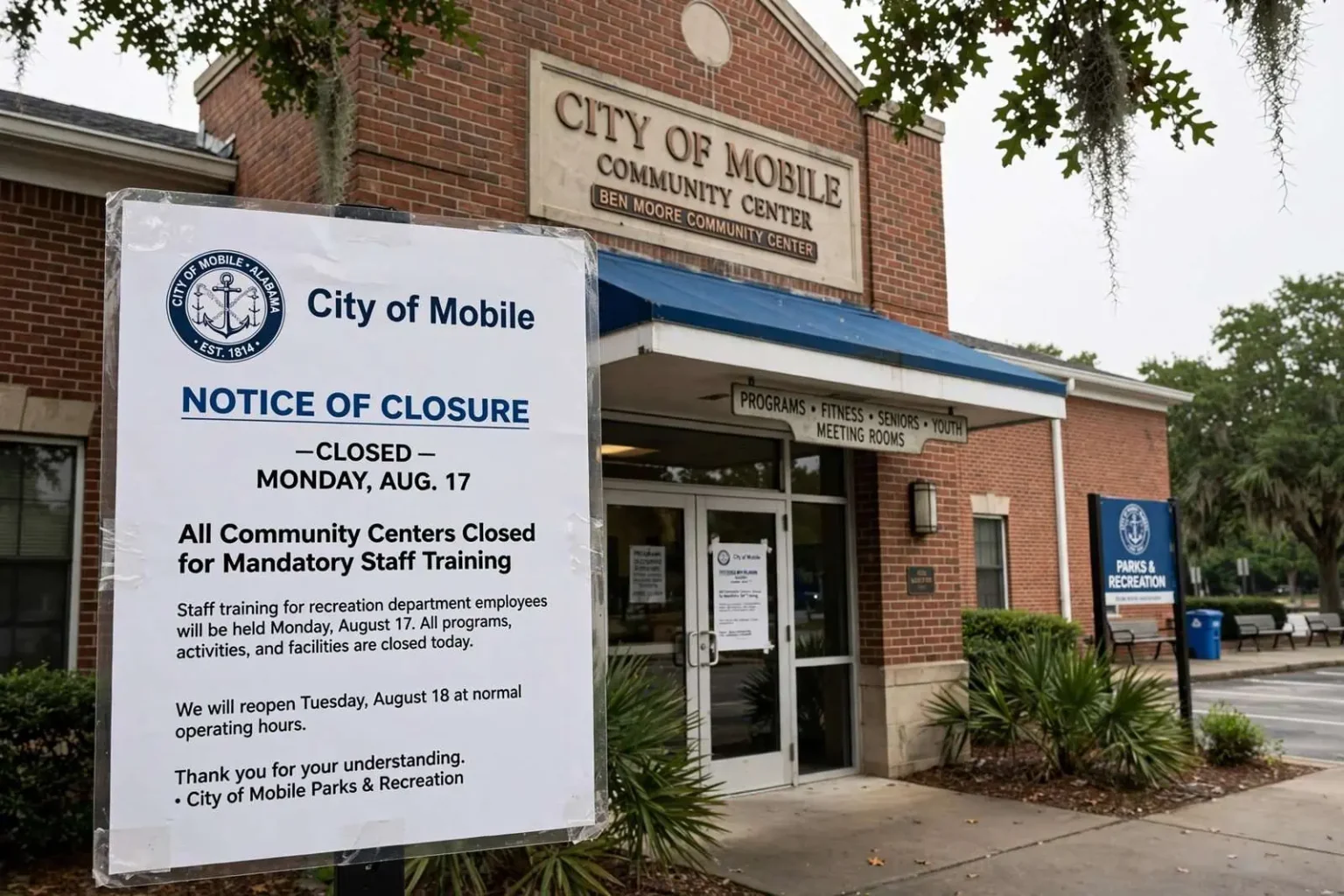
MOBILE, Ala. — All City of Mobile community centers will close Monday, Aug. 17, for mandatory staff training, according to a city news release, giving the recreation system’s employees a full day of professional development before the centers reopen on their normal schedule the next morning.
The one-day closure applies to every community center in the city’s network — the facilities that host recreational, educational, and community programming across Mobile’s neighborhoods. Regular operations resume Tuesday, Aug. 18, when the centers return to their normal operating hours and the programs that depend on them resume as usual.
The city framed the closure as a planned, system-wide investment in the people who run the centers. Mandatory staff training of this kind gathers the recreation department’s workforce — center directors, program coordinators, front-desk staff, and the part-time employees who keep the doors open — for instruction that the city considers essential to operating the facilities safely and well.
For residents who rely on the centers for after-school programming, senior activities, gym time, or meeting space, the closure meant a single Monday of adjusted routines, announced in advance through the city’s news release so that families and organizations could plan around it.
What Mobile’s Community Centers Do
The City of Mobile’s community centers form one of the most widely used parts of the municipal government’s public-facing work. Spread across the city’s neighborhoods — from downtown and the peninsula communities of the river delta to West Mobile’s residential districts — the centers serve residents within short distances of home, offering recreation that does not require a drive across town.
Inside and around the facilities, the programming spans nearly every age group. Young people fill the gyms and playgrounds after school, with organized athletics — youth basketball, baseball, football, and cheer programs that have fed the city’s high school teams for generations — anchoring the calendar. Adults use fitness rooms and gymnasiums. Senior citizens gather for programs designed around their schedules, from exercise classes to social events that for many older Mobilians are the fixed points of a week.
The centers also serve as community infrastructure in the broader sense. Neighborhood associations hold their meetings there. Civic groups, churches without their own halls, and families planning reunions book the rooms. During elections, some serve as polling places. And in emergencies — hurricanes foremost among Gulf Coast concerns — the city’s recreation facilities are natural candidates for staging areas and shelter support, a role their staff train to fill.
A system with that many functions requires a staff with that many competencies, which is the logic behind a training day that pulls everyone together at once.
Why Mandatory Training Matters
Running a public recreation center is a more demanding job than its reputation suggests. Staff are responsible for the safety of everyone in the building — children in programs, seniors in classes, athletes in competition — and for the security of public property. They handle first aid, manage conflicts, enforce rules, track memberships and registrations, maintain schedules, and keep the facilities clean and functional.
Training keeps those skills current. Safety protocols evolve, emergency procedures are refreshed, and software and administrative systems change as the city upgrades its operations. Personnel policies and customer-service standards get revisited. And because recreation staffs include many part-time and seasonal employees, the workforce’s composition shifts constantly, making periodic all-hands instruction the practical way to keep the whole system operating to a single standard.
Concentrating the training into a single day — rather than scattering it across afternoons when centers are partially staffed — trades one closed day for the least possible disruption. The city’s choice of a Monday, ahead of the Tuesday reopening, gave the centers a clean break: closed for training, open as usual the next day, with no lingering half-schedules.
The word “mandatory” in the city’s announcement carries its own significance. By requiring every employee’s attendance, the city signaled that the training covered material staff cannot opt out of — the safety and procedural instruction that underlies the department’s responsibility for the public it serves.
Planning Around a One-Day Closure
The city’s news release announcing the closure did the work that such announcements exist to do: it told residents which day would be affected, why, and when normal operations would return. Families whose children attend after-school programs, organizations with Monday bookings, and regulars whose gym or senior-center routines anchor their week all had what they needed to rearrange a single Monday.
One-day closures of recreation facilities are among the least disruptive a city can schedule. Unlike a school closure, no instruction is lost; unlike a road closure, no commute is affected. The programming that a center would have hosted on Aug. 17 simply resumes the next day, and most of the system’s regular users experience the closure as a one-day pause rather than a loss.
The announcement also reflected a communication practice that has become standard in municipal government: publicizing routine operational changes through news releases so that residents encounter them through news outlets and social media rather than discovering locked doors. Mobile’s release included the essential details — all centers, Monday, Aug. 17, staff training, normal hours Tuesday, Aug. 18 — in the compact form residents need.
The Recreation Department’s Role in City Life
Mobile’s parks and recreation operations reach more residents on a daily basis than almost any other municipal service. Police and fire respond when called; public works passes by; but the recreation system has standing appointments with thousands of families — the practices, classes, and programs that fill afternoons and evenings across the city.
That daily presence gives the department’s staff an unusual community role. Center employees become familiar figures in their neighborhoods, watching children grow from playground age to high school athletics, and their facilities host the ordinary gatherings — birthday parties, league games, neighborhood meetings — that make up a community’s private history.
The city’s investment in training that staff is an investment in that relationship. Centers run by well-trained employees are safer, better organized, and better able to serve the range of residents who walk through their doors. A single day of training across the system is the mechanism by which a large, dispersed workforce stays a single workforce — operating under the same procedures, held to the same standards, and prepared for the emergencies the Gulf Coast inevitably delivers.
By Tuesday, Aug. 18, the centers reopened on their normal schedule, the gyms and classrooms and meeting rooms back in use, and the training day receded into the department’s routine. For the city, the closure of Aug. 17 was a modest transaction: one day of darkened centers in exchange for a staff better prepared to run them — a trade that the neighborhoods served by Mobile’s community centers will collect on quietly, every day the doors open as scheduled.
The closure announcement also offers a glimpse of how a city’s recreation calendar is built around reliability. Programs that run on weekly schedules — a Tuesday evening exercise class, a Wednesday night league, a Thursday senior lunch — depend on facilities that open when they are supposed to. Staff training days are scheduled into that rhythm deliberately, typically early in the week when weekend programming has wound down and midweek traffic has not yet peaked.
The People Who Run the Centers
A community center’s staff is the difference between a building and a community asset. The directors who run each facility manage schedules, supervise part-time workers, coordinate with the city’s recreation administration, and serve as the daily face of city government in their neighborhoods. The program staff lead the activities — coaching the youth leagues, instructing the classes, running the summer camps that fill the long school break. The part-time attendants staff the front desks, monitor the gyms, and keep order in facilities that can host hundreds of visitors a day.
Training that entire workforce together serves purposes beyond the curriculum. Employees from centers across the city meet each other, exchange the practices that work at their facilities, and hear the same instructions at the same time — an alignment that scattered, center-by-center training cannot achieve. For a department whose workers are spread across dozens of sites, the all-hands day is also the one occasion each year when the whole staff is literally in one room.
The investment reflects the department’s responsibilities. Recreation staff are often the first responders to injuries on courts and in fitness rooms, the managers of facilities during severe weather, and the adults responsible for children whose parents are counting on the center’s supervision. Every one of those duties depends on training that is current, and mandatory training days are how the city keeps its promise that the staff watching over its residents knows what to do.
Mobile’s Network of Neighborhood Facilities
Mobile’s community center system traces its history through the city’s development across the twentieth century, when neighborhoods from the downtown peninsula to the western suburbs grew up around schools, churches, and the municipal parks that anchored public life. The centers built along the way inherited that role, and the city’s recreation administration has maintained and expanded the network as the population moved and grew.
Today the facilities range from large multi-use centers with gymnasiums, fitness areas, and meeting rooms to smaller neighborhood buildings that serve a handful of programs. Each reflects its community: the neighborhoods near the river delta, the historic districts south of downtown, and the postwar subdivisions of West Mobile all support center usage patterns shaped by their residents’ ages and routines.
The city’s parks and recreation operations tie the centers together with the broader system of parks, playgrounds, and athletic fields that Mobile maintains. Programs move between facilities, leagues use fields and gymnasiums across the network, and the staff who trained on Aug. 17 operate the whole chain of public spaces where Mobile’s residents gather to play, exercise, and meet.
The Cost of Skipping Training
It is worth stating plainly why a city closes a popular amenity for a day to train its staff. Recreation facilities concentrate exactly the risks that unprepared staff turn into incidents: children at play, adults exercising, equipment in use, and buildings open to the public for long hours. A workforce that has not refreshed its first aid knowledge, its emergency procedures, and its operational protocols is a workforce one crisis away from proving why the training day exists.
Cities that run recreation systems with less discipline discover the cost in lawsuits, injuries, and the quiet erosion of public confidence that follows an unmanaged incident. Mobile’s choice to make the training mandatory — closing the entire system rather than training around partial schedules — is the version of this responsibility taken seriously.
The residents of Mobile’s neighborhoods, for their part, accepted the trade the way users of public services always do: one day’s inconvenience announced in advance, weighed against facilities that open on time, run safely, and serve everyone. By Tuesday, Aug. 18, the centers were back on their normal operating hours, and the only visible evidence of the training day was a staff a little sharper than it was on Friday — which is exactly how a well-run recreation system is supposed to work.