
Mobile County Grand Jury Declines to Indict Teacher in Case of 4-Year-Old Hospitalized With Alcohol Poisoning
A Mobile County grand jury returned a no-bill on Nov. 12, declining to indict a teacher arrested in 2025 after a 4-year-old student landed in intensive care with a dangerously high blood alcohol level.
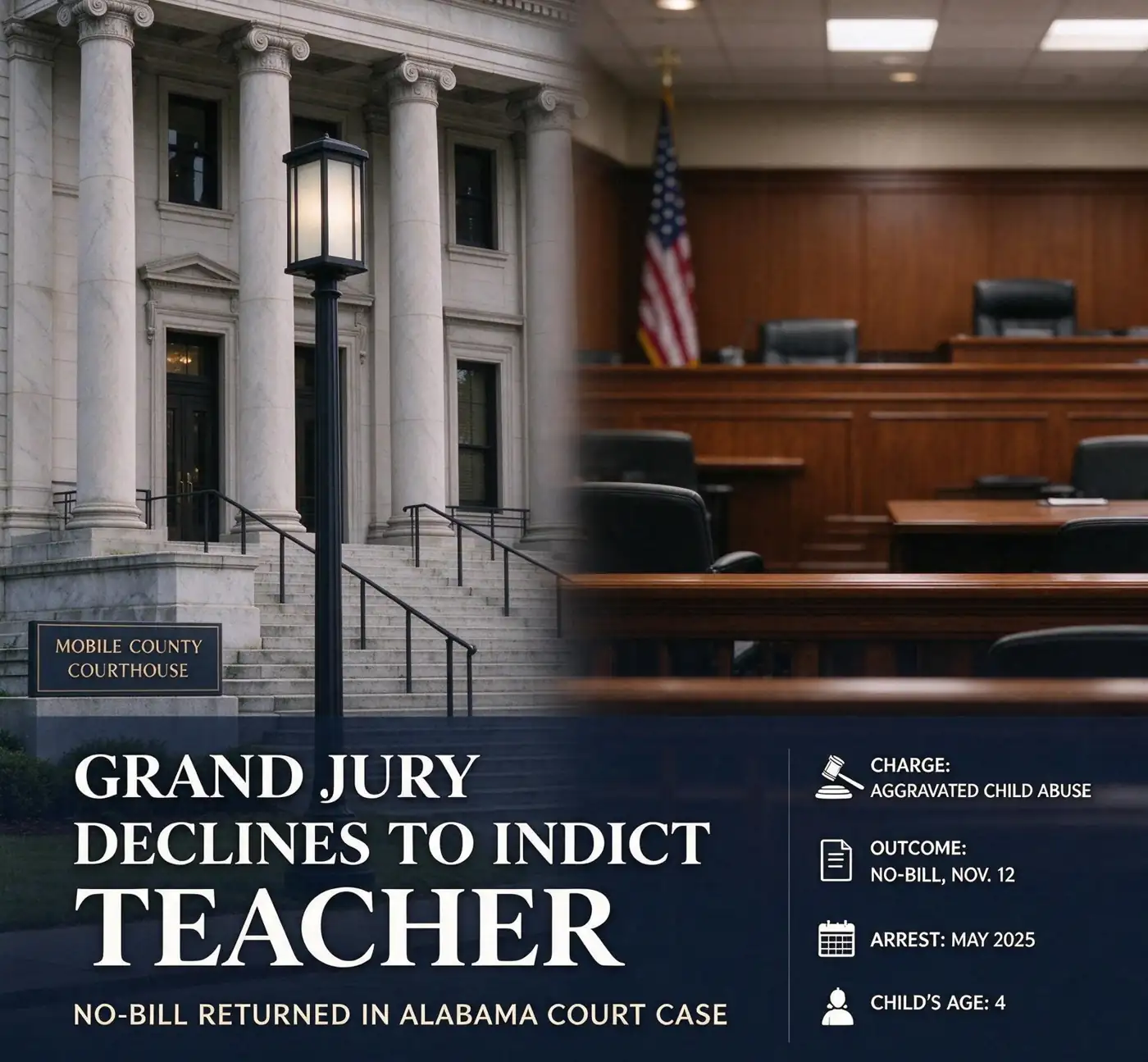
MOBILE, Ala. — A Mobile County teacher who was arrested last year after a 4-year-old in her classroom became severely intoxicated will not face trial on the felony charge that followed. Court records show a grand jury returned a no-bill in the case on Nov. 12, meaning jurors chose not to issue an indictment for aggravated child abuse.
The decision effectively closes the prosecution as it stood, roughly a year and a half after the arrest. The child, who was 4 at the time, had spent two days in an intensive care unit with a blood alcohol level that investigators said was 3.5 times the legal limit for adult drivers.
The teacher is not being named in this article because she was never indicted, and the child is not identified because of the child’s young age.
The Grand Jury’s Decision
A no-bill, sometimes written as no bill or no true bill, is the formal result when a grand jury reviews the evidence in a case and decides it does not support sending the matter forward for trial. In this instance, the panel declined to indict on the single felony count that prosecutors had pursued after the arrest.
Grand jury deliberations in Alabama are confidential, so the public generally does not learn how jurors voted, which witnesses testified or what evidence weighed most heavily in the outcome. The court record reflects only the result, which in this case was entered on Nov. 12.
Key facts at a glance
- Charge: Aggravated child abuse
- Arrest: May 2025
- Grand jury outcome: No-bill, returned Nov. 12, 2026
- Child’s age at the time: 4
- Medical care: Two days in an intensive care unit
- Reported blood alcohol level: 3.5 times the adult legal limit
- Possible source examined: A bottle of hand sanitizer, which investigators could not confirm as the cause
What Led to the Arrest
The case began in spring 2025, when detectives said a young student in the teacher’s care had consumed ethanol, the type of alcohol found in beverages and in many household and personal care products. According to investigators, the amount the child took in came close to being fatal.
Officers took the teacher into custody in May 2025. The accusation filed against her was aggravated child abuse, one of the more serious child abuse offenses under Alabama law.
Prosecutors with the Mobile County District Attorney’s Office said at the time that the teacher was the sole adult in charge of supervising the child during the window when investigators believe the alcohol was swallowed. That point became a central part of the case against her.
An unresolved question about the source
One question that investigators were never able to settle was exactly where the alcohol came from. During the investigation, authorities located a hand sanitizer bottle, yet they were unable to determine whether that product was what the child had ingested.
With the grand jury declining to indict, that question is unlikely to be explored in open court. No trial testimony, cross-examination or evidence presentation will take place on the felony count as it was originally filed.
How Alabama Grand Juries Work
In Alabama, most felony cases must pass through a grand jury before they can go to trial in circuit court. An arrest and a charge filed by police or prosecutors are only the first steps. Before a defendant can be tried on a felony, a grand jury typically must review the evidence and decide whether to return an indictment.
A grand jury is different from the trial jury most people picture. Its members do not decide guilt or innocence. Instead, they weigh whether there is probable cause, a much lower standard than proof beyond a reasonable doubt, to believe a crime was committed and that the accused person committed it.
Some general features of the process in Alabama include:
- Size: A grand jury is made up of 18 citizens drawn from the county’s jury pool.
- Vote required: At least 12 grand jurors must agree before an indictment can be returned.
- Secrecy: Proceedings are closed to the public, and jurors and witnesses are generally barred from disclosing what happened inside the room.
- Prosecutor’s role: Prosecutors present evidence and witnesses, and jurors may ask questions. The defense typically does not present its side.
- Outcomes: The panel either returns a true bill, which is an indictment, or a no-bill, which ends that presentation of the case.
What a no-bill does and does not mean
A no-bill is not the same as a not-guilty verdict. Because no trial takes place, the person is neither convicted nor acquitted. As a general legal matter, the protection against double jeopardy does not attach at the grand jury stage, which means prosecutors can, in some circumstances, bring a case to a later grand jury if new evidence comes to light.
No such plan has been announced in this case. As the record stands, the teacher is not under indictment on the charge that stemmed from the 2025 incident.
About the Charge
Alabama law treats aggravated child abuse as a Class B felony. The statute covers abuse, torture or willful maltreatment of a child under 18 that is aggravated by factors such as serious physical injury or a pattern of harm. A conviction on a Class B felony in Alabama carries a possible prison sentence ranging from two to 20 years.
Because the grand jury did not indict, none of those penalties are in play, and the question of whether the conduct described by investigators met the legal definition will not be decided by a trial jury.
Why Alcohol Is So Dangerous for Young Children
The medical details of the case highlight a risk that pediatricians and poison control experts warn about often: even a small amount of alcohol can be life-threatening for a young child.
Children have much smaller bodies than adults, so a few swallows can produce a high blood alcohol concentration. Their livers are also less able to process alcohol, and young children are especially vulnerable to a sharp drop in blood sugar after drinking it. That combination can lead to drowsiness, vomiting, slowed breathing, seizures, loss of consciousness and, in severe cases, death.
For context, the legal driving limit for adults in Alabama is a blood alcohol concentration of 0.08 percent. A level 3.5 times that threshold, or roughly 0.28 percent, would be in the range that can cause serious harm even in a grown adult.
Hand sanitizer and other hidden sources
Many alcohol-based hand sanitizers contain between 60 and 95 percent ethyl alcohol or isopropyl alcohol, making them far stronger by volume than beer or wine. Federal health agencies and poison centers have reported rising numbers of calls involving children who swallowed sanitizer, particularly in the years after hand sanitizer became a fixture in homes, classrooms and vehicles.
Other everyday products can also contain significant amounts of alcohol, including:
- Mouthwash
- Perfume, cologne and aftershave
- Some cough and cold medicines
- Flavoring extracts, such as vanilla
- Rubbing alcohol and some cleaning products
Tips for parents and caregivers
Child safety experts recommend a few simple precautions at home, in child care settings and in schools:
- Store sanitizer and other alcohol-containing products up high and out of sight of small children.
- Supervise young children whenever they use hand sanitizer, and use only a small amount rubbed in until dry.
- For young children, choose soap and water for handwashing whenever it is available.
- Never leave open drinks containing alcohol where children can reach them.
- Watch for unusual sleepiness, stumbling, vomiting or confusion in a child who may have gotten into a product.
If a child may have swallowed alcohol or another potentially harmful product, call Poison Help at 1-800-222-1222, which connects to a local poison center at any hour. If the child is having trouble breathing, will not wake up or is having a seizure, call 911 immediately.
The Role of the District Attorney’s Office
The Mobile County District Attorney’s Office handles felony prosecutions arising in the county, including cases investigated by local police departments and the sheriff’s office. After an arrest, prosecutors review the investigative file, decide which charges to pursue and present the case to a grand jury when a felony indictment is sought.
Cases involving young children can be especially difficult to bring forward. Very young children usually cannot describe what happened in a way that can be used as evidence, so investigators often rely heavily on medical records, timelines, physical evidence found at the scene and accounts from adults who were present. When a key fact, such as the origin of a substance a child swallowed, cannot be pinned down, that gap can weigh on how a grand jury views the evidence.
Where Things Stand
The grand jury’s Nov. 12 decision brings the aggravated child abuse case to a halt. The teacher’s attorney and the child’s family have not publicly addressed the outcome.
The 4-year-old’s two-day stay in intensive care remains the most serious documented consequence of the incident, and the source of the alcohol remains undetermined. With no indictment returned, the matter will not move to trial in Mobile County Circuit Court unless prosecutors bring it before another grand jury.