Mobile County’s Confirmed COVID-19 Cases Climb to 18 as Statewide Testing Passes 4,000
Mobile County's known COVID-19 case count rose to 18 in late March 2020, as the Alabama Department of Public Health reported more than 4,000 tests conducted statewide and the state's first pandemic-related death.
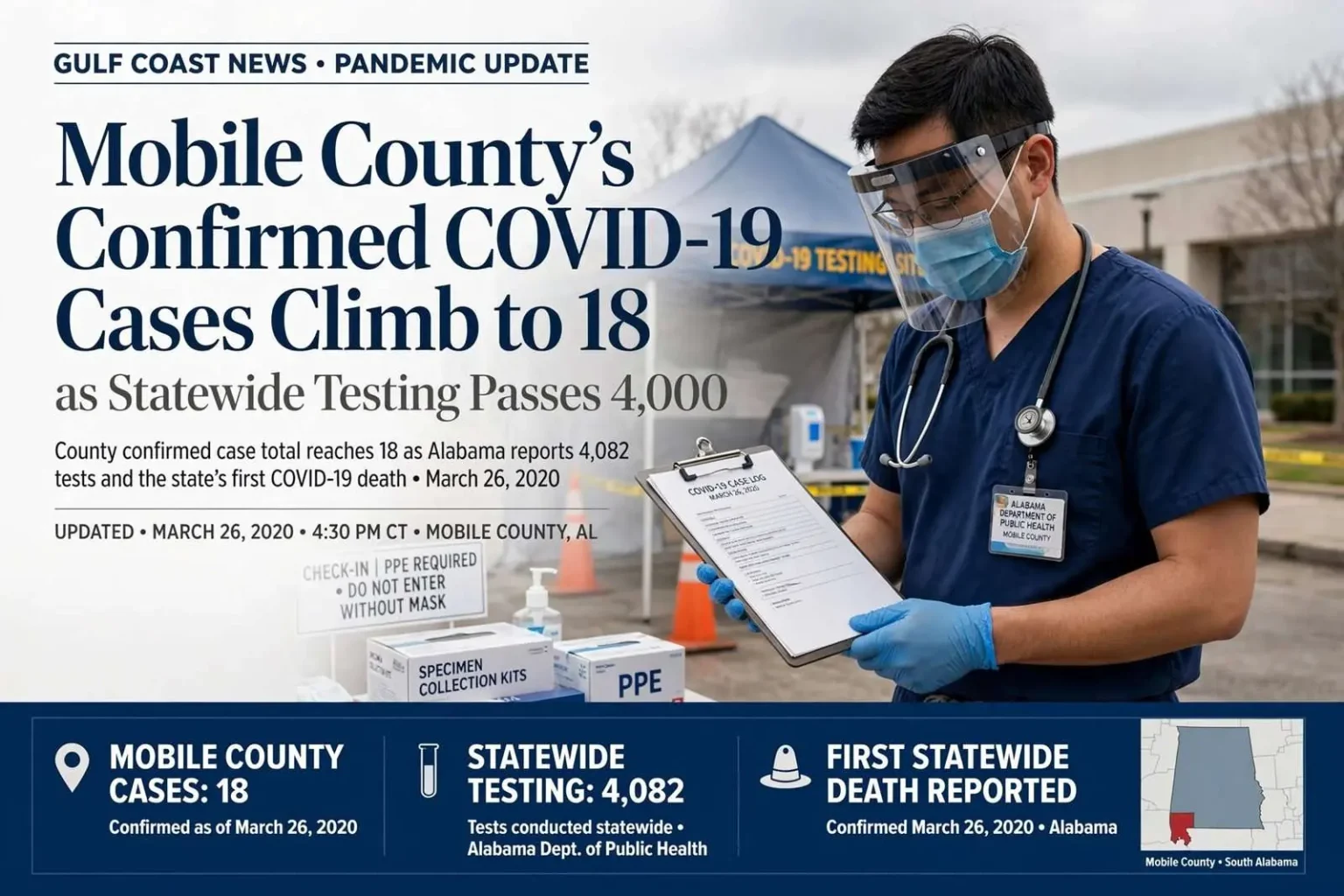
Mobile County’s confirmed COVID-19 case count had climbed to 18 as of Thursday afternoon, March 26, 2020, according to updated case figures compiled from Alabama Department of Public Health reporting. The increase kept the county at the center of the state’s early pandemic watch list, even as the total remained small by the standards of what would come later in the spring. For residents who had spent the previous two weeks tracking each daily update, the number served as the clearest available measure of how far the virus had reached into the Gulf Coast region.
The county-level update arrived as the Alabama Department of Public Health reported 4,082 tests conducted statewide, along with the first confirmed COVID-19 death in Alabama. Together, those figures marked a sobering milestone in the state’s experience with the new coronavirus, which had first been detected in Alabama earlier in March. In a matter of days, the outbreak had moved from a handful of scattered cases to a confirmed fatality and a steadily growing count of infections spread across multiple counties.
During those early weeks of the pandemic, the steady rise in county-by-county case totals was watched closely across South Alabama. Newspapers, television stations, and residents themselves refreshed the state health department’s online dashboard throughout the day, treating each afternoon update as the defining news event of the moment. Local officials used the daily updates from the state health department to gauge how quickly the virus was spreading in the region and to make decisions about closures, staffing, and public messaging.
Understanding what the numbers meant required some context. A confirmed case was a person whose positive test result had been verified and reported through the state’s official reporting system. That process involved collecting a sample from a patient, running it at a laboratory, reporting the result, and having public health staff confirm the details before the case appeared in the public tally. Each step took time, which meant the day’s published count always reflected the situation as it stood several days earlier rather than in real time.
Limited testing shaped what the official numbers could show
Testing access remained limited in the pandemic’s early weeks, and that constraint shaped everything about how the outbreak appeared in the data. Early in the response, testing capacity in Alabama and across the country was strained by shortages of swabs, reagents, and the protective equipment needed to collect samples safely. Priority for testing initially went to hospitalized patients, health care workers, and people with known exposure to a confirmed case, leaving many people with milder symptoms without a way to confirm whether their illness was COVID-19.
Because so many infections went untested, the official case counts reported by the Alabama Department of Public Health likely captured only a portion of the actual infections circulating in Mobile County and other Alabama counties at the time. Public health officials acknowledged this openly in their briefings, describing the confirmed totals as a lower bound rather than a complete picture. Epidemiologists compared the visible cases to the tip of an iceberg, with the larger share of infections either mild enough to go unreported or simply never tested amid the capacity constraints.
The gap between confirmed cases and actual infections made the count of tests performed nearly as important as the count of positive results. A rising number of tests meant the state was learning more about where the virus was spreading, while a plateau in testing could make an outbreak appear smaller than it was. That was why the statewide figure of 4,082 tests, modest against Alabama’s population of roughly five million, drew as much attention as the case counts themselves.
Health officials continued to rely on the available data, along with hospitalization trends, to communicate the pace of community spread to the public. Hospitalizations offered a clearer signal of the outbreak’s severity than case counts alone, because severe illness was more likely to bring a patient into the medical system regardless of testing availability. An increase in patients requiring hospital care indicated that community transmission was accelerating even when the confirmed case totals lagged behind.
Tracking hospital capacity also carried practical weight for the region. Mobile is the hub of medical care for a wide stretch of the central Gulf Coast, drawing patients from southwestern Alabama and neighboring parts of Mississippi and the Florida Panhandle for advanced treatment. A sustained surge of COVID-19 patients would strain not only the county’s own hospitals but the referral network that smaller rural hospitals across the region depended on, so officials watched admission numbers as a leading indicator of coming pressure.
What was known, and not known, by late March 2020
By March 26, much about the virus remained uncertain. Scientists were still learning how easily COVID-19 spread from people without symptoms, how long the period of infectiousness lasted, and which groups faced the greatest risk of severe outcomes. The guidance offered to the public reflected that uncertainty: wash hands frequently, avoid touching the face, stay home when sick, and keep distance from other people in public. The term social distancing was entering everyday conversation, and the practice of six feet of separation was becoming a common sight in stores and workplaces.
The first confirmed COVID-19 death in Alabama, reported alongside the March 26 figures, underscored the stakes behind each daily update. A single fatality transformed the outbreak from an abstract health statistic into a matter of life and loss within the state, and health officials used the moment to renew calls for residents to take the recommended precautions seriously. Throughout the pandemic, deaths would be reported through the same state system as cases, with investigations to confirm the cause, which meant death totals also trailed events by several days.
As Alabama’s second-most populous county, Mobile County was among the areas monitored most closely by state and local health officials as COVID-19 spread across South Alabama in the spring of 2020. The county was home to the city of Mobile, the state’s fourth-largest city and the anchor of a metropolitan area whose economy centered on the Port of Mobile, aerospace and shipbuilding, healthcare, and tourism along the nearby Gulf beaches. Its position on Interstate 10, a major east-west freight corridor, connected the county to a constant flow of travelers, which added to officials’ concerns about the virus’s spread.
Mobile County’s size and population density distinguished its outbreak from those in Alabama’s more rural counties. Dense population made person-to-person transmission easier to sustain, and the county’s role as a regional commercial center meant more workplaces, more visitors, and more opportunities for the virus to move through the community. At the same time, the county’s concentration of hospitals, clinics, and public health resources gave it more capacity to respond than many smaller counties possessed.
The county health department worked in coordination with the Alabama Department of Public Health to investigate confirmed cases, identify close contacts, and advise those contacts to quarantine. That contact tracing work was a cornerstone of the early pandemic response, aimed at interrupting chains of transmission before they could grow into larger clusters. With 18 confirmed cases spread across a county of more than 400,000 residents, investigators still had some ability to trace each case’s known contacts, an approach that would become far more difficult as totals climbed in the weeks ahead.
Neighboring counties and the wider Gulf Coast picture
Attention in the region extended beyond Mobile County’s borders. Baldwin County, directly to the east across Mobile Bay and connected by the I-10 Bayway and the Bankhead and Cochran bridges, reported its own growing case totals during the same period, as did Washington, Clarke, Monroe, and Escambia counties to the north and east. Because residents crossed county lines daily for work, shopping, and medical care, officials stressed that the outbreak could not be understood as a collection of separate local problems but as one regional phenomenon.
The pandemic’s early weeks had already reshaped daily life across South Alabama by the time the March 26 update was published. School systems across the state had closed their buildings and shifted to remote or take-home learning. Houses of worship suspended in-person services or moved them online. Restaurants in Mobile and across the region restricted service to takeout and delivery, and public gatherings were scaled back or canceled. Each of these steps followed guidance from state and federal health authorities intended to slow the spread of the virus and keep the rising case counts from overwhelming hospitals.
The statewide response had been building for weeks before the March 26 figures. Alabama’s governor had declared a state of emergency earlier in March, opening the door to emergency purchasing and coordination among state agencies, and the state had followed with escalating public health orders as case counts grew. The Alabama Department of Public Health updated its case totals each day, and county health officers issued guidance tailored to local conditions. Federal agencies, including the Centers for Disease Control and Prevention, supplied testing support and recommendations that state officials adapted to Alabama’s circumstances.
For Mobile County residents, the practical question raised by each afternoon update was what to do differently the next day. Health officials’ advice remained consistent as the count climbed to 18: stay home except for essential errands, maintain distance from people outside the household, wash hands thoroughly and often, and call ahead before visiting a clinic or emergency room if symptoms developed. Residents experiencing fever, cough, or shortness of breath were urged to contact their health care provider by phone rather than arriving in person, both to protect themselves and to limit exposure for others in waiting rooms.
Residents and local governments across the county watched the daily case counts for signs of how the outbreak might affect the region in the weeks ahead. Municipal officials in Mobile, Prichard, Saraland, and the county’s other municipalities adjusted their operations as the numbers changed, postponing meetings, closing facilities, and reassigning employees. Business owners made plans around an outbreak whose duration nobody could yet predict, and families weighed the advice of health officials against the disruption to work, school, and income that the response measures brought.
What the 18-case milestone would come to represent
Looking back, the March 26, 2020, update occupied a small but significant place in the region’s pandemic history. Eighteen confirmed cases and 4,082 statewide tests were, in retrospect, the very beginning of a curve that would climb far higher in the months that followed, through subsequent waves in 2020 and beyond. The day also marked the appearance of the pandemic’s human cost in Alabama with the state’s first confirmed death, a reminder of why the early weeks of preparation and caution mattered so much.
The experience of those weeks also left lasting lessons for the region. The limits of early testing became a driver of expanded capacity in the months that followed, as drive-through and community testing sites multiplied across Mobile County and the rest of the state. The daily ritual of watching county-level counts shaped how South Alabama residents understood public health data, and the coordination among the state health department, county health officers, hospitals, and municipal governments formed the framework on which the longer pandemic response would rest. For Mobile County, the climb to 18 confirmed cases was the moment when the approaching storm that health officials had warned about for weeks finally came into local view.