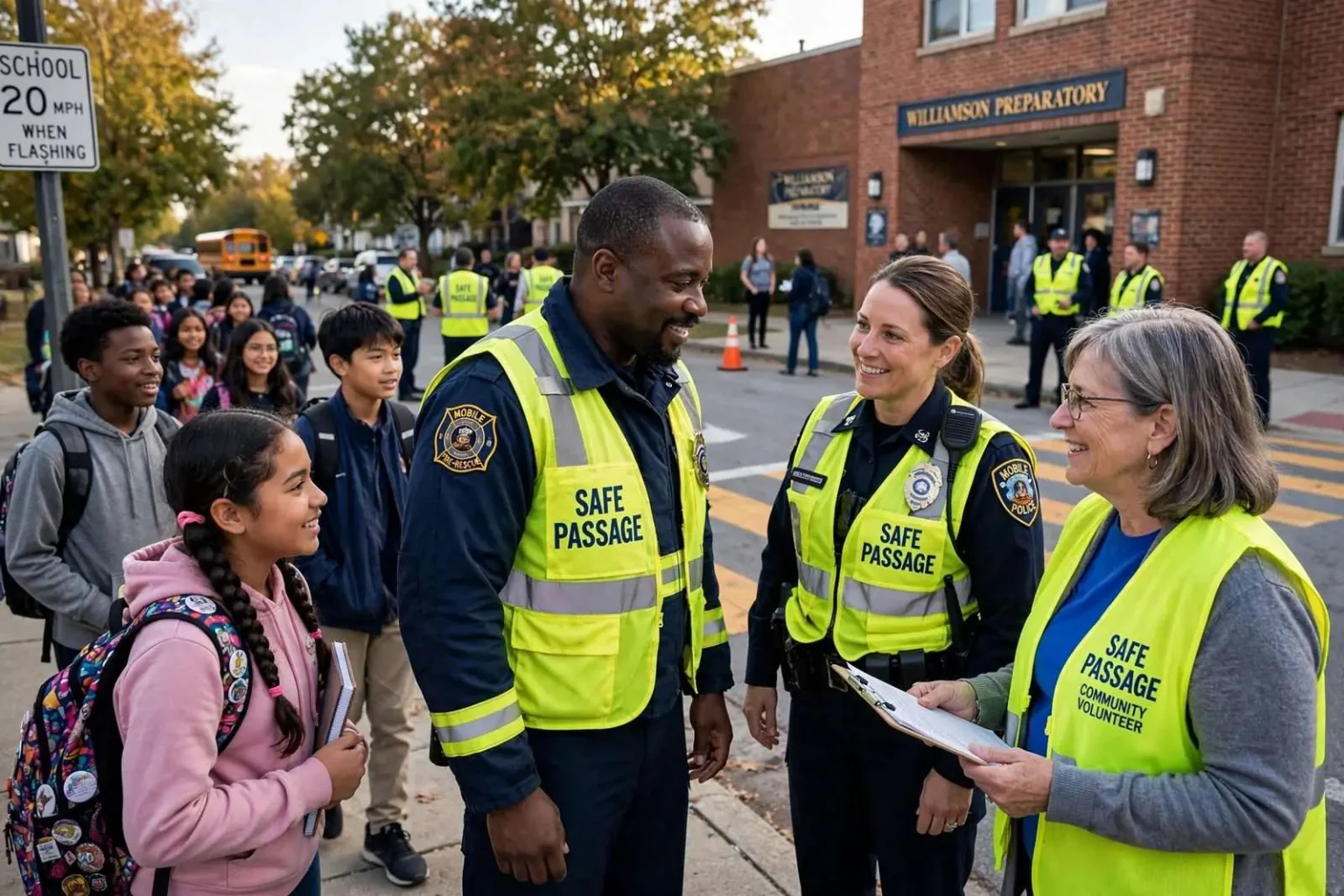
The City of Mobile is expanding its Safe Passage program, an initiative that places police officers, firefighters, public safety workers and community volunteers along the routes students walk home after school lets out. The program, which started as a pilot at a handful of campuses, is now growing to reach more schools and more of the neighborhoods where families have raised concerns about what happens in the hours between the final bell and dinner time.
The program is currently active at several campuses, including Williamson Preparatory, and city officials say the results at those schools have convinced them the model deserves a wider footprint. Rather than adding enforcement, the expansion adds adults — familiar, friendly faces who stand along walking routes at dismissal time, greeting students by name and keeping an eye on the corners and crossings where trouble has historically started.
City officials say the presence of familiar faces along student walking routes has already changed how students interact with public safety workers. “We started the program and started the pilot. Initially they were like, ‘who are you guys?’ But eventually they came to a point of saying, ‘hey, where were you yesterday?'” said Curtis Graves, the city’s public safety director. That shift, from suspicion to expectation, is precisely the outcome the program was designed to produce.
The program’s staffing draws from across city government rather than from any single department. Police officers and firefighters who join Safe Passage rotations do so in addition to their regular duties, and public safety workers are joined by community volunteers recruited through neighborhood associations and faith organizations. That mix is deliberate: a uniform signals institutional commitment, while a familiar neighbor signals personal investment, and students respond to both in different ways.
Mobile’s public safety director oversees coordination among the city’s police, fire and emergency communications operations, and Safe Passage is one of several initiatives the office has used to put city personnel into neighborhoods in non-enforcement roles. Officials describe the approach as a long-term investment in trust — the kind that determines whether a witness calls 911, whether a parent feels comfortable talking to an officer, and whether a young person sees a badge as a threat or a resource.
Presence, Not Policing
Officials say the goal isn’t to police students, but to provide a steady, visible presence that helps prevent conflicts before they start. Fights that once gathered crowds in the minutes after dismissal depend on opportunity; a consistent adult presence at the gate and along the route removes much of it. The program’s architects describe it as a form of prevention that costs far less than the alternative of responding to incidents after they happen.
“Just 30 minutes out of the month. If you are consistent with that, they’ll see 30 minutes out of the month and know that you care,” Graves said. His framing is aimed at the volunteers and city workers whose participation makes the program scalable: a modest commitment, repeated reliably, builds the relationships the program depends on. The math matters for a city trying to cover many campuses without straining its payroll.
The model borrows from programs that have run in large cities across the country for more than a decade, where adults stationed along school walking routes — many of them parents, retirees and neighborhood residents — are credited with reducing post-dismissal violence in the corridors around schools. Mobile’s version blends that community-volunteer approach with the institutional weight of its own public safety departments, sending police officers and firefighters out not as enforcers but as greeters and mentors at the school door.
A Second Outlet for Conflict
Mobile Mayor Spiro Cheriogotis said the program also gives students another outlet when conflicts do arise. “For these fights that happened in the past, the whole school campus, you know, maybe they’ll come to us so that we can help them understand how to resolve conflict without violence,” he said. The mayor’s point is that the adults along the route are not merely watching — they are available, and students increasingly use them that way.
Conflict resolution, in the program’s design, starts with a relationship. A student who knows the firefighter standing at the corner has someone to bring a problem to before it becomes a fight, and a parent who recognizes the volunteer walking the route has someone to tell when something feels wrong. City officials describe the program as building a web of small connections that make violence less likely and reporting easier.
School dismissal times concentrate hundreds of students onto a handful of streets in a span of minutes, and the cities that run Safe Passage-style programs have found those minutes to be the most productive place to prevent violence. Crowds form, grievances surface and bystanders gather — all in the open, all in a predictable window. Adults stationed along the route break up the dynamic simply by being present, and the effect compounds as students come to expect them.
The expansion also reflects a shift in how Mobile’s public safety leadership measures success. Rather than counting only arrests and response times, officials point to absence — the fights that didn’t happen, the confrontations that dissolved when a familiar adult was standing nearby. That kind of result is harder to chart, but it is the metric Graves and Cheriogotis both emphasize when describing why the program is worth growing.
Programs of this kind also change the adults involved, officials say. City employees who might otherwise interact with young people only in emergencies describe the dismissal shift as the most rewarding part of their week, and volunteers frequently report that they learn the students’ names, moods and friendships within a few visits. That familiarity is what allows an adult to spot the difference between a rough day and a brewing conflict — a judgment no camera or patrol car can make.
What Williamson Has Seen
Williamson Principal Tammy George said the school has already seen fewer incidents since the program launched. “Our students are responding to community resources as well as just helping them make better choices, not only inside the building during the school day, but as well as when they leave us and go into the community,” George said. Her account suggests the program’s influence runs in both directions — shaping behavior on campus while extending the school’s reach beyond its own walls.
Williamson Preparatory serves students in a part of Mobile that has historically faced many of the challenges the Safe Passage program is designed to address. For a school leader, the minutes after dismissal are among the hardest to manage: students scatter in every direction, supervision ends at the property line, and the conflicts that build during a school day often come to a head on the walk home. George said the visible presence along those routes has changed the calculation for students who might otherwise settle scores in the street.
The Long-Term Vision
City leaders say they hope to eventually extend that same sense of community well beyond school grounds. “What I would love to see is that for every one of these kids leaving here, as they walk down any street on their way home, they would see neighbors sitting on their front porch,” Cheriogotis said. The image captures the program’s ambition: a city where adult presence is not a program but a habit, where the front porch does the work the city government is currently doing by deployment.
Getting there, officials acknowledge, takes the same ingredients that made the pilot work — consistency, familiarity and time. A volunteer who appears once and disappears teaches students nothing; one who comes back every week becomes part of the landscape the way Graves described. The city’s expansion plan is built around that lesson, prioritizing reliability at each campus over breadth that the city cannot sustain.
School leaders involved in the pilot say the results have made the case for them. Fewer post-dismissal incidents mean fewer disciplinary proceedings, fewer calls to parents and less wear on the relationships between students and administrators. Principals describe the program as extending the school day’s culture a few blocks further into the neighborhood, and several have asked for additional coverage at dismissal, the busiest and least supervised window of their week.
For now, the expansion means more campuses added to the roster, more city workers and volunteers trained for the post, and more walking routes where the sight of a firefighter or a neighbor in a Safe Passage vest becomes routine. City officials say they will keep measuring what the schools themselves report — and if the early results from Williamson hold, the program that began as a 30-minute-a-month commitment could become a fixture of how Mobile’s neighborhoods look at 3 o’clock in the afternoon.