
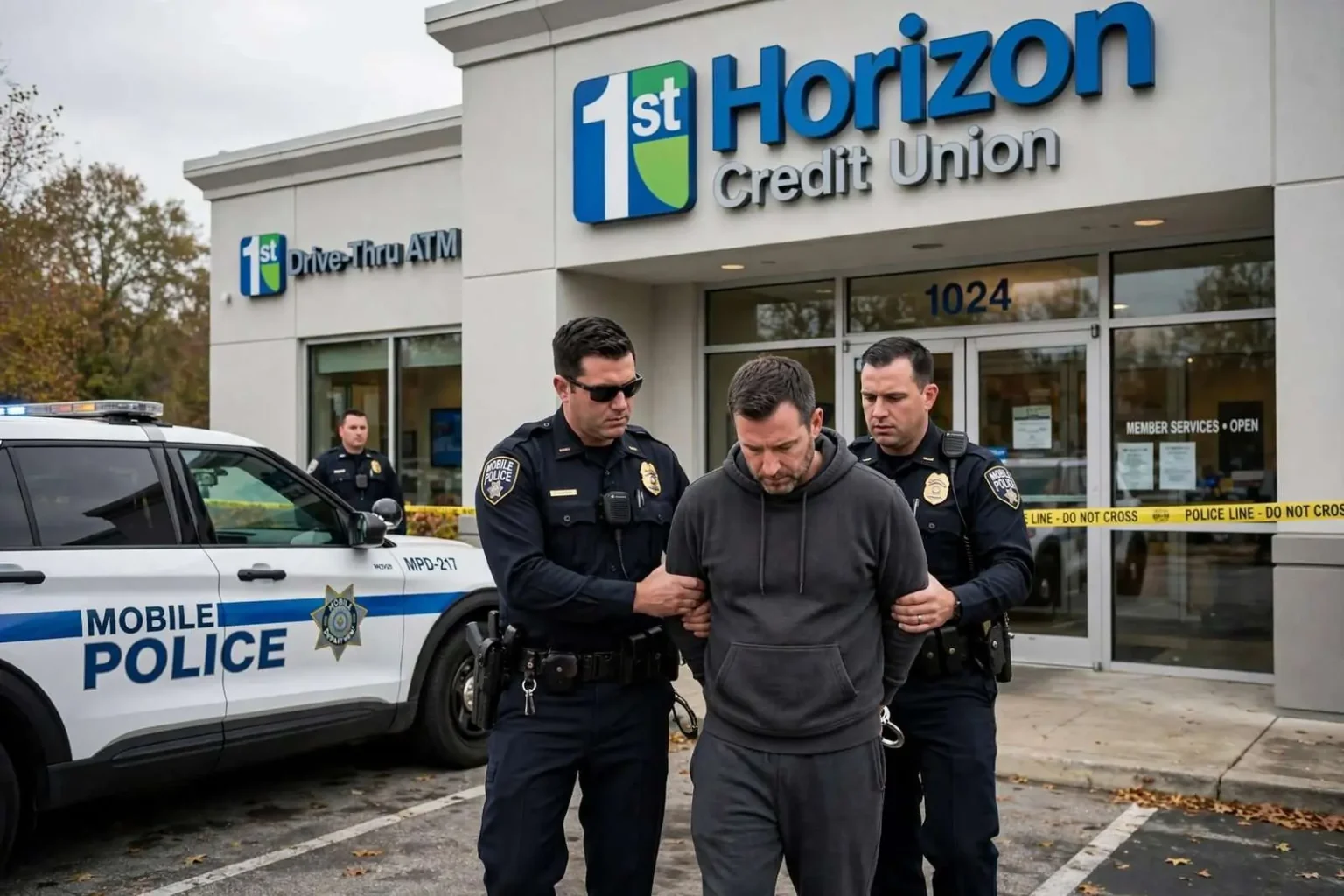
A Mobile man with a history of white-collar crimes was arrested after allegedly using fraudulent documents created from stolen identities at a local credit union, according to the Mobile Police Department. Travis Sopson, 43, was identified as a suspect after Mobile Police responded to 1st Horizon Credit Union on September 28 in reference to a fraud report.
Investigators reviewed security footage from the credit union and linked Sopson to the incident. The review gave detectives a clear picture of the man they were looking for, and it set in motion the sequence that ended with his arrest days later — at the same branch, while he was allegedly running the same scheme a second time.
Sopson reportedly returned to the same 1st Horizon Credit Union on October 2, this time carrying multiple fraudulent documents allegedly created from stolen identities. Police arrested him at the scene. Returning to the site of a reported fraud is one of the more common patterns in repeat financial crimes, and in this case it meant officers were able to take him into custody with the alleged evidence in hand.
According to MPD, Sopson has a documented history of white-collar crimes, including a prior identity theft incident in 2022. He was charged with trafficking in stolen identities and identity theft following his arrest. The trafficking charge — carrying the identities of multiple victims rather than a single one — reflects the volume of material police say was involved when he was taken into custody.
How Identity Theft Cases Unfold at the Counter
Credit unions and banks are on the front line of identity fraud. Tellers and member-service representatives are trained to compare identification documents against account records and to watch for inconsistencies — addresses that do not match, signatures that look traced, photographs that do not quite fit the person standing at the window. When a document fails that scrutiny, the institution typically completes the interaction as calmly as possible, preserves the paperwork and the surveillance video, and calls police.
That is the process that appears to have played out at the 1st Horizon branch on September 28. The initial fraud report gave Mobile Police a starting point; the security footage gave detectives an identification; and the October 2 return gave officers the chance to make an arrest in progress rather than tracking a suspect across the city. Fraud detectives with MPD handle cases of this kind as part of their regular caseload, working with victims’ financial institutions to document the paper trail.
Trafficking in stolen identities is treated by Alabama law as a serious felony precisely because of how such identities are used. A stolen identity is raw material for opening accounts, cashing checks, obtaining loans, and claiming benefits in someone else’s name, and a set of fraudulent documents can victimize dozens of people before it is detected. Each real person whose information appears in a trafficked set is a potential victim with credit damage to untangle, which is why prosecutors charge the accumulation and use of identities separately from any single act of fraud.
Bond Revoked and Court Dates Ahead
Sopson’s bond was revoked following the arrest. In Alabama, a defendant’s bond can be revoked when a new arrest occurs while charges are pending, when the original bond conditions are violated, or when the court concludes the defendant is a danger or a flight risk. Revocation means he will be held in the Mobile County jail pending further proceedings rather than released on a new bond.
He has separate court dates scheduled for Thursday, October 26, and Monday, November 6, as the case proceeds through the Mobile County court system. The pair of dates reflects the layered charges — identity theft and trafficking in stolen identities — moving through arraignment and early pretrial proceedings. Each hearing gives the court a checkpoint for bond status, discovery, and the defense’s preparation.
What Identity Theft Means for Its Victims
For the people whose identities were used to build fraudulent documents, the consequences land long after the arrest. Victims typically discover the damage through declined applications, unfamiliar accounts, or collection notices for debts they never opened. Untangling a single stolen identity can take months of disputes with credit bureaus, banks, and government agencies, and victims of multi-victim trafficking cases sometimes learn their information was compromised only when investigators contact them.
Residents who suspect their information has been misused have a standard playbook: place a fraud alert or security freeze with the major credit bureaus, review account statements line by line, file a report with the Federal Trade Commission at IdentityTheft.gov, and file a police report with the local department. A police report matters in cases like this one because it documents the crime for creditors and gives investigators a paper trail that can be tied to a specific defendant and a specific set of documents.
Financial institutions in the Mobile area have steadily hardened their front-line defenses in recent years. Check imaging, real-time account verification, identity-verification software, and mandatory employee training have all raised the difficulty of walking into a branch with someone else’s papers. But the schemes persist because the material keeps circulating — data breaches, mail theft, and discarded documents all feed the supply of names, dates of birth, and Social Security numbers that fraudsters turn into counterfeits.
A Repeat Pattern Investigators Recognize
MPD’s account of the case describes a pattern familiar to fraud detectives: a suspect with a prior record returning to a profitable scheme. A prior identity theft incident in 2022, followed by a September fraud report and an October arrest with multiple fraudulent documents in hand, is the kind of repetition that drives how these cases are charged and sentenced. Repeat offenders in financial crimes face progressively harsher exposure, and prosecutors treat a documented history as an aggravating factor.
The arrest also illustrates the value of institutional memory at a single branch. Staff who had already reported a fraud on September 28 were in a position to recognize the same man when he came back through the door on October 2, and the arrest at the scene closed the loop between the two visits. Investigators will now work to identify the victims whose information was used, notify them, and document the full scope of the fraudulent documents Sopson is alleged to have carried.
The case now sits with the Mobile County court system, with hearings on October 26 and November 6 and a defendant held without bond. The charges — trafficking in stolen identities and identity theft — will be tested against the evidence MPD gathered: the September fraud report, the security footage linking Sopson to the first incident, and the fraudulent documents police say he carried when he returned to the credit union and was arrested.
For the credit union’s members, the episode is a reminder that the institution’s front-line staff are often the first to catch identity fraud — and that the reports they file are what allow detectives to connect one visit to the next, one document to the next, and eventually one suspect to the whole pattern.
The distinction between the two charges matters for how the case will be presented. Identity theft addresses the unauthorized use of another person’s identifying information, while trafficking in stolen identities addresses the possession and movement of that information in volume — the gathering of multiple victims’ details into a working set of documents. Prosecutors use the trafficking charge when the evidence shows a supply of identities rather than a single act, and the multiple documents Sopson is alleged to have carried into the credit union on October 2 are central to that theory.
Mobile police detectives will also trace where the identities came from. Fraud investigators routinely work backward from a seized set of documents to the sources of the underlying information, which can connect one defendant’s arrest to a wider investigation involving data breaches, mail theft, or other schemes. Each identified victim is notified, and each account opened or altered in a victim’s name becomes another count investigators can document.
Members of the credit union and other area residents can follow the case through the Mobile County court system’s public dockets as the October 26 and November 6 dates arrive. The charges carry significant prison exposure if proven, and the revoked bond means Sopson will attend each hearing from custody. Additional hearings will be scheduled as discovery moves between the state and the defense.
For now, the case moves on the schedule the court has set: October 26 and November 6, in Mobile County, with Sopson in custody after his bond was revoked. The September 28 fraud report, the security footage, the October 2 return to the branch, and the arrest at the scene together form the backbone of the case MPD will present — a documented history of white-collar crime that, according to the department, includes a prior identity theft incident in 2022 and now a second, more elaborate run at the same credit union.


