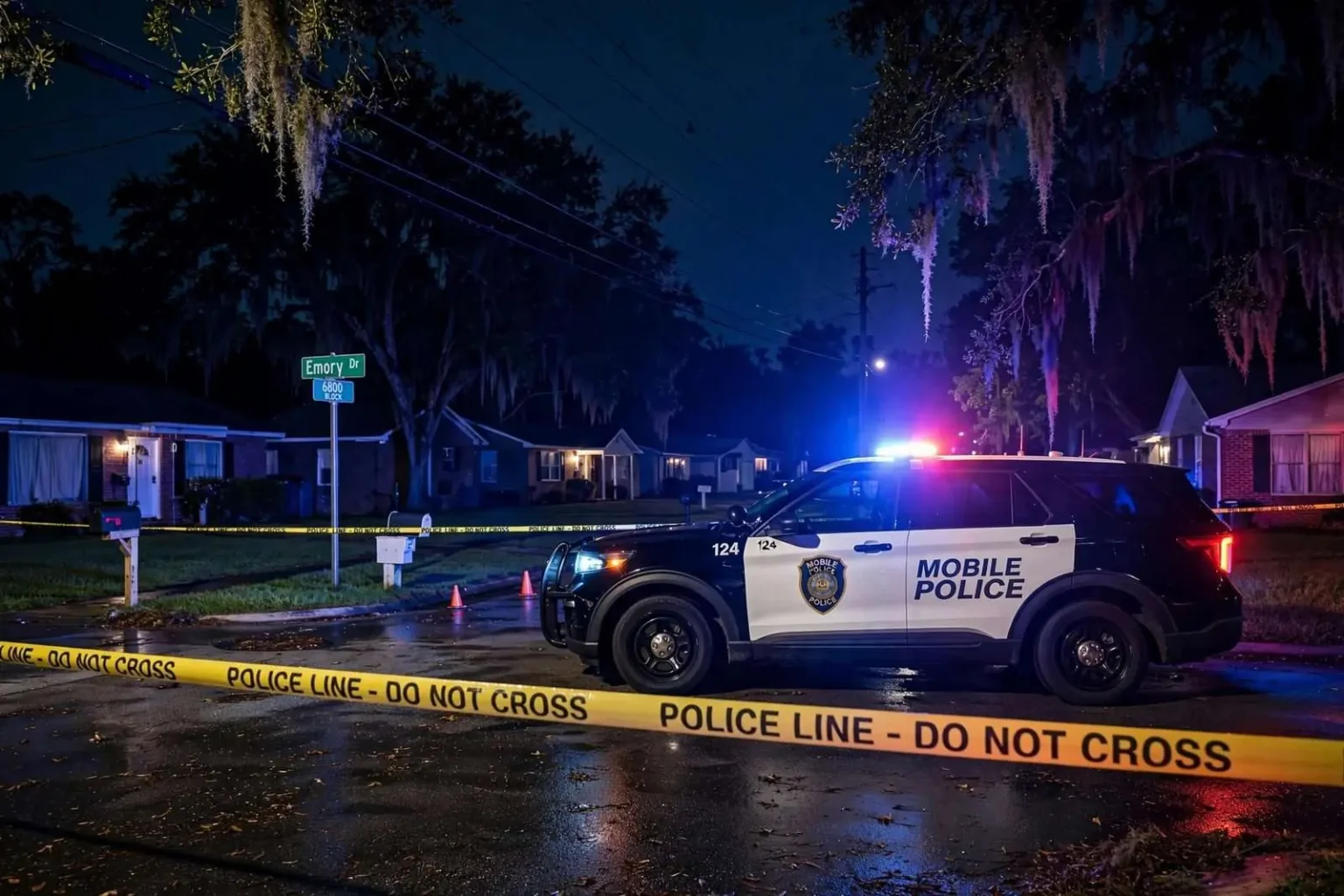
MOBILE, Ala. — A Mobile man is facing a second-degree assault charge after police say he struck another man with an object during an argument last weekend on Emory Drive. The arrest, made days after the incident, closes the first chapter of a case that began with a late-night report of a fight in a west Mobile neighborhood and ended with a booking photo at Metro Jail.
According to the Mobile Police Department, officers responded to the 6800 block of Emory Drive around 10 p.m. Saturday, Aug. 8, after receiving a report of an assault. The timing matters in cases of this kind: a night-time disturbance report brings officers to the scene while evidence is fresh, and in this one investigators found a victim with injuries serious enough to require hospital treatment but — by police accounts — not life-threatening.
What police say happened
Investigators said the victim told them he was struck with a “foreign object” during an argument with 43-year-old Eugene Brauer, whom he knew. The detail that the two men knew each other places the incident in the most common category of assault cases police handle: violence between acquaintances rather than between strangers, arising from an argument that escalated instead of being resolved.
The victim was taken to a hospital and treated for non-life-threatening injuries. Police did not describe the object used or the severity of the injuries beyond that classification, and MPD did not release further details about what sparked the argument between Brauer and the victim — a gap that is common early in assault cases, where the account of the dispute rests on the victim’s statement and any physical evidence until investigators complete their work.
The arrest and charges
Police located and arrested Brauer on Wednesday, Aug. 12, several days after the incident. He was booked into Mobile County Metro Jail and charged with second-degree assault, according to jail records. The gap between the Saturday-night incident and the Wednesday arrest reflects the ordinary rhythm of assault investigations: officers identify the suspect, consult with investigators, and take the suspect into custody once the case supports a charge — in this case, within four days of the incident.
Brauer had a bond hearing scheduled for Friday, Aug. 14, at 8:30 a.m., with bond set at $7,500. In Alabama, second-degree assault is a felony, and the charge typically covers a person who intentionally causes physical injury to another by means of a deadly weapon or dangerous instrument — the category into which a strike with an object generally falls. A $7,500 bond places the case in the range of mid-level felony charges, allowing release pending trial under the court’s conditions while the prosecution proceeds.
The case now moves to the court system, where the Mobile County District Attorney’s Office will review the evidence and determine how to proceed. Assault cases of this kind typically turn on the physical evidence from the scene, the victim’s account, and any witnesses to the argument — details MPD has not released publicly as the investigation remains active.
About the Mobile Police Department
The Mobile Police Department (MPD) is the law enforcement agency responsible for policing Alabama’s third-largest city. Covering a city of nearly 190,000 residents spread across neighborhoods from downtown to the western corridors where Emory Drive sits, MPD investigates crimes ranging from property offenses to violent felonies, and it routinely asks members of the public to share tips that may aid an investigation.
The department’s caseload spans the full range of criminal work — patrol responses, detective units assigned to assaults, robberies and homicides, and specialized divisions for domestic violence, narcotics and gang-related crime. Assault cases like Saturday night’s on Emory Drive are worked by MPD’s investigators after patrol officers secure the scene and take the initial report, with the felony charge ultimately reviewed and prosecuted by the District Attorney’s Office.
The department works alongside the Mobile County District Attorney’s Office, which prosecutes state criminal cases, and with state and federal agencies on matters that cross jurisdictional lines. That division of labor shapes cases like this one: MPD develops the facts and makes the arrest, the DA’s office evaluates the charge and carries it into court, and the two agencies coordinate from the night of the incident through the bond hearing and beyond.
How the public can help
Residents can report non-emergency information through the department’s tip line and through national crime-reporting programs. In assault investigations, witnesses who saw the argument, heard the disturbance or know the relationship between the parties can provide investigators with the corroboration that early cases need — and the department’s public requests for tips reflect how often those accounts make the difference in moving a case forward.
The bond hearing scheduled for Friday morning is the next public step in the case. From there, the file moves through the standard felony process — district court proceedings, possible grand jury review and, if the case proceeds, trial or resolution by plea. MPD’s release of the basic facts — the charge, the bond, the hearing date — follows the department’s standard practice in assault arrests, giving the public the outline of the case while the investigation’s specifics remain with investigators and prosecutors.
What second-degree assault means
Alabama’s assault statute distinguishes degrees by intent and means. Second-degree assault — the charge Brauer faces — generally involves causing serious physical injury to another person, or causing any physical injury by means of a deadly weapon or dangerous instrument, among other provisions. A conviction on the charge carries potential prison time, fines and restitution to the victim, with the exposure rising if prior convictions enter the sentencing calculation. The felony classification also means the case will proceed in circuit court rather than municipal court if it moves forward as charged.
For the victim, the case’s practical chapter began at the hospital, where treatment for non-life-threatening injuries preceded the paperwork of a criminal complaint. For MPD, it began at 10 p.m. on a Saturday in the 6800 block of Emory Drive, and it continued through four days of investigation to the Wednesday arrest. The bond hearing Friday morning marks the next step in a process that will run in the courts for months — the ordinary machinery of a felony assault case, set in motion by an argument that escalated on a Mobile street.
The Emory Drive case sits within MPD’s patrol geography in the city’s western reaches, an area of residential streets and commercial corridors where the department’s response times and investigative follow-through are measured the same way they are downtown: by how quickly a report becomes an arrest. The four days between the Saturday-night incident and Wednesday’s arrest is a typical interval for a felony assault case in which the suspect is known to the victim — long enough for investigators to verify the account and prepare the charge, short enough that the case arrived at jail intake with its evidence current.
Assaults between acquaintances carry their own investigative texture. Unlike stranger attacks, they rarely involve questions of identification; instead, the work centers on reconstructing the argument — where it started, who escalated it, what was within reach and when. The victim’s statement that he was struck with a foreign object gives investigators the core of the charge; physical evidence from the scene, medical records from the treating hospital and any witness accounts complete it. What MPD has not released is the rest of the picture, from the object involved to the words that preceded the blow, and the department’s silence on those details is a function of the case’s pending status rather than a gap in the file.
The $7,500 bond figure will draw its share of commentary — a number that reflects both the charge’s severity and the court’s assessment of the defendant’s ties to the community. Bond in Alabama serves the constitutional purpose of securing a defendant’s appearance at trial while preserving the presumption of innocence, and Friday’s 8:30 a.m. hearing is the point where those considerations become a court order. If Brauer posts bond, his release will come with conditions, and his appearances in court will be tracked the way every felony defendant’s are.
The Mobile County Metro Jail booking, meanwhile, places the case in the county system’s records — a public ledger of who is charged with what, when they were booked and on whose warrant. Jail records in cases like this one are how the basic facts of an arrest become public: the charge, the bond amount and the scheduled first appearance. They are also how the counting works — one more second-degree assault case among the hundreds MPD files in a year, and one more argument that ended not in reconciliation but in a hospital bed and a jail cell.
The department’s closing guidance remains the same in every such case: anyone with information about the incident can come forward, and the tip line is open. For a neighborhood in the 6800 block of Emory Drive, the arrest is the visible outcome; for investigators, the case continues until it reaches a courtroom.