Mobile Nail Salon Steps Up to Supply Providence Hospital With Masks and Gloves
A Mobile nail salon, Top Nails 2, donated about 1,300 gloves and 6,500 masks to Providence Hospital after a hospital pharmacist reached out to the local Vietnamese business community amid a shortage of protective equipment.
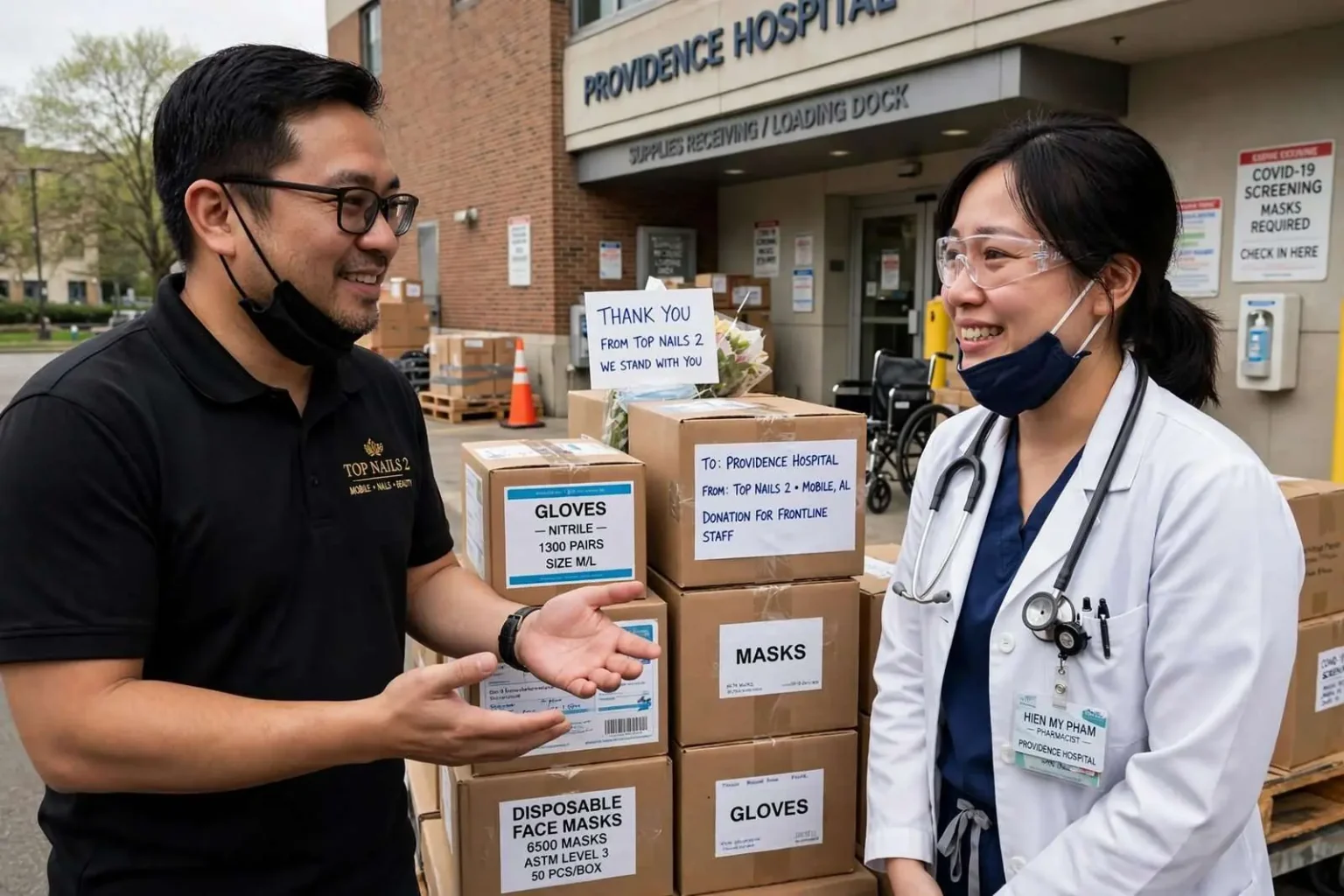
A Mobile nail salon has donated thousands of pieces of protective equipment to Providence Hospital, helping ease a supply crunch that has left many local healthcare workers scrambling to protect themselves as they treat patients during the coronavirus outbreak. Top Nails 2, a salon in the Vietnamese community that serves the greater Mobile area, delivered six boxes of gloves and five boxes of masks to the hospital over the weekend, according to hospital staff. Combined, the donation amounts to roughly 1,300 pairs of gloves and 6,500 masks now available to protect doctors, nurses and other frontline staff who have been working around the clock since the pandemic reached Alabama in the spring of 2020.
The gift came together after a Providence Hospital pharmacist grew increasingly troubled watching colleagues search for ways to protect themselves without adequate supplies on hand. “It broke my heart to see my health care family share ideas on Facebook about how to make masks from cloth and how to protect themselves,” said Hien My Pham, a pharmacist at the hospital. Across the country, hospital workers in the early weeks of the outbreak resorted to improvised face coverings, reused masks between shifts and turned to social media to ask for donations as federal stockpiles fell short of demand.
Pham said she began looking for a solution after seeing a story about a nail salon owner in the Northeast who had donated unused gloves and masks to hospitals facing shortages of their own. The idea clicked immediately. Nail technicians work with masks, gloves and other protective gear every day as a routine part of their services, meaning salons across the country already held inventory that hospitals desperately needed. Recognizing that many nail salons keep a supply of protective gear on hand for daily use, she reached out to salon owners she knew personally in the local Vietnamese community, hoping someone might be able to help.
Top Nails 2 owner Huy Nguyen did not hesitate, gathering the boxes of gloves and masks from his business and handing them over for Pham to deliver to the hospital. “We feel like it is our responsibility to share what we have to the community,” Nguyen said. His salon, like others in Mobile’s Vietnamese business community, had stocked up on masks, gloves and sanitizing supplies both for its technicians and for customers, and much of that inventory was suddenly idle as salons scaled back or shut down under public health orders meant to slow the virus’s spread.
For Pham, the response was overwhelming. “I just started crying. I said thank you so much,” she said. What had begun as a long-shot phone call to business owners she knew had turned into a meaningful infusion of protective equipment for a hospital whose staff had been watching supply estimates dwindle week by week.
An Easy Decision for the Salon
Nguyen said the decision to give away supplies the salon might otherwise need was an easy one, framing it as a matter of protecting the broader community from the spread of the virus. “If we do not help the nurse or the doctor or the hospital to stop the spread of this virus, then one day we will get that virus,” Nguyen said. The logic was straightforward: healthcare workers standing between the community and the outbreak needed the equipment more than a temporarily closed salon did.
The gesture also reflected the deep roots of Mobile’s Vietnamese community, which has grown into one of the city’s most visible immigrant communities over the past several decades. Vietnamese-owned nail salons, restaurants and markets are fixtures across Mobile and the surrounding suburbs, and community members have long organized around churches, family associations and local causes. When a call for help went out from inside Providence Hospital, it traveled quickly through personal networks that connected the hospital’s staff directly to the owners behind those businesses.
Part of a National Wave of Grassroots Giving
The donation reflects a broader wave of grassroots giving that emerged across the country in the spring of 2020, as nail salons, dentists, construction companies and other businesses that regularly use masks and gloves in their daily operations found themselves with supplies that hospitals and clinics urgently needed. With national distribution channels for personal protective equipment strained, many hospitals turned to their own communities to help close the gap. Requests went out through hospital foundations, social media groups and word of mouth, and businesses answered with whatever they had on hand.
The shortages that prompted such donations were unprecedented in modern healthcare. Demand for N95 respirators, surgical masks, gowns and gloves surged worldwide at the same time, tying up manufacturers and distributors and leaving even large hospital systems rationing supplies. Frontline workers in hard-hit regions wore the same mask for multiple shifts, and smaller community hospitals like those serving Gulf Coast cities often found themselves at the back of the line for resupply.
Providence Hospital, a longtime fixture in west Mobile, continued treating patients throughout the outbreak, and its staff — like healthcare workers everywhere — faced the dual challenge of caring for coronavirus patients while protecting themselves and their families. Pharmacists, nurses, physicians, housekeepers and technicians all depended on the same shrinking stockpile, which is why donations of everyday items like examination gloves carried outsized emotional weight inside the building.
For salons, the pandemic brought its own reckoning. Governors’ orders closed personal-care businesses across Alabama for weeks, leaving owners with payroll obligations, rent and idle inventory. Some, like Nguyen, chose to put their stockpiles to work in the fight against the virus rather than hold them for reopening day, joining dentists who donated nitrile gloves, tattoo parlors that shipped masks to distant hospitals, and construction firms that emptied job-site trailers for local clinics.
What Donations Like This Meant on the Ground
Healthcare workers across the Mobile area have continued to raise concerns about access to adequate protective equipment as they care for patients. Local business owners stepping forward with donations, however small, have helped provide some relief while larger supply chains work to catch up with demand. Each box of masks delivered to a hospital loading dock represented shifts that nurses could work with greater confidence, and each box of gloves extended the life of supplies that staff had been stretching for weeks.
Public health officials have emphasized that community partnerships of this kind complement, rather than replace, formal procurement. Hospitals continue to work through state and federal channels, distributors and new suppliers to rebuild inventories, while donations buy time and morale in the interim. The relationships forged during the shortage — between hospitals and the businesses around them — have also left behind networks that many communities expect to draw on again if future emergencies strain supplies.
For the staff at Top Nails 2, the weekend delivery to Providence Hospital was a simple act with a clear purpose. The salon’s gloves and masks moved from a shelf in a Vietnamese community business to the hands of Mobile doctors and nurses within days of a phone call, a turnaround that formal channels could rarely match. And for the pharmacist who made the call, the episode stands as proof that the fastest help sometimes comes not from a warehouse across the country, but from neighbors across town who see protecting healthcare workers as their own responsibility.
The Scale of the Shortage in Alabama
Alabama’s first confirmed coronavirus cases arrived in mid-March 2020, and within weeks the state had closed schools, restricted gatherings and ordered nonessential businesses to scale back. Hospitals were told to prepare for a surge that other states were already experiencing, conserving ventilators, converting rooms and postponing elective procedures to free up beds, masks and staff. Even as the Gulf Coast’s case counts initially lagged behind hot spots in other regions, the uncertainty made conservation of protective equipment a daily discipline for every department.
That preparation collided with a hard reality: the global supply chain for protective gear was itself in crisis. Manufacturers in the United States and abroad were running at capacity, but demand had multiplied several times over in a matter of weeks, and price gouging and counterfeit gear were creeping into the market. Hospital purchasing teams that once placed routine orders found queues stretching months long, and smaller orders were bumped in favor of bulk buyers. The result was that many facilities, including community hospitals, depended on improvisation — stretching supplies, screening visitors, and appealing to the public for help.
Those appeals worked in ways no one fully anticipated. Sewing groups produced cloth masks for visitors and nonclinical staff. Schools, churches and 3D-printing hobbyists fabricated face shields. And businesses like Top Nails 2, which had been sitting on commercial-grade supplies, became unexpected donors. The pharmacy staff member who reached out to salon owners was part of that larger pattern, but the speed and warmth of the local response still surprised her.
The masks and gloves that arrived from the salon also carried practical value beyond their count. Commercial salons stock the same categories of protective equipment hospitals use — nitrile and latex gloves, procedure masks and sanitizing products — so donated items could go straight into circulation without adaptation. That is not always true of community donations, which often require sorting and screening before clinical use.
A Community That Shows Up
Mobile’s Vietnamese community, centered along corridors in the western and central parts of the city, has built a strong commercial footprint over more than four decades, with family-run salons, restaurants and grocery businesses serving customers across the metro area. Community institutions, including churches and cultural organizations, have long channeled support to newcomers and to causes around the city. The quick answer from Top Nails 2 fit a pattern that longtime observers of the community describe as characteristic: when a personal connection asks for help on behalf of a shared institution, the response tends to come fast and without ceremony.
Hospital officials did not treat the donation as a one-time gesture but as an example of the kind of community relationship that sustains local healthcare in a crisis. Pharmacists, nurses and physicians who received the equipment passed their thanks back through the same personal channels that delivered it, closing a loop that began with a Facebook post about homemade masks and ended with boxes of professional-grade supplies on a hospital dock.
As the outbreak stretched on, stories like this one became the way many Gulf Coast residents made sense of an otherwise abstract crisis. The virus’s impact was measured in case counts and hospital capacity, but the response was measured in neighbors helping neighbors — a pharmacy team member moved to tears by a salon owner’s generosity, and a business community that understood, as Nguyen put it, that helping stop the spread today was the surest way to protect everyone tomorrow.