
Volunteers to Clean Headstones at Mobile National Cemetery for 9/11 Day of Service
Carry the Load, GEHA and the National Cemetery Administration are bringing volunteers to Mobile National Cemetery on Saturday to clean headstones and beautify the grounds as part of the nationwide 9/11 Day of Service and Remembrance.
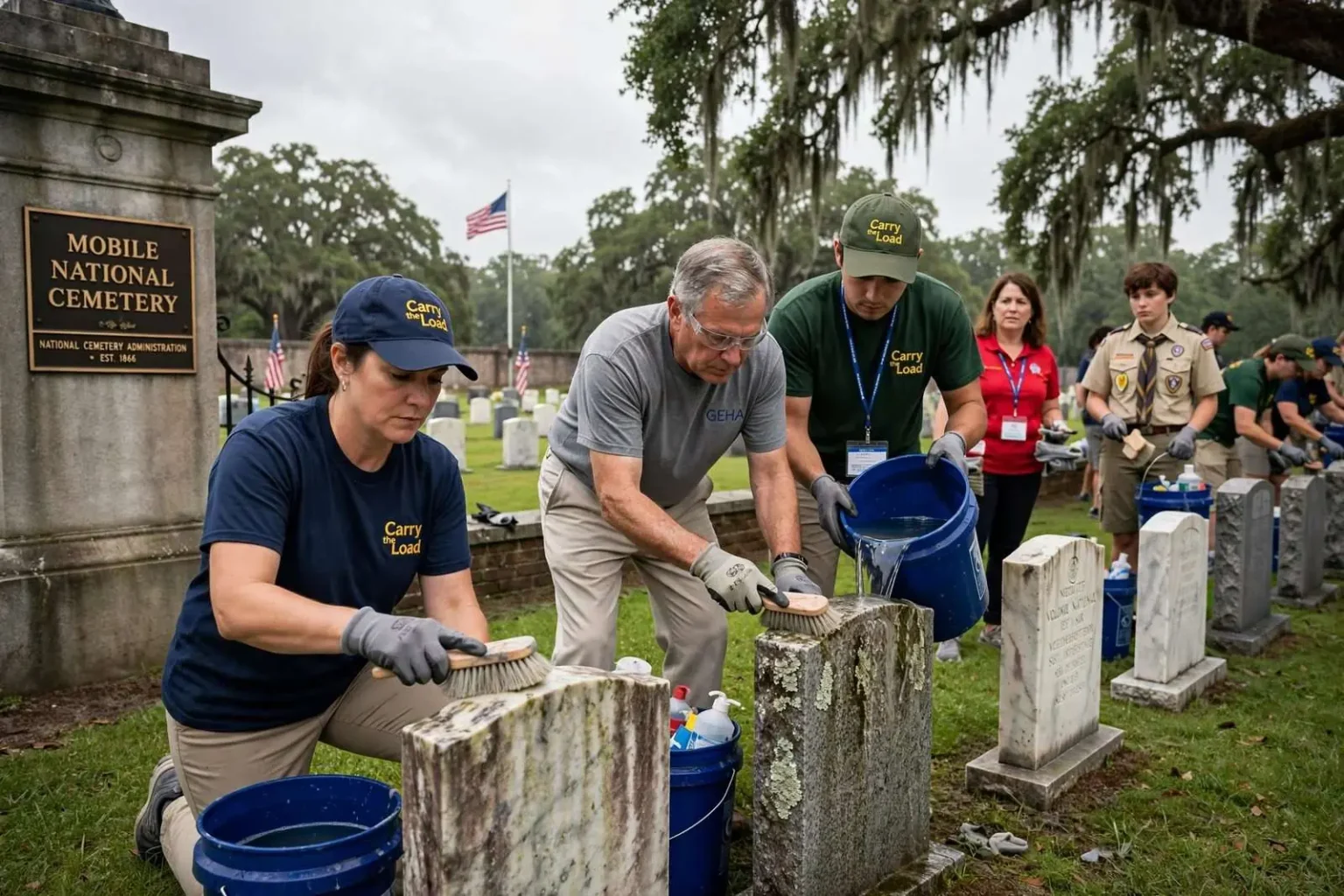
Volunteers will spend Saturday morning at Mobile National Cemetery cleaning headstones and tidying the grounds, turning the 25th anniversary of the Sept. 11 attacks into a few hours of physical work on behalf of the dead.
Local residents are set to gather Saturday, Sept. 12, in what organizers describe as an act of remembrance and service to the nearly 3,000 people killed in the terror attacks 25 years ago. The project runs from 10 a.m. to 1 p.m. at the cemetery, 843 Owens St. in Mobile. It is free and open to the public, but registration is required.
The Mobile event is one stop in a nationwide effort organized by Carry the Load, the Government Employees Health Association and the National Cemetery Administration. According to a news release, community members across the country are taking part in an event “designed to turn remembrance into action.”
Cleaning Stones as a Form of Memorial
On the 9/11 Day of Service and Remembrance, volunteers clean and restore headstones and beautify the grounds at cemeteries across the country, with particular attention to national cemeteries “where our heroes have been laid to rest,” according to the release.
“It’s a tangible act to honor the nearly 3,000 people who lost their lives on Sept. 11, 2001, and the military members and first responders who answered the distress call in the days and years that followed.”
The word doing the work in that sentence is “tangible.” Ceremonies produce a feeling; a cleaned headstone produces a cleaned headstone. It is a form of commemoration that leaves physical evidence behind, and one that scales — a hundred volunteers working three hours can restore a substantial section of a small cemetery in a single morning.
There is also a practical dimension. Marble and granite grave markers weather. In the Gulf Coast’s climate, with year-round humidity, heavy rainfall and long stretches of heat, headstones accumulate biological growth quickly. Lichen, algae and moss darken the stone, fill the engraved lettering and, over years, contribute to surface deterioration. Names become difficult to read. Dates disappear into the grain.
Cemetery preservation guidance generally calls for a conservative approach to that problem: clean water, soft-bristle brushes and patience, working from the bottom of the stone upward. Household cleaners, bleach, pressure washers and wire brushes are widely discouraged because they can etch, stain or permanently scar the stone. Volunteers at organized events are typically briefed on the correct method and supplied with the right tools, which is one of the reasons these projects are run as coordinated events rather than as informal drop-ins.
Who Is Behind the Effort
Carry the Load is a national nonprofit built around the idea of restoring meaning to days that have drifted toward the generic. The organization emerged from the veteran community with an initial focus on Memorial Day, arguing that a holiday widely treated as the start of summer had lost its connection to the people it exists to honor. Its signature activity is a long-distance relay that moves across the country each spring, with participants walking in memory of specific service members, first responders and their families.
The group’s programming has since broadened beyond Memorial Day into a year-round calendar that includes volunteer service projects, and cemetery restoration has become one of its recurring formats. The 9/11 anniversary is a natural fit for that model, both because of the National Day of Service designation attached to the date and because the attacks are inseparable from the first responder and military service that followed.
The Government Employees Health Association, generally known as GEHA, is a nonprofit that provides health and dental benefits to federal employees, retirees and their families. It is among the larger carriers participating in the federal employee benefits program, and it has an established record of sponsoring service projects oriented toward the federal and military communities it serves.
The National Cemetery Administration is the arm of the U.S. Department of Veterans Affairs responsible for the nation’s national cemeteries. It maintains more than 150 of them across the country, along with soldiers’ lots and monument sites, and it is charged with keeping those grounds to what the agency calls a national shrine standard — meaning headstones upright and legible, grounds maintained, and the overall appearance worthy of the people buried there. Volunteer partnerships are one of the ways that standard is sustained across a very large inventory of sites, many of them a century and a half old.
Mobile National Cemetery
Mobile National Cemetery sits on Owens Street, a modest, walled burial ground tucked into the city rather than set apart from it. Like most national cemeteries, it is administered by the National Cemetery Administration and holds the graves of veterans of American conflicts.
The national cemetery system itself dates to 1862, when Congress authorized the president to purchase land for the burial of soldiers who died in service during the Civil War. The system expanded rapidly during and after that war, and a number of the oldest national cemeteries, including several across the South, trace their origins to that period. Over the following century and a half the system grew to encompass burials from every subsequent American conflict.
Older, in-town national cemeteries like Mobile’s occupy a particular place in that story. They tend to be small, they tend to be full or nearly full, and they tend to hold the oldest and most weathered markers in the system — precisely the stones that benefit most from careful hand cleaning.
The Day of Service, Explained
The federal designation that frames Saturday’s project has a specific legislative history. Congress named Sept. 11 as Patriot Day in the months after the attacks, establishing an annual observance marked by flags at half-staff and a national moment of silence. In 2009, lawmakers went further, designating the date as a National Day of Service and Remembrance and formally encouraging Americans to observe the anniversary through volunteer work.
The reasoning behind that second designation was straightforward. The impulse that surfaced in September 2001 — the blood donation lines, the supply drives, the surge in enlistment and in applications to fire and police departments — was widely understood at the time as one of the few constructive things to come out of the day. The service designation was an attempt to give that impulse an annual outlet.
In practice, the designation now anchors a broad slate of volunteer activity nationwide each September, spread across food banks, veterans’ organizations, schools, disaster preparedness efforts and, increasingly, cemetery restoration projects like the one in Mobile.
What Volunteers Can Expect
Cemetery cleanup work is not strenuous in the way that, say, a build project is, but it is outdoor work in September on the Gulf Coast. Volunteers at events of this type generally find a few things worth planning for.
- Heat and humidity. A 10 a.m. to 1 p.m. window covers the warmest part of a Mobile morning. Water, a hat and sun protection are sensible.
- Closed-toe shoes. Cemetery ground is uneven, and older sections can have sunken areas around graves.
- Clothing that can get wet and dirty. Stone cleaning involves a great deal of water.
- Gloves, if you prefer your own. Organizers at these events typically supply brushes, buckets and cleaning materials.
- Instruction. Expect a briefing on proper technique before work begins. The rules exist to protect the markers.
The work is generally appropriate for a wide range of ages and physical abilities, and it is common to see families, scout groups, veterans’ organizations, civic clubs and school groups participating together. It is also, by most volunteers’ accounts, unexpectedly absorbing. Reading a name off a stone that has been illegible for years tends to land differently than reading one off a list.
Remembrance in Its 25th Year
The choice to mark the anniversary through service reflects where the observance sits after a quarter-century. The generation that experienced Sept. 11, 2001, as adults is moving toward retirement. The generation now entering the workforce has no memory of it at all. Ceremonies remain, but the emphasis in many communities has shifted toward participation — toward giving people something to do rather than something to watch.
The release’s language about the “military members and first responders who answered the distress call in the days and years that followed” points at that longer arc as well. The response to Sept. 11 did not conclude in September 2001. It extended through two decades of military deployments, through the illnesses that emerged among Ground Zero responders, and through the careers of people who chose fire service, law enforcement, emergency medicine or the military because of what they saw that morning. National cemeteries hold many of them.
How to Take Part
Saturday’s project at Mobile National Cemetery runs from 10 a.m. to 1 p.m. at 843 Owens St. in Mobile. There is no cost to participate and the event is open to the public, but organizers require advance registration, so prospective volunteers should sign up through the organizing groups rather than simply arriving on site.
For those unable to attend, national cemeteries accept volunteer support year-round through the National Cemetery Administration’s volunteer program, and Carry the Load maintains a calendar of service projects and relay events throughout the year. Local veterans’ service organizations in Mobile and Baldwin counties also organize periodic cemetery maintenance efforts, particularly around Memorial Day and Veterans Day.