Mobile Police Chase Ended in Prichard Crash in 2008
A developing 2008 WKRG report said a Mobile Police pursuit ended after a white car crashed on Wilson Avenue in Prichard, with two men taken into custody.
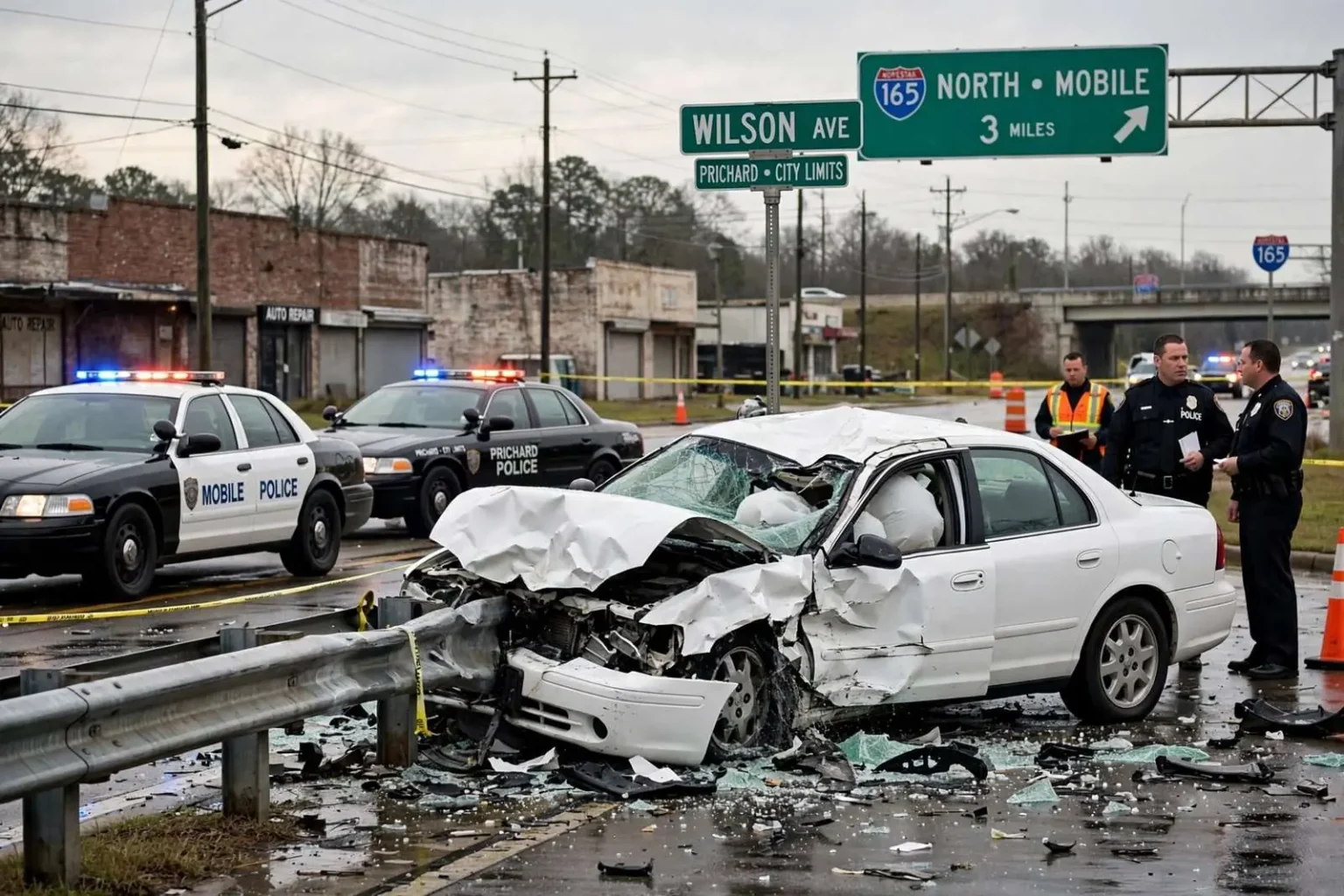
Mobile Police Chase Ended in Prichard Crash on Wilson Avenue in 2008
Originally reported February 28, 2008. A Mobile Police pursuit ended in Prichard after a white car crashed on Wilson Avenue near Interstate 165, according to a developing local news report from February 2008. The incident, which unfolded along one of the busiest corridors connecting the two cities, ended with two men taken into custody at the scene.
The report said two men were taken into custody following the crash. At the time of publication, authorities had not said why Mobile officers were pursuing the vehicle, leaving open the central question that developed stories like this one typically answer in later updates — what prompted the pursuit in the first place, and what charges the men taken into custody would ultimately face.
The station described the report as developing and said it would continue following the story. This historical update does not state later charges, findings or court outcomes, and it preserves the account exactly as it stood on the day the original report aired.
The Geography of a Pursuit Across City Lines
Wilsons Avenue cuts through the heart of Prichard, Alabama’s fourth-largest city at the time, and its intersection area near Interstate 165 made it a natural endpoint for a chase moving north out of Mobile. Interstate 165 runs from downtown Mobile to the edge of Prichard, feeding traffic into the city’s street grid, and Wilson Avenue carries a steady mix of commuter and neighborhood traffic through residential districts.
Pursuits that cross municipal boundaries are a recurring feature of policing in Mobile County, where the cities of Mobile and Prichard sit directly adjacent to one another and where county roads, state highways and interstates weave the two communities together. An officer from one jurisdiction can find himself chasing a vehicle into another agency’s city within seconds, triggering the coordination — and the jurisdictional questions — that such transitions always involve.
Under standard practice, the pursuing agency retains primary responsibility for a chase it initiated, while the agency whose city the chase enters is typically notified and may assist with the pursuit’s end, scene security and any additional arrests. The crash that ended this pursuit occurred in Prichard, which meant Prichard police and county emergency responders would have been part of the response even though Mobile officers had initiated the stop.
How Police Pursuits Worked in 2008
The pursuit policies of the era balanced two competing imperatives: apprehending a fleeing suspect and protecting the public from the dangers a chase creates. Departments across Alabama, including Mobile’s, maintained written pursuit policies that gave officers discretion to begin a pursuit based on the seriousness of the underlying offense, but required them to weigh traffic conditions, speeds, weather and the risks posed to bystanders as the chase continued.
By 2008, law enforcement nationally had already absorbed years of research showing that vehicle pursuits endanger the public far more often than they protect it, with a substantial share of pursuits ending in collisions and a significant proportion of those involving uninvolved motorists or pedestrians. That research drove steady tightening of policies in the years that followed, and departments increasingly emphasized alternatives — aerial support, spike strips, and in some cases the decision to break off chases involving minor offenses.
The Mobile Police Department, like other large municipal agencies in the state, reviewed pursuit incidents as a matter of routine, and any chase that ended in a crash would have generated internal documentation alongside the criminal case. What the original report could not say — because it had not yet been determined — was whether the pursuit in this instance complied with policy, and what the outcome of that review would be.
What Happens After a Pursuit Ends in Custody
When a pursuit concludes with an arrest, as this one did with two men taken into custody, a chain of legal processes begins. The suspects face immediate charges tied to the underlying reason for the stop, and fleeing or eluding an officer is itself a criminal offense under Alabama law, with penalties that escalate when the flight involves a vehicle and endangers others. Additional charges can follow — reckless endangerment, traffic violations, and any offenses discovered as a result of the stop.
Prichard crashes involving fleeing vehicles also bring insurance and liability questions for anyone hurt or whose property is damaged, and they frequently prompt scrutiny of the pursuit itself. In the months after an incident like this, the developing story would typically be filled in by court records: the charges filed, the names released, the dates of initial appearances. This article does not include any of those later details, because the preserved account does not contain them.
The two men taken into custody would have been booked into the county jail system, and the white car they were in would have been processed as evidence if the underlying case warranted it. Those mechanics were the same in 2008 as they are today, even as technology — dashboard cameras, GPS, automated license plate readers — has changed how pursuits begin and end.
Prichard in 2008
The Prichard of 2008 was a city working through decades of economic transition. Once a thriving industrial suburb of Mobile with a busy commercial core, it had lost population and businesses over the previous decades, and city government was wrestling with the budget pressures that followed. Public safety remained one of the city’s largest concerns and largest expenses, and its police department worked cases alongside the much larger Mobile Police Department just across the city line.
Wilson Avenue, where the white car crashed, runs through neighborhoods that knew the sound of emergency sirens as a routine part of city life. Intersections near the Interstate 165 connection see regular traffic accidents even in ordinary circumstances, and a crash involving a fleeing vehicle drew responses from across the city’s emergency services.
For residents of both cities, incidents like this one raised a familiar set of questions — how fast was the chase, through what streets, who was put at risk — that local news coverage of the era tried to answer as facts became available. The developing nature of the original report reflected that process in real time, with the station promising updates as authorities released more information.
The Unanswered Question: What Started the Chase
The most conspicuous gap in the original report was the reason for the pursuit. Chases begin for many reasons — a traffic violation the driver chose not to answer, a vehicle reported stolen, a driver suspected in another crime — and the underlying cause shapes everything that follows, from the charges filed to the department’s internal review. In 2008, as now, agencies typically did not release the reason for a pursuit until they had confirmed it, which could take days while reports were written and the vehicle was examined. Until that information was made public, neighbors were left to sort the confirmed details from speculation, which is precisely why the station labeled its report developing.
Why Historical Pursuit Reports Still Matter
An archived report like this one serves several purposes years later. For readers researching a family history, a legal question or the background of a particular neighborhood, it documents what was publicly known on a specific date — that a pursuit occurred, where it ended, and that two men were in custody. For anyone studying policing in Mobile County, it is a data point in the longer story of how pursuit practices evolved over the decades.
The account also illustrates the limits of breaking news. The original report said authorities had not disclosed why Mobile officers were pursuing the vehicle, and it made no claims beyond what had been confirmed at the time. That restraint is part of what makes such archives reliable: they record a moment without hindsight, without the charges and outcomes that later reporting would supply.
This article’s preserved account ends where the original reporting ended — with a white car crashed on Wilson Avenue near Interstate 165, two men in custody, and a station promising to continue following the story. Whatever came afterward, in courtrooms or in subsequent news coverage, is not part of this record.
A Note on This Historical Update
This article preserves a report originally published on February 28, 2008. It does not reflect current conditions, later investigative findings, charges, or court outcomes, and no conclusion should be drawn about the people involved beyond what the original account stated. Names were not released in the preserved report, and this update has not added any.
Readers seeking current information about police pursuit policies in Mobile or Prichard should consult those departments directly, as policies and leadership have changed many times since 2008. What this record documents is a single February evening — a chase that began in one city and ended in a crash in another, and the two men taken into custody when it did.