
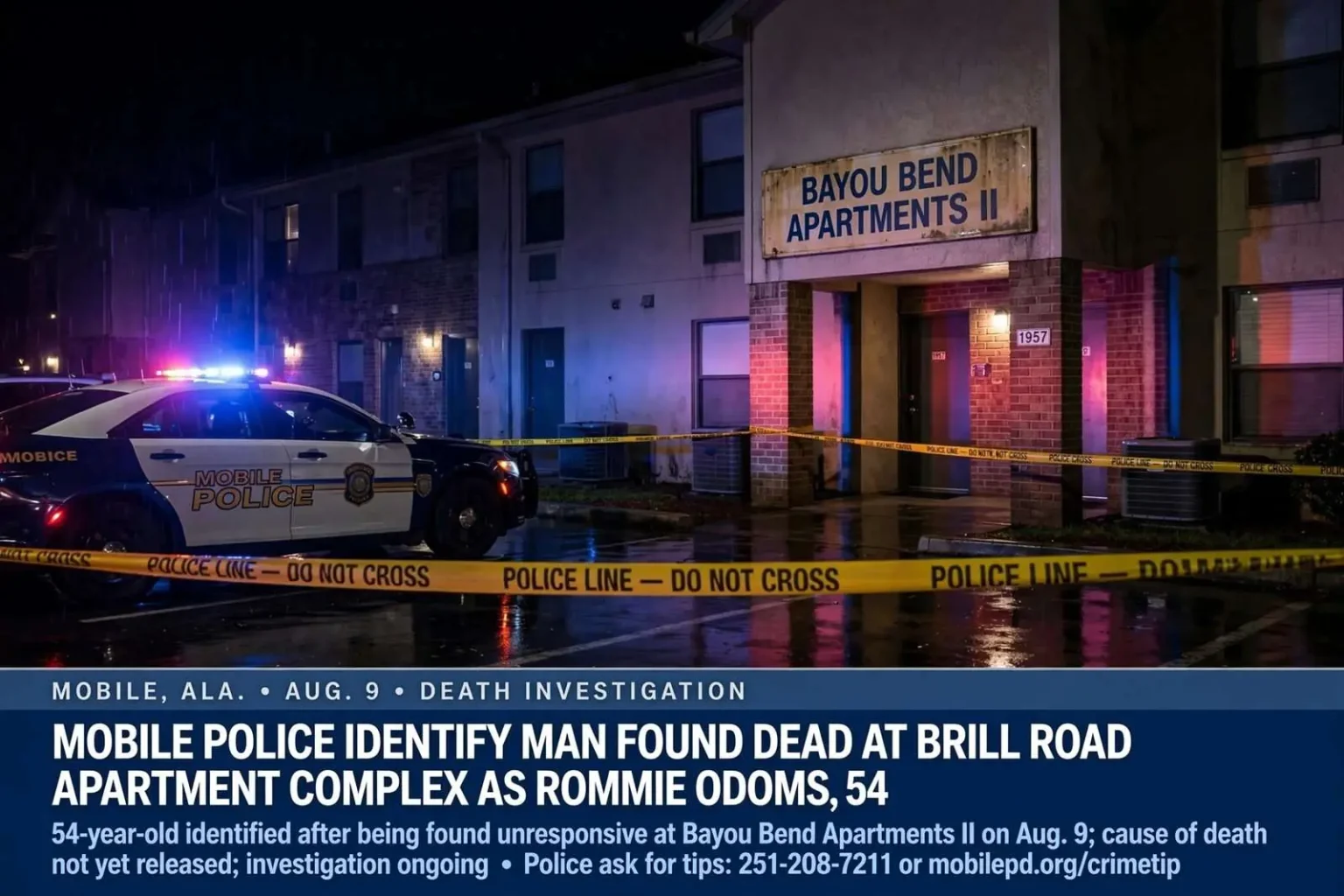
MOBILE, Ala. — Mobile police identified the man found dead at a Brill Road apartment complex earlier this month as 54-year-old Rommie Odoms. Officers were called to the Bayou Bend Apartments II in the 1957 block of Brill Road around 2:08 a.m. on Tuesday, Aug. 9, after a man was found unresponsive inside the complex. Medics took him to a hospital, where he later died. The Mobile Police Department has not released a cause of death, and investigators have not said whether foul play is suspected — both facts keeping the case officially an unexplained death rather than a declared homicide. The death remains under active investigation, and police are asking anyone with information to call Mobile police at 251-208-7211 or leave an anonymous tip at mobilepd.org/crimetip. Until the medical examiner’s findings are complete, the department’s public account of the case begins and ends with the call, the identification, and the appeal for information.
The sequence described in the police report — a pre-dawn emergency call, a man found unresponsive at an apartment complex, transport by medics, death at a hospital — is the standard opening of what detectives classify as a death investigation. In Mobile, as in other Alabama cities, an unattended death triggers parallel responsibilities: patrol officers secure and document the scene, investigators take over the inquiry, and the county coroner’s office assumes jurisdiction over the body. The determination of cause and manner of death — whether natural, accident, suicide, or homicide — belongs to the medical examiner, not the police department, which is why a department can truthfully say that no cause of death has been released and that foul play is not confirmed even weeks after the event. The autopsy and toxicology work behind those findings takes time, and nothing in the public record of this case indicates what those results will show.
The location — Bayou Bend Apartments II on Brill Road — sits in west Mobile, an area of apartment complexes, retail corridors, and neighborhoods stretching toward Theodore and Tillmans Corner to the south. Brill Road runs off Airport Boulevard, one of west Mobile’s principal east-west arteries, and the corridor around it is among the more densely populated parts of the city outside downtown. Apartment complexes in the area house a mixed population of families, workers, and older residents, and a death at one of them in the middle of the night naturally unsettles the community of neighbors, who are typically among the first people detectives canvass.
How a Death Investigation Proceeds
When police are called to an unresponsive person, the first responders’ priority is medical — medics attempt treatment and transport if there is any chance of survival. In this case, the man was taken to a hospital before he died, which means emergency room staff became part of the record: their observations of the body, any injuries noted on arrival, and the circumstances surrounding the death all enter the case file. Deaths that occur after hospital transport are handled through the same coroner and medical examiner process as deaths at the scene, but the hospitalization adds a layer of documentation that investigators review when they assess what happened.
The decision of whether a death involves foul play is made from evidence, not presumption. Detectives look at the scene — signs of disturbance, forced entry, or struggle — at the body — visible injuries inconsistent with natural causes — and at the man’s history and circumstances. Interviews with neighbors, family, and anyone who saw him in his final hours build the timeline that either supports a natural-death explanation or raises questions requiring deeper inquiry. The department’s statement that investigators have not said whether foul play is suspected reflects the middle ground of an open case: nothing announced, nothing ruled out, and the inquiry continuing until the evidence points one way or the other.
For the family of Rommie Odoms, the identification resolves one question — who died — while leaving the harder ones open. Families in these cases typically wait on the medical examiner’s findings for official confirmation of how their relative died, and police departments generally notify next of kin before releasing a name publicly, as was done here. The department’s appeal for information is directed in part at people who knew the man: friends, relatives, and acquaintances who may hold the details — his health, his routines, his recent contacts — that give investigators the context the physical evidence alone cannot supply.
Anonymous tips occupy an important place in cases like this one, whatever their eventual classification. The channel police publicized — mobilepd.org/crimetip, alongside the 251-208-7211 number — allows people who know something to pass it along without giving a name, which lowers the barrier for neighbors and acquaintances who might otherwise stay silent. Tips in death investigations frequently supply the small facts that never appear in a report: who visited the apartment in the days before, whether there had been an argument heard through the walls, whether the man had spoken of health problems or feared someone. Investigators weigh each tip against the physical and medical evidence, and in a case where the cause of death has not been announced, even apparently minor accounts can matter.
The mobile police department’s handling of the case follows a pattern residents of Mobile have seen before. When a death occurs that is not immediately explainable, the department’s public statements are deliberately spare — the location, the time, the identification, and the request for help — while the investigative substance proceeds without announcement. If the medical examiner’s findings eventually establish a natural cause, the case closes quietly. If instead the findings point to violence, the case converts to a homicide investigation, and the department’s messaging changes accordingly, with detectives re-interviewing witnesses and the appeal to the public intensifying. The open question in the Brill Road case is which of those two paths the evidence will take.
The Waiting Period for a Community
For the residents of Bayou Bend Apartments II, an unexplained death in the complex is unsettling precisely because it is unexplained. Neighbors typically learn of such events through police presence and word of mouth, and until authorities announce a cause, speculation fills the gap. Property managers and complex staff generally cooperate with detectives during the canvass, and residents who were awake in the early hours of that Tuesday — anyone who saw or heard something around 2:08 a.m. — are the witnesses most likely to hold useful information. The pre-dawn hour means many potential witnesses were asleep, which narrows the pool and raises the value of what any early riser or night worker may have noticed.
The case also illustrates the ordinary arithmetic of death investigation in a city Mobile’s size. Departments distinguish between deaths that are immediately apparent crimes, which launch homicide investigations on the spot, and deaths that require medical findings before classification, which stay in the death-investigation track. The latter category includes most unattended deaths — many of them ultimately natural, given the ages and health conditions of the people involved — and it is the medical examiner’s report, not early impressions, that sorts them. A 54-year-old man found unresponsive could fit any of the possible outcomes, which is exactly why the department has committed to neither.
What remains public in the case is the account police have given: Rommie Odoms, 54, found unresponsive at Bayou Bend Apartments II in the 1957 block of Brill Road around 2:08 a.m. on Aug. 9, transported to a hospital, and pronounced dead there; no cause of death released; no determination on foul play; the investigation active. The rest belongs to the medical examiner’s findings and to whatever the canvass of neighbors, friends, and family turns up. For now the department’s request stands: anyone who knows anything about the man or his final hours is asked to call 251-208-7211, or to leave what they know anonymously at mobilepd.org/crimetip, where the information will be worked into the investigation without their name attached.
Death investigations in apartment settings also carry a procedural dimension that shapes how quickly answers arrive. The scene inside an apartment is preserved until investigators have documented it, which can mean a unit sealed for days while technicians photograph and process it. Items collected — anything from medications to correspondence to trace evidence — go to the appropriate examiners, and the medical examiner’s office conducts the autopsy on its own schedule. Toxicology results, which screen for substances that could explain an unexplained death, are among the slowest findings and can take weeks. That pace frustrates families and neighbors, but it exists because the classification of a death — and any prosecution that might follow a homicide finding — depends on the accuracy of that work.
The wider Brill Road corridor has seen its share of the routine calls that fill west Mobile’s police blotter — disturbances, thefts from vehicles, domestic complaints, and occasional serious crimes at apartment properties along the road. Departments track that pattern when they assess a death: a location’s history is context, not conclusion, and investigators are careful to build each case on its own evidence. What matters for the Brill Road case is the specific record of Aug. 9 — the call at 2:08 a.m., the condition in which the man was found, the accounts of those who discovered him — and that record remains in the hands of investigators who have not yet shared their conclusions publicly.


