
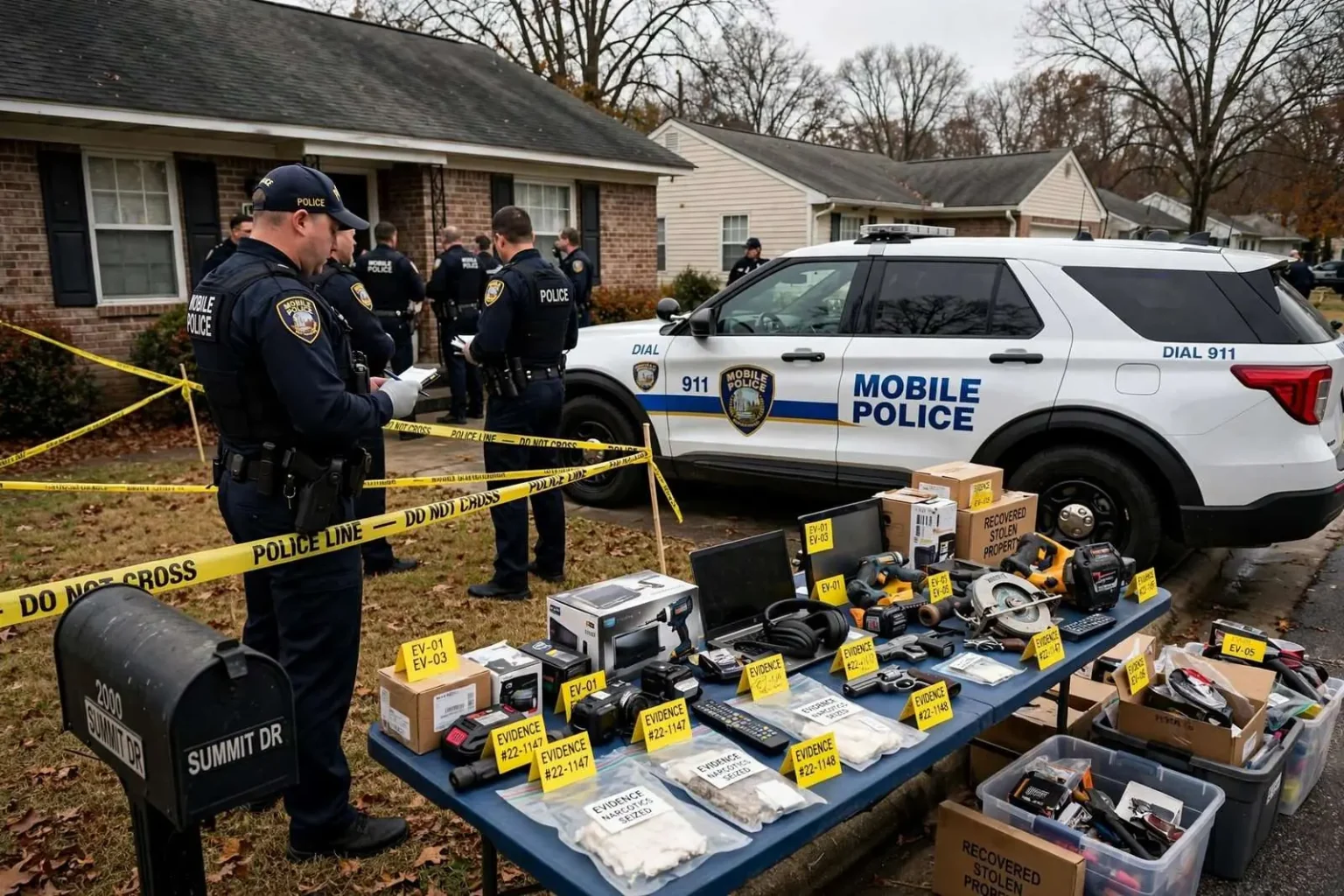
MOBILE, Ala. — A Mobile man is facing a long list of charges after police say a search of a home on Summit Drive turned up merchandise stolen from storage units, illegal drugs, firearms — and a baby left near the drugs. The Mobile Police Department said officers were sent to the 2000 block of Summit Drive on Wednesday, Nov. 16, 2022, after receiving a report about stolen items.
Using a search warrant, investigators searched the residence and recovered what police described as numerous items taken in previously reported storage unit burglaries. Officers also located drugs and guns during the search. What began as a property-crime follow-up escalated into a multi-layered case spanning burglary, narcotics and firearms charges — and a child welfare emergency in the middle of it.
A search warrant uncovers more than expected
The search warrant served on the Summit Drive home produced the kind of accumulation investigators rarely expect from a single residence. Property recovered at the scene matched items reported stolen in a series of storage facility break-ins across the area — the pattern of theft that initially drew detectives to the address. Alongside the stolen merchandise, officers located illegal drugs and firearms inside the home, adding narcotics and weapons charges to what had started as a burglary investigation.
The combination matters legally. Stolen property ties the suspect to the break-ins; drugs found in quantity with firearms nearby can elevate trafficking considerations under Alabama law, which treats the presence of a gun in a drug case as an aggravating factor; and the firearms themselves raise questions about possession by anyone legally barred from having them. Each recovered item becomes a separate thread for detectives to trace back to a reported burglary, a process that can expand the charge list well beyond the initial arrest.
Baby found near drugs
While carrying out the warrant, officers discovered a 2-month-old infant near drugs inside the home, according to the department. Police said the baby was returned to its mother. The discovery shifted the scene from a routine search to an emergency, and it is the detail likely to weigh heaviest in how the case is ultimately viewed — by prosecutors, by judges and by the community.
When children are found in proximity to drugs during a search, officers are required to loop in child welfare authorities, and Alabama’s dependency laws give the state broad authority to act where a child’s environment endangers them. In this case the infant was returned to the mother’s care, but the finding will remain part of the case record and may factor into any proceedings that follow from the drugs found in the home. It is also a stark reminder of what officers sometimes find behind the doors of ordinary residential streets: the 2000 block of Summit Drive sits in a quiet residential part of the city, the kind of neighborhood where a row of storage-unit burglaries seems impossibly distant until a search warrant reveals otherwise.
The arrest and the charges
Jason Secrest, 40, was arrested at the scene and booked on multiple charges, including burglary and drug-related offenses, police said. The full list of charges was not immediately available, which is common in complex searches: prosecutors typically wait to review everything recovered before deciding which counts to file, and detectives must first match recovered items to specific victims’ reports. A burglary charge under Alabama law carries serious potential prison time on its own, and each unit burglarized can support a separate count.
The arrest capped an investigation into a series of break-ins at area storage facilities, where suspects have repeatedly targeted units for tools, electronics and other resaleable goods. Storage facilities present a particular challenge for investigators: units are rented month to month, their contents vary widely from renter to renter, and victims often discover the theft days or weeks after it occurs — long after any trail has cooled. The recovery of numerous items inside a single residence suggests the kind of consolidated haul that lets detectives close multiple cases at once, returning stolen property to owners who had largely given up seeing it again.
Why storage units are targeted
Storage facility burglaries have grown into a recurring property-crime problem across the Gulf Coast and nationally. Units hold exactly what thieves want: power tools that resell quickly, electronics, televisions, furniture and boxes whose contents no one but the renter can readily identify. Facilities span acres of Roll-up doors that are individually secured but collectively vulnerable, and a single intruder who defeats the perimeter can work through many units in one visit. For victims, the loss is often double — the property itself and the records, keepsakes or tools of a trade stored inside.
Detectives did not say whether additional arrests are expected in the case, and the investigation remains open. When property from multiple burglaries surfaces in one search, investigators typically work backward through pawn records, online marketplace listings and victim reports to determine whether others participated in the break-ins or received the goods. That follow-up can produce further charges weeks or months after the initial arrest.
How the investigation came together
The path from a storage-unit burglary report to a search warrant runs through evidence work that most victims never see. Detectives collect facility surveillance footage, gate-access logs and victim inventories, then watch for items surfacing — at pawn shops, on resale apps or in conversations with informants. A report about stolen items led officers to the 2000 block of Summit Drive, and what they documented there supported a warrant. The raid’s yield — stolen merchandise, drugs, firearms — validated the investigative work that preceded it, and it illustrates why police ask burglary victims to record serial numbers and photograph valuables: those details are what allow recovered property to be matched, and charges secured, months later.
The Nov. 16 search also demonstrates the compounding nature of such cases. A single address produced evidence for multiple burglary cases, narcotics offenses and firearms scrutiny all at once, because the suspect’s alleged method — stealing from many units and consolidating the goods — left a single trail leading back to one home.
What residents can do
Anyone with information about storage unit burglaries or other property crimes in Mobile is asked to contact the Mobile Police Department or leave an anonymous tip with Mobile Area Crime Stoppers. Tips to Crime Stoppers can qualify for cash rewards when they lead to arrests, and the anonymity removes the hesitation many witnesses feel about getting involved in a neighbor’s case. In investigations like this one, tip information about who is selling suspected stolen goods — and where — is often the thread that unravels the entire operation.
Facility renters can reduce their own exposure as well. Locks rated for storage units, insurance riders covering stored property, and regular visits to check on a unit all help, and renters who notice damaged locks, cut hasps or unfamiliar foot traffic are urged to report it immediately rather than assume management is already aware. The rapid reporting that followed the earlier burglaries in this case is what ultimately built the file that brought officers to Summit Drive.
Secrest remains presumed innocent unless convicted, and the case will proceed through the Mobile County court system as charges are finalized. What police recovered on Nov. 16 — merchandise, drugs, firearms and an infant inches from danger — now forms the record that prosecutors, judges and possibly a jury will weigh. For the storage-facility victims across the area, the search marks the first real prospect of getting property back; for the neighborhood on Summit Drive, it was the day the quiet street learned what one of its homes had been holding.
The baby’s presence in the home also carries administrative consequences beyond the criminal case. Child welfare agencies document such findings, and the mother’s cooperation with any resulting safety planning typically determines whether the family remains together under supervision or faces dependency proceedings. Police did not identify the relationship between the mother and Secrest, and the department’s statement did not indicate whether additional adults were present during the search. The infant’s age — just two months old — made the discovery especially alarming, since newborns cannot move away from hazards and depend entirely on the adults around them.
Officers are trained to treat any child found at a drug scene as endangered until evaluated, and the return of the baby to its mother indicates authorities judged the immediate danger resolved once the scene was secured. The episode nonetheless becomes a permanent part of the record — both the criminal file and the child welfare file — and its circumstances will follow the case through the courts, where such findings routinely influence bond decisions and sentencing.


