
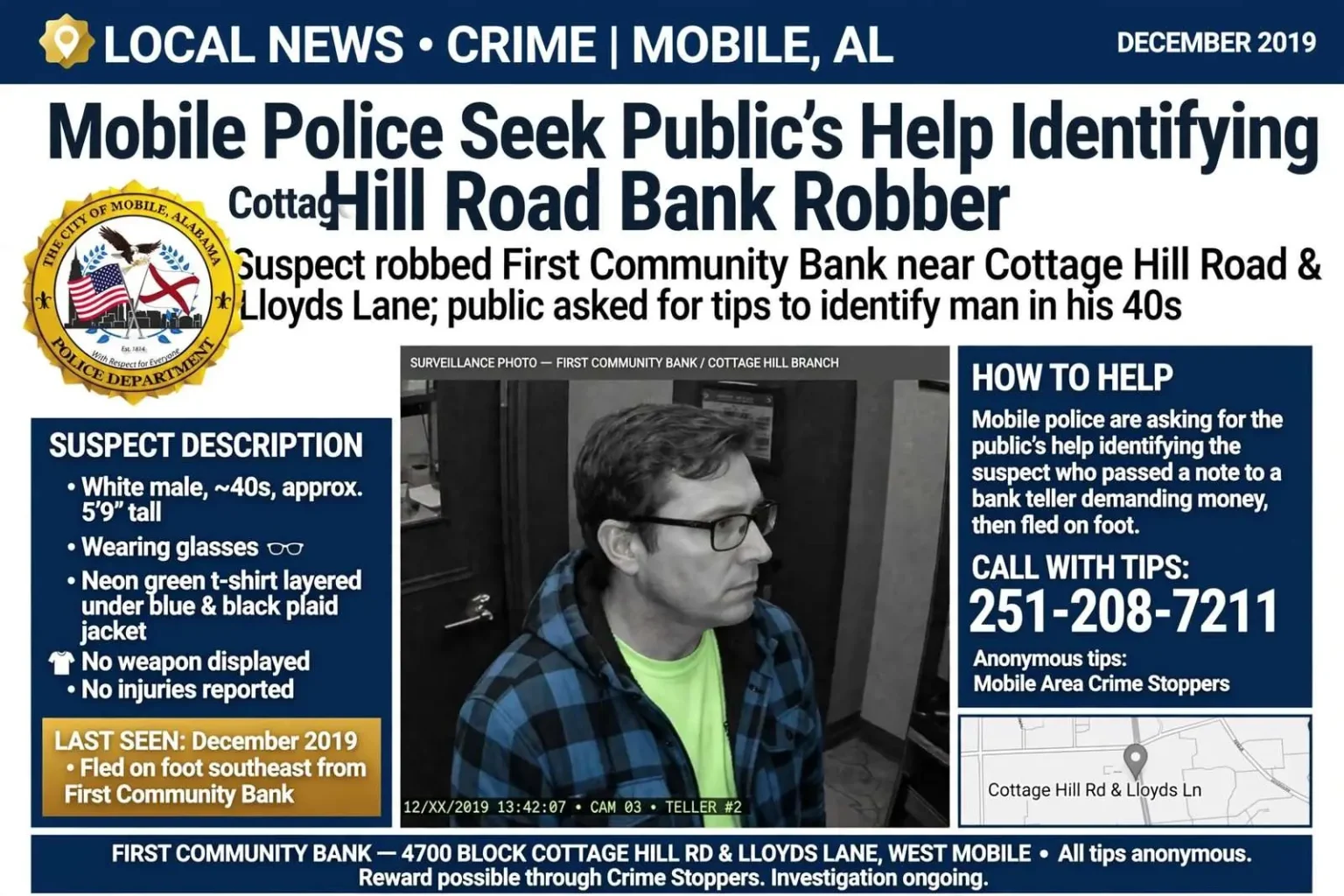
Mobile police are asking the public to help identify a man who robbed a bank near the intersection of Cottage Hill Road and Lloyds Lane in December 2019. According to investigators, the suspect walked into the First Community Bank branch and passed a note to a teller demanding money. The teller complied, handing over an undisclosed amount of cash before the man fled on foot. No weapon was displayed during the encounter and no one was injured.
Police described the suspect as a white male in his 40s, approximately 5 feet 9 inches tall, who wears glasses. At the time of the robbery he was dressed in a neon green t-shirt layered under a blue and black plaid jacket. Investigators released surveillance imagery from the branch and canvassed the surrounding West Mobile commercial corridor for witnesses.
Anyone with information that could help identify the suspect was urged to call the Mobile Police Department at 251-208-7211. Tips can also be provided anonymously through Mobile Area Crime Stoppers.
The note-passing robbery: a common playbook
The Cottage Hill Road robbery fits the most common pattern in American bank robbery. The majority of bank robberies involve no displayed weapon; instead, a robber passes a demand note to a teller, announces or implies a threat, and leaves quickly with whatever cash is in the drawer. Banks train tellers to comply with such demands, prioritizing the safety of employees and customers over the money, which is insured and replaceable.
The discipline explains why no one was injured in the December 2019 incident and why the amount taken went undisclosed. Bank robbery investigations typically withhold the exact loss figure — a practice that helps investigators verify any future confession against details only the robber would know. An undisclosed amount means anyone later claiming to be the robber cannot simply parrot a number from a news report.
Fleeing on foot is likewise typical for suburban branch robberies. Getaway vehicles draw cameras and witnesses; a robber who leaves on foot through a busy commercial corridor can blend into parking lots and side streets within minutes. But the strategy has a cost: without a vehicle, the suspect’s route was confined to the area around Cottage Hill and Lloyds Lane, which is why investigators concentrated their canvass there.
The Cottage Hill Road corridor
The intersection of Cottage Hill Road and Lloyds Lane sits in the heart of West Mobile’s retail belt, a corridor of shopping centers, branch banks, restaurants and medical offices stretching west from I-65. Cottage Hill Road carries tens of thousands of vehicles a day, and the commercial properties along it are lined with the parking-lot surveillance cameras that have become the backbone of property crime investigations in the area.
First Community Bank is a Mobile-based community bank with branches across the Gulf Coast, and its Cottage Hill branch sits amid that dense retail environment. Branch banks in commercial strips face a particular exposure: their lobbies are open to anyone walking in from a parking lot, and a midday robber can arrive and leave without a car ever appearing on a camera.
Why cold cases like this return to the public
Bank robbery cases are often solved weeks or months after the crime, when a tip connects a face to a name — a robbery pattern that continues, an arrest for another offense, or an acquaintance who recognizes the clothing. That is why Mobile police have kept the Cottage Hill Road case active in their public appeals rather than letting it fade with the news cycle.
The suspect description remains specific enough to act on: a white male in his 40s, about 5 feet 9 inches tall, wearing glasses, dressed in a neon green t-shirt under a blue and black plaid jacket. Someone who knows a man matching that description who came home with unexplained cash that December, or who saw him near the Cottage Hill and Lloyds Lane intersection on the day of the robbery, holds the detail detectives need.
Mobile Area Crime Stoppers offers a channel for exactly that kind of reluctant witness. Tips submitted through the program are anonymous by design — callers receive a tip number instead of giving a name, and reward payouts are arranged without revealing the tipster’s identity. The program has operated in the Mobile area for decades and regularly clears cases ranging from robberies to homicides on tips that callers would not make directly to police.
The Mobile Police Department’s tip line at 251-208-7211 remains the direct alternative for callers willing to identify themselves. Both routes feed the same investigative process: tips are logged, cross-checked against the case file, and run down by the detectives assigned to the robbery squad.
How bank robbery investigations work
Bank robbery carries federal consequences, which shapes how these cases are built. Because most banks are federally insured, robbery of a branch can be prosecuted in federal court under federal bank robbery statutes, and the FBI’s Mobile field office routinely works such cases alongside MPD. The result is a two-track investigation: local detectives develop the local leads, and federal prosecutors often take the case once a suspect is identified — with sentencing exposure measured in years or decades under federal guidelines.
That exposure matters even in a note-passing robbery with no weapon displayed. Federal sentencing for bank robbery is driven by the loss amount and by enhancements for threats, weapons and restraint, but the baseline for any conviction runs measured in years. The severity is one reason bank robbery clearance rates are comparatively high: the crime’s seriousness justifies the sustained investigative effort that pawn-shop thefts or shoplifting cases rarely receive.
Surveillance imagery is the other pillar of these investigations. Modern branch banks record high-resolution footage of every teller interaction, and the released photos from the Cottage Hill branch preserved the suspect’s most identifiable features — the glasses, the jacket, the build. Investigators distribute those images to other agencies, check them against known offenders, and hold them for comparison against future suspects, since robbers who remain free tend to offend again.
What West Mobile residents can do
For people who work or shop along Cottage Hill Road, the case is a reminder of how much information passes unseen through a commercial corridor. Employees at the shops around Lloyds Lane see the same faces every week; residents of the neighborhoods behind the retail strip see who cuts through their streets. A man on foot carrying cash away from a bank branch that December morning crossed paths with someone — a delivery driver, a neighbor, a fellow shopper — who may still remember the moment without knowing its significance.
Mobile police ask anyone with that memory, however fragmentary, to call 251-208-7211 or submit an anonymous tip through Mobile Area Crime Stoppers. The suspect who passed a note at the First Community Bank branch near Cottage Hill Road and Lloyds Lane in December 2019 has remained unidentified for years — but the surveillance images, the description and the tip channels remain open, and bank robbery cases have a way of closing on the strength of a single phone call.
The area around Cottage Hill and Lloyds Lane has seen its share of commercial crime over the years, and Mobile’s westside precinct has adjusted patrols accordingly. Retail corridors concentrate cash-handling businesses — banks, pharmacies, restaurants — and the same foot traffic that supports them offers cover for opportunistic offenders. Detectives assigned to robbery cases in the corridor work a rotating list of surveillance contacts, which is how imagery from a single branch robbery expands into a canvass of the surrounding blocks.
What happens when a tip comes in
When someone calls 251-208-7211 or submits a Crime Stoppers tip about the Cottage Hill Road robbery, the information enters a structured process. Call takers log the details verbatim and pass them to the case detective, who checks the tip against what the investigation already holds — the surveillance images, the timeline, the undisclosed loss amount. A credible tip that names a suspect triggers the next tier: criminal history checks, additional surveillance, and interviews that can turn an anonymous voice into a prosecutable case.
Rewards from Crime Stoppers are paid only when a tip leads to an arrest or case clearance, and the program’s board approves the amounts. The anonymity protections are what make the system work in cases like this one, where the person who recognizes the man in the plaid jacket may be a relative, a coworker or a neighbor who does not want that recognition attached to their name.
Keeping the case visible
Years after the December 2019 robbery, the case remains in Mobile police’s public appeals — a decision that reflects both the unsolved status and the durability of the evidence. Surveillance photographs do not expire, and a description as specific as a white male in his 40s, roughly 5 feet 9 inches tall, who wears glasses and was dressed in a neon green t-shirt under a blue and black plaid jacket, stays usable as long as someone out there can match it to a face.
The First Community Bank branch near Cottage Hill Road and Lloyds Lane continues to operate in the same busy West Mobile corridor, its tellers trained in exactly the protocol that kept the December 2019 encounter injury-free: comply, stay calm, and let the cameras and the investigators do the rest. The man who passed the note that day left with an undisclosed amount of cash and, so far, with his identity intact — a status that changes the moment the right call reaches 251-208-7211 or the Crime Stoppers line.


