

When Roy Clark became a bartender, he didn’t think he’d have to do this much math.
But there he was, calculating how to turn a recipe for one tiki cocktail with 12 ingredients into a batch of 64 drinks — figuring the volume of each component, including one that measures only half a teaspoon, then scaling it up incrementally to fill liter-sized vessels. “Math was always my worst subject,” said Clark, general manager of The Haberdasher, laughing. Yet the process had to be repeated for the entire specialty menu his team built for Mobile Tiki Week. Batching, it turns out, is the only way to survive a tiki week.
A Week of Island Time Downtown
Taking place Aug. 17-22 this year, Mobile Tiki Week is a community-wide celebration of island-inspired drinks, food and culture that swept up 43 official venues — bars, restaurants, coffee shops and breweries across downtown. Every locale is listed in a free Mobile Tiki Week “passport” that visitors can have stamped at each stop, turning the week into a scavenger hunt for adults with a taste for rum.
Each venue creates a specialty drink or a full menu for the occasion. The range is enormous: a small-batch pineapple beer at one stop, an extravagant pu pu platter at the next, a flaming punch bowl sized for six to share somewhere else. Many venues deck their interiors in South Seas décor — The Haberdasher transforms itself into a series of 1950s-era tiki huts, thatched roofs included — and MOB City Rides turns its fleet of golf cart taxis into land-roving party barges.
The Man Behind the Madness
Clark is not just a participant; he is the founder. Each summer since 2013, he has showcased tropical libations rooted in historical recipes at an annual “tiki week” at The Haberdasher. In 2017, he expanded “Haberdasher Tiki Week” into “Mobile Tiki Week,” which has grown into one of downtown’s most anticipated summer traditions.
“I’m really happy how organically it’s grown,” Clark said. “Aside from the first year or two that I decided to bring on other bars, we’ve rarely asked anyone to participate; they’ve all come to me wanting to be a part of it.”
“I think that translates into more businesses actually being stoked to do Mobile Tiki Week, not just feeling obligated to. Hopefully that excitement will come out through the drinks and food and the general atmosphere we’re all collectively creating that week.”
The week has proven to be a boon for downtown venues, arriving at the moment when summer business tends to slow after school starts. Yet in late August it is common to see aloha-shirt-wearing packs of imbibers roving downtown, getting their passports stamped to prove they ate and drank as much as they could. Clark said people travel from New Orleans, Birmingham and Pensacola to take part — and some locals go further, using vacation time and booking hotel rooms downtown for a longer stretch of tiki.
“It’s all about the drinks and food and dressing up festively to escape the muggy doldrums of late summer,” he said.
Giving Back to the Gulf Coast
The celebration has a charitable streak. At the end of Mobile Tiki Week, participating businesses are asked to donate a portion of their sales to Feeding the Gulf Coast, the local food bank. In 2025, those donations totaled $4,952 — real money for a food security organization, raised one tiki drink at a time.
The Haberdasher: Unofficial Headquarters
The Haberdasher is the unofficial HQ of Mobile Tiki Week, and participants tend to stop in at least once during the week to see what’s new on the bar’s elaborate menu. That is why batching — measuring out ingredients ahead of time in large quantities — is essential there. The bar can sell hundreds of tiki drinks in a single night; last year it sold more than 2,200 specialty cocktails over the course of the week.
“We would never be able to put out the volume of drinks that we put out, to service the number of customers that come through, without batching,” Clark said. “We’re able to make about double the amount of drinks we would otherwise. Over the course of an eight-hour service, that’s huge.”
The show is preserved, though. Drinks are still shaken and garnished in front of the customer — one of the iconic elements of tiki is the spectacle, and Clark loves to put on a show.
A Student of the Craft
Clark grew up in Irvington and, after school, dedicated himself to playing punk music. He fell into bartending as a way to make steady cash and as another creative outlet. Once he mastered classic cocktails — typically three- or four-ingredient drinks — he wanted something more complex. For him, that was tiki, which boomed in post-war America and enjoyed a major resurgence in the 2010s.
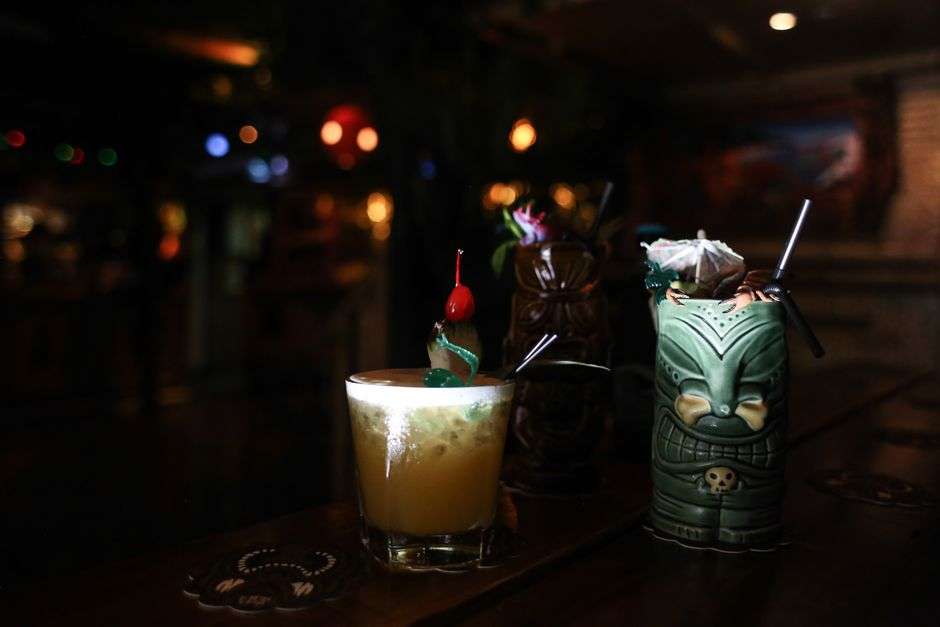
Tiki drinks are characterized by long lists of tropical ingredients, boozy rum bases and spectacular garnishes, drawing heavy inspiration from Polynesian aesthetics.
“The early creators of tiki cocktails like Trader Vic and Don the Beachcomber were doing craft cocktails before that was a thing,” Clark said. “They were playing with what at the time were exotic ingredients like fruit juices that were unheard of or hard to come by in the ’30s, ’40s and ’50s. I can only imagine what they would have been able to come up with given the amount of ingredients that we now have access to in this country. It would be amazing.”
Beyond the cocktails, the aesthetics of tiki culture intrigued him as well — not the colorful shirts, which he avoids, typically wearing all black, but the moody ambiance and the skull motifs.
“Tiki has an escapist, tropical atmosphere,” he said. “There’s something a little dark and brooding and dangerous about it, too.”
Where Tiki Week Goes Next
Asked where he sees the festival heading, Clark pointed toward education: events, speakers and seminars on the history of tiki in America, the indigenous cultures and art that inform the tiki aesthetic, and cocktail classes.
After finishing his batching calculations at The Haberdasher, Clark drove his pickup across downtown to Monroe’s Pub and Patio in the Leinkauf Historic District, another Tiki Week venue. There, bar manager Clark Wortham was testing tropical drinks for his specialty menu and looking for feedback.
“That’s Mr. Tiki, that’s Roy the Beachcomber!” Wortham called as Clark approached the bar. “The hardest-working man in Mobile.”
One of Wortham’s creations mashed up two tiki classics: the Queen’s Park Swizzle — rum, lime, bitters and mint — and the Missionary’s Downfall, a blend of rum, peach, pineapple, honey and mint.
“To me, it kind of tastes a little flat, and I can’t figure out what to add to it,” Wortham said.
He prepared the drink and pushed it across the bar to Clark.
“It’s a good start,” Clark said after a few sips. He suggested infusing the honey syrup with fresh mint for brightness. “I also think you could do more rum.”