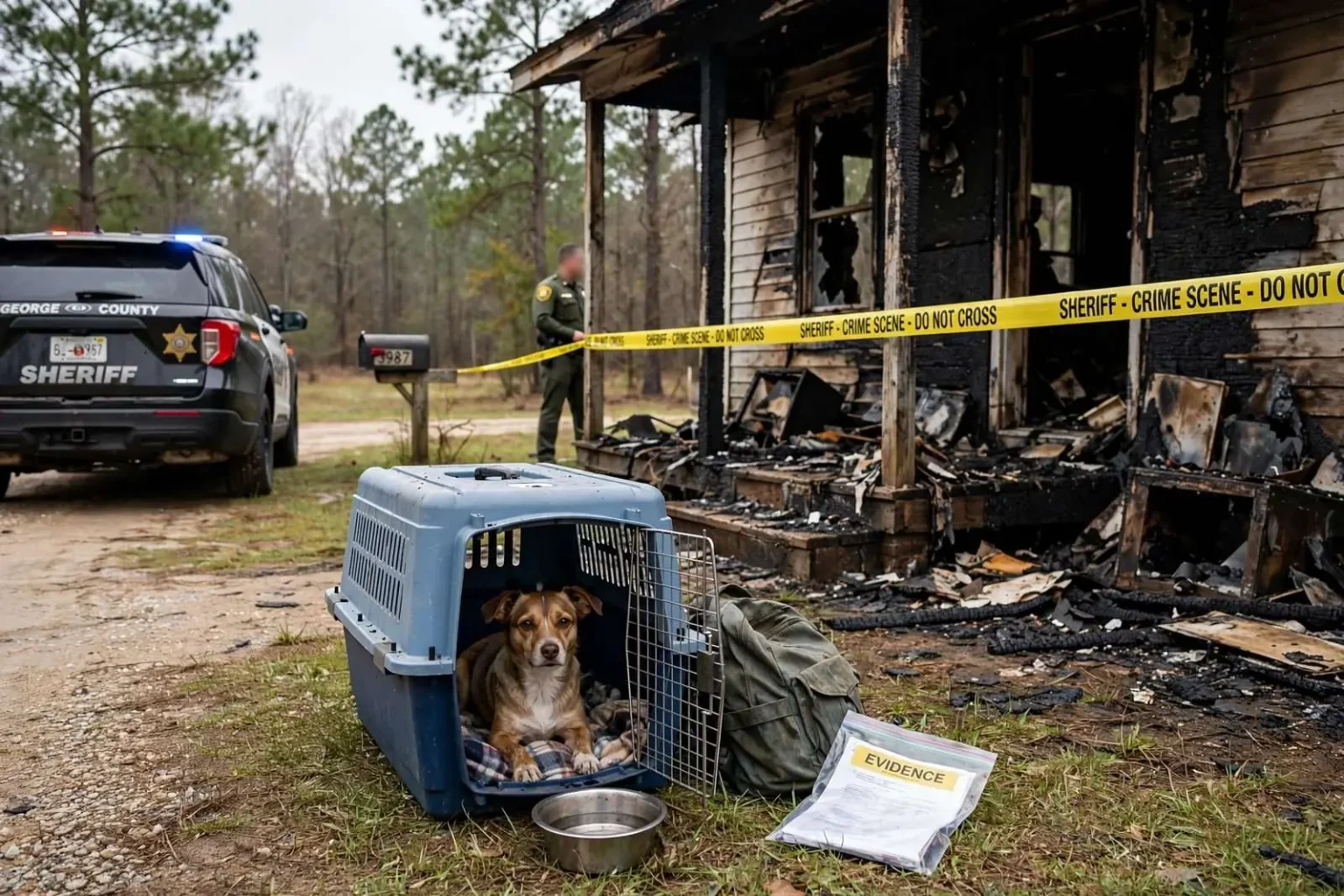
GEORGE COUNTY, Miss. — A Mobile woman is facing arson, property damage and animal cruelty charges following an incident at a home where she had been staying, according to the George County Sheriff’s Office. Deputies were called last Friday about a woman accused of damaging and burning a homeowner’s property. Investigators identified her as Maria Lewis, 55. The case stretches across state lines in a familiar way — a Gulf Coast resident involved in an incident just over the Alabama line, in one of southeast Mississippi’s rural counties — and it now moves through the Mississippi court system rather than Alabama’s.
According to investigators, Lewis had been staying at the residence and was in the process of being evicted. They allege she caused several thousand dollars in damage and set additional items on fire. Deputies also say Lewis placed her small dog in a carrier and left it in the woods without food or water. A neighbor found the animal the following day, and the dog was recovered alive — an ending that animal control officers say is far from guaranteed when a pet is abandoned in heavily wooded country, where predators, heat and dehydration pose immediate threats.
A judge set bond at $20,000 for malicious mischief and $25,000 for arson. Lewis remained in the George County jail. The bond amounts reflect the two charges separately, with the arson count carrying the higher figure, and they place the combined cost of pretrial release at $45,000. Whether bond is eventually reduced, posted or modified will depend on Lewis’ counsel and the court’s review of her ties to the area and her likelihood of appearing for trial.
The Charges Under Mississippi Law
Mississippi treats arson as a felony, with penalties scaled to the type of structure involved and whether anyone was placed at risk. The state’s arson statutes distinguish between occupied dwellings, unoccupied buildings and personal property, and the potential sentence rises with the danger the fire created. When a fire is set at a residence — even one with no one inside at the time — prosecutors weigh the risk to surrounding structures and to the people next door, which is why arson counts typically carry more substantial bond amounts and exposure than the property damage counts filed alongside them.
Malicious mischief, the property damage charge in this case, covers the willful destruction of another person’s property, and its severity in Mississippi scales with the value of what was destroyed. Investigators here alleged several thousand dollars in damage, which places the alleged conduct in the felony range rather than misdemeanor territory. Combined with the arson count, the state’s case will rest on establishing not just that the damage and fire occurred, but that Lewis intentionally caused them — the element that separates a felony conviction from a civil dispute over a damaged rental.
Animal cruelty charges in the state likewise carry escalating consequences depending on the circumstances and whether the conduct is found to have been aggravated. Mississippi strengthened its animal cruelty laws in recent years, and leaving an animal confined without food or water falls squarely within the conduct those statutes target. The fact that the dog survived and was found quickly by a neighbor shapes how that count proceeds, since aggravated outcomes — injury or death of the animal — would have raised the potential penalties considerably.
Eviction and Property Crime
Evictions produce a disproportionate share of property crime calls nationally, and the timing described by investigators here — damage occurring as a tenancy ended — is a pattern law enforcement encounters regularly. Deputies responding to an eviction-adjacent complaint are documenting a scene that may become evidence, separating the landlord’s losses from normal wear, and identifying witnesses among neighbors who observed the activity. That documentation matters doubly in cases like this one, where the difference between a civil eviction dispute and criminal charges turns on what was intentionally damaged or burned.
That context does not resolve the case, but it does explain why deputies pursued charges quickly once the connection was established. The allegations have not been proven in court, and Lewis is presumed innocent unless and until convicted. From here, the case follows the ordinary path of a Mississippi felony prosecution: an initial appearance, formal charges filed by the district attorney, and a preliminary setting before the case moves toward trial in George County Circuit Court. Until then, the account from the sheriff’s office remains an allegation, and the bond amounts and jail status are procedural measures rather than findings of guilt.
Property owners in eviction situations have practical steps available as well. Mississippi landlords proceed through the justice court system to remove a tenant, and documenting the condition of the property before and after a tenancy — with dated photographs and a written inventory — protects both sides if a dispute turns criminal. Law enforcement officers responding to an eviction-related call rely heavily on that documentation to sort allegations into civil claims and criminal charges, and cases like the one filed in George County typically move forward on the strength of it.
George County and the Gulf Coast Law Enforcement Network
George County sits in southeast Mississippi, with its county seat at Lucedale along the U.S. 98 corridor that links Mobile to Hattiesburg. The county borders Alabama’s Mobile and Washington counties directly, and its sheriff’s office handles a rural jurisdiction where deputies cover long distances between communities — the kind of territory where a single residence incident draws a response from across the county. Cross-border cases like this one are common enough along the state line that agencies there routinely coordinate with Alabama counterparts on warrants, records and suspect locations.
The George County jail, where Lewis remained held after her bond was set, serves as the county’s primary detention facility, holding inmates awaiting trial alongside those serving shorter sentences. In rural Mississippi counties, jail capacity is limited and pretrial detention carries real costs to the county, which is part of why bond hearings weigh whether a defendant can be safely released under conditions rather than held at taxpayer expense. The $45,000 combined bond in this case gives the court leverage to ensure appearance at trial while the charges are litigated.
For Mobile-area readers, the case is a reminder that the Gulf Coast’s population flows freely across the state line — for work, family and housing — and that legal trouble follows the person, not the home state. A Mobile resident charged in Mississippi faces Mississippi’s courts, Mississippi’s bond structure and, if convicted, Mississippi’s sentencing ranges, which differ from Alabama’s in the details even where the offenses share names.
Fire Risk and Property Safety
Residential fires in the Mobile area highlight the importance of working smoke detectors, accessible fire hydrants, and rapid emergency response. The absence of occupants in this incident was fortunate, but the damage underscores the vulnerability of residential structures. A fire set inside or alongside a home moves through furnishings faster than most people expect, and volunteer fire departments in rural counties like George operate with longer response times than city companies — which is why early detection and prevention carry even more weight outside city limits.
Homeowners are encouraged to review their fire safety plans and maintain appropriate insurance coverage. That includes testing smoke detectors on every level of the home, keeping documentation and photographs of furnishings and belongings that would be needed for an insurance claim after a fire, and knowing what a homeowner’s or landlord’s policy covers when damage is caused deliberately by a tenant or guest. Insurers handle deliberately set fires differently from accidental ones, and the documentation owners can produce — inventories, receipts, photos — often determines how a claim is resolved after a criminal case ends.
The dog found alive in the woods the day after the incident closes out the part of the case with a recoverable victim. The animal, now in the care of those who found it, will not testify, but its condition — fed, watered and healthy enough to be found alive — is now part of the record the animal cruelty charge will be argued around. Neighborhood awareness played the decisive role in that recovery, and deputies have pointed to the neighbor’s discovery as the reason the animal survived: in rural areas where an abandoned pet may go unseen for days, the difference between a finder and a scavenger is usually a matter of hours.
The case now rests with the George County court system, where the three charges — arson, malicious mischief and animal cruelty — will each require the state to prove intent beyond a reasonable doubt. The facts alleged are straightforward: damage as an eviction proceeded, a fire that followed, and a pet left to fend for itself in the woods. How a jury weighs them, and what sentence Mississippi law would impose on a conviction, remains ahead. For now the record shows a Mobile woman jailed in Lucedale under $45,000 bond, a homeowner assessing several thousand dollars in losses, and a small dog that lived because a neighbor went looking the next morning.