On Mon Louis Island, a Husband-and-Wife Chef Team Serves Fifteen Guests at a Time
Once a month on a pier at the edge of Mon Louis Island, chefs Amber and Hunter Harris set a long table for fifteen and serve a five-course menu built around Mobile Bay seafood. Every dinner sells out.
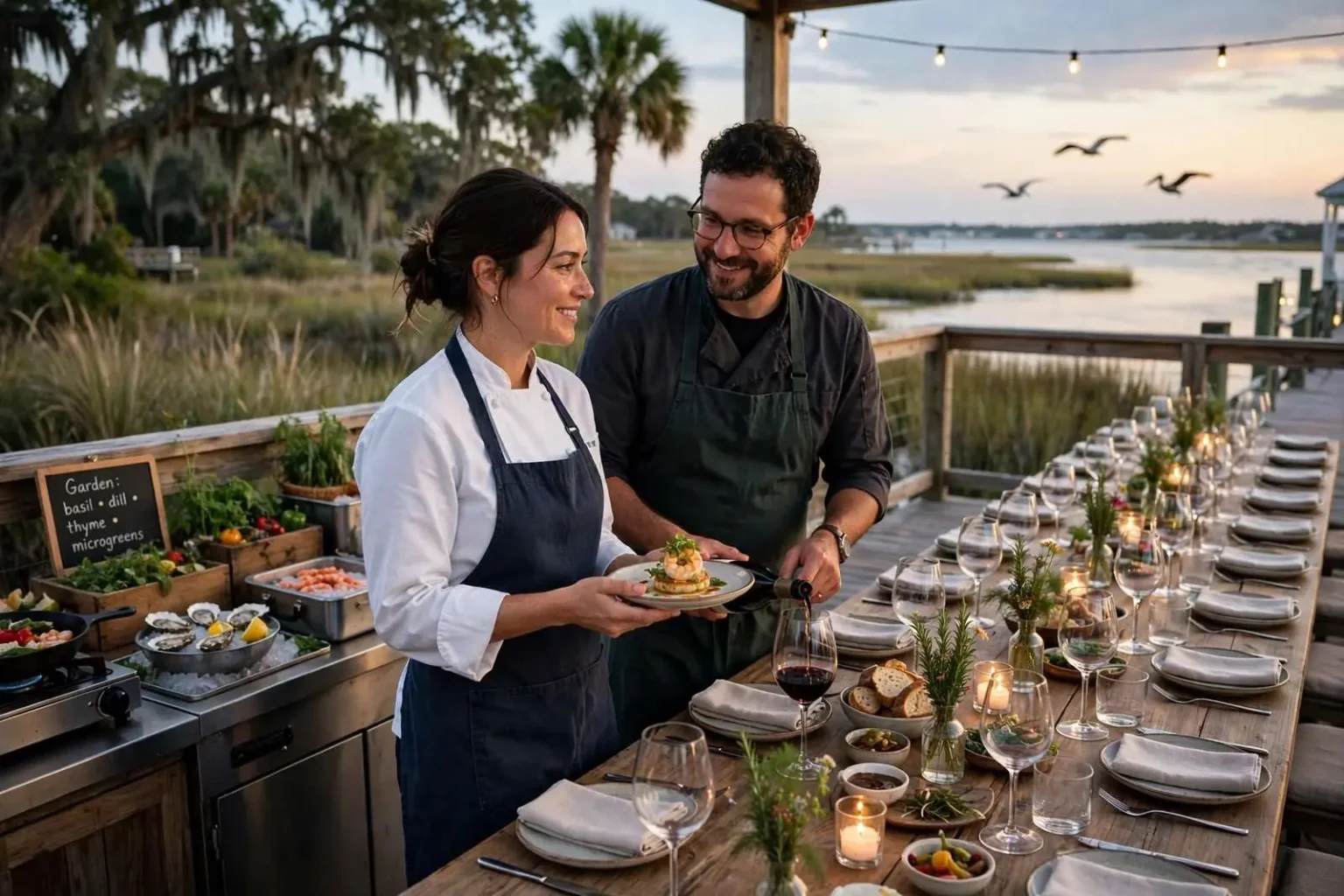
Mon Louis Island is the kind of place that even lifelong Mobile County residents can drive past without registering. It sits down the bay, small and quiet, where the wind moves through the palms and pelicans work the shallows. Once a month, on the deck at the end of a pier there, a long table is set for exactly fifteen people, and a five-course dinner begins. This is the Mon Louis Supper Club, run by chefs Amber and Hunter Harris, a married couple who built a high-end dining experience on the property where Amber grew up and where the two of them were married. The supper club operates by reservation only, with a fixed menu that changes monthly based on what the Gulf, the local farms, and the couple’s own garden provide.
The setting is intentionally intimate. The deck seats fifteen at a single communal table, meaning strangers become temporary dinner companions. There is no menu to choose from — the chefs decide what to serve, and the guests eat what arrives. The price is fixed, announced in advance, and includes wine pairings selected by Hunter. The experience lasts about three hours, moving from passed canapés on the pier to the main courses at the table, with a pause for dessert and coffee under the stars. There is no staff beyond the Harrises themselves — they cook, serve, pour, and clear, creating a rhythm of service that feels less like a restaurant and more like a dinner party hosted by exceptionally skilled friends.
A Kitchen That Started With Sunday Dinner
Amber was born and raised on Mon Louis Island. As a girl, she told her mother she wanted to learn to cook. Her mother’s solution was to invite Amber’s grandparents over every Sunday after church and let her run the whole affair. “I made it a whole thing,” Amber recalls. “Made an invitation, explained the menu and set the table the way I wanted.” Those Sunday dinners turned into a career. She trained at the Culinary Institute of America in New York, then traveled to China and Italy, spent a semester in Napa Valley studying farm-to-table cooking, interned in Hawaii, and worked aboard private yachts. She did not expect to come home. “I thought I was never going to come back home, but something brings you back,” she says. “I really did miss the people, the place, the body of water we have here. It’s really special and unique.”
The Culinary Institute of America’s rigorous classical training gave Amber a technical foundation — sauce work, butchery, pastry, the discipline of the brigade system. Her international stints expanded her palate: Sichuan peppercorns in Chengdu, hand-rolled pasta in Bologna, the precision of kaiseki in a Kyoto ryokan. The Napa Valley semester connected her with the farm-to-table movement’s emphasis on provenance and seasonality. The yacht work taught her to cook in confined spaces with limited provisions for demanding clients. Every experience added a tool to her kit, but the Mon Louis Sunday dinners remained the template — food as hospitality, cooking as love language.
Two Cooks, Two Temperaments
Hunter started working in kitchens at fourteen and never seriously left. “I’ve never done anything else. Flirted with other stuff, went right back to it,” he says. He grew up outside New Orleans and trained at the Louisiana Culinary Institute, absorbing Cajun, French, Latin American and Asian techniques along the way. His father-in-law describes the result as “that Louisiana flair.” Hunter puts it more bluntly: “Everything’s gotta have flavor.” The two met working in restaurants in Fairhope, married, and talked for years about doing something of their own. The family property on Mon Louis, with its pier, its deck, and its view of the bay, was the obvious setting.
Hunter’s Louisiana Culinary Institute education grounded him in the Gulf Coast’s culinary DNA — the holy trinity of onion, celery, and bell pepper; the dark roux that anchors gumbo and étouffée; the respect for Gulf seafood that demands minimal interference. His time in New Orleans kitchens exposed him to the city’s high-pressure, high-volume restaurant culture, where consistency at speed is the measure of a cook. Amber’s fine-dining background brought precision, plating discipline, and a global reference library. Together, they cover a spectrum that runs from a perfect roux to a delicate consommé, from a blackened redfish collar to a yuzu-cured scallop crudo.
The supper club’s fifteen-seat limit is both practical and philosophical. The deck’s dimensions, the kitchen’s output capacity, and the Harrises’ desire to maintain personal contact with every guest converge on that number. “Fifteen is the most we can cook for properly without compromising,” Hunter says. “And it’s the most we can talk to.” The communal table forces a social dynamic that private tables avoid — conversation flows across the length of the table, wine is passed hand to hand, and the boundary between service and hospitality dissolves. Guests who arrive as strangers often leave having exchanged contact information, invited to each other’s events, connected by the shared experience of a meal that could not be replicated.
The menu development process begins weeks in advance. Amber and Hunter meet with their core suppliers — the shrimper who brings white and brown shrimp off his boat in Bayou La Batre, the oysterman who harvests from Murder Point and Point aux Pins, the farmer in Loxley who grows heirloom tomatoes and Japanese sweet potatoes, the forager who finds chanterelles in the pine woods after rain. They build the menu around what will be at its peak the week of the dinner. A spring menu might feature soft-shell crab with a ramp and morel ragout, followed by grilled grouper with a cucumber-dill beurre blanc, then a strawberry-rhubarb crisp with vanilla bean ice cream. A fall menu might lead with roasted oysters on the half shell with mignonette, move to duck breast with persimmon glaze and dirty rice, and close with a pecan praline tart.
Sourcing the Gulf and the Land
The Harrises’ commitment to local sourcing is not marketing — it’s logistics and ethics. The Gulf’s seasons dictate the protein: shrimp in spring and fall, crab in summer, oysters in the months with an R, finfish year-round but varying by species. The farms around Mobile and Baldwin counties provide produce on a calendar that respects heat, humidity, and hurricane season. The couple’s own garden, a quarter-acre behind the house, supplies herbs, microgreens, edible flowers, and the occasional vegetable crop that survives the deer and the salt spray. They preserve, pickle, and ferment to extend the seasons — shrimp heads become stock, tomato gluts become jam, citrus peels become oleo-saccharum for cocktails.
This approach requires flexibility that a conventional restaurant cannot accommodate. A commercial kitchen with a printed menu and inventory par levels needs predictable supply. The Mon Louis Supper Club, by contrast, can pivot when the shrimper calls to say the catch is light, or when the farmer texts that the strawberries came early. The fixed guest count means they buy exactly what they need — no waste, no frozen backup. The communal format means every plate is identical, eliminating the line-cook scramble of firing different entrees at different times. The result is a kitchen that runs on communication rather than tickets, where Amber and Hunter move around each other in a choreography refined over hundreds of dinners.
The Rhythm of a Supper Club Evening
Guests arrive at 6:30 p.m., directed down a shell drive to the pier, where Amber passes champagne and a single-bite amuse — perhaps a spoonful of crab bisque with a dot of caviar, or a pickled shrimp on a cracker with herb aioli. The sun sets over the bay, painting the water in colors that no camera captures. At 7:00, they move to the table. The first course arrives: a composed salad or chilled soup, plated with the precision of a fine-dining restaurant but served family-style on the communal table. Hunter pours the first wine pairing — a crisp Muscadet for the oyster course, a Grüner Veltliner for the vegetable course.
The main course follows, usually a protein with two or three composed elements: a starch, a vegetable, a sauce. The Harrises plate each dish themselves, walking the length of the table to place them. They explain the dish, the source of each component, the technique. Guests ask questions — about the farm, the fisherman, the spice blend, the wine. The conversation meanders from food to family to the weather to the news of the day. At 8:30, a palate cleanser — a sorbet, a granita, a chilled fruit broth. Then dessert, coffee, a final pour of something fortified or distilled. By 9:30, the evening winds down. Guests linger on the pier, looking at stars reflected in dark water, reluctant to break the spell.
Community and Sustainability
The Mon Louis Supper Club has become a quiet economic engine for the island and the surrounding waters. The Harrises’ standing orders with local fishermen and farmers provide predictable income for small producers who often struggle with the volatility of wholesale markets. The supper club’s reputation has drawn food writers from regional and national publications, bringing attention to the Gulf’s seafood and the farmers who feed it. But the Harrises resist scaling. They have no interest in a second location, a cookbook, a product line, or a television show. “This is our life,” Amber says. “Not a brand.”
For the guests, the supper club offers something increasingly rare: a meal without distraction. Phones are not banned, but the setting discourages them — the light ruins the darkness, the conversation demands presence. In a culture that fractures attention into notifications and feeds, three hours of sustained, shared focus is a luxury. The fifteen strangers at the table become, for one evening, a community defined by the food they eat, the wine they drink, and the bay they watch. When they leave, they carry the memory of that community back into their separate lives — a reminder that connection is possible, that the Gulf is still generous, that a husband and wife can build something beautiful on the edge of the water and invite the world to share it, fifteen at a time.