Monroe County Trafficking Task Force Joins Mississippi Operation To Sharpen Its Tactics
Monroe County's human trafficking task force assisted an operation in Mississippi, and Sheriff Tom Boatwright says the tactics learned will be used locally.
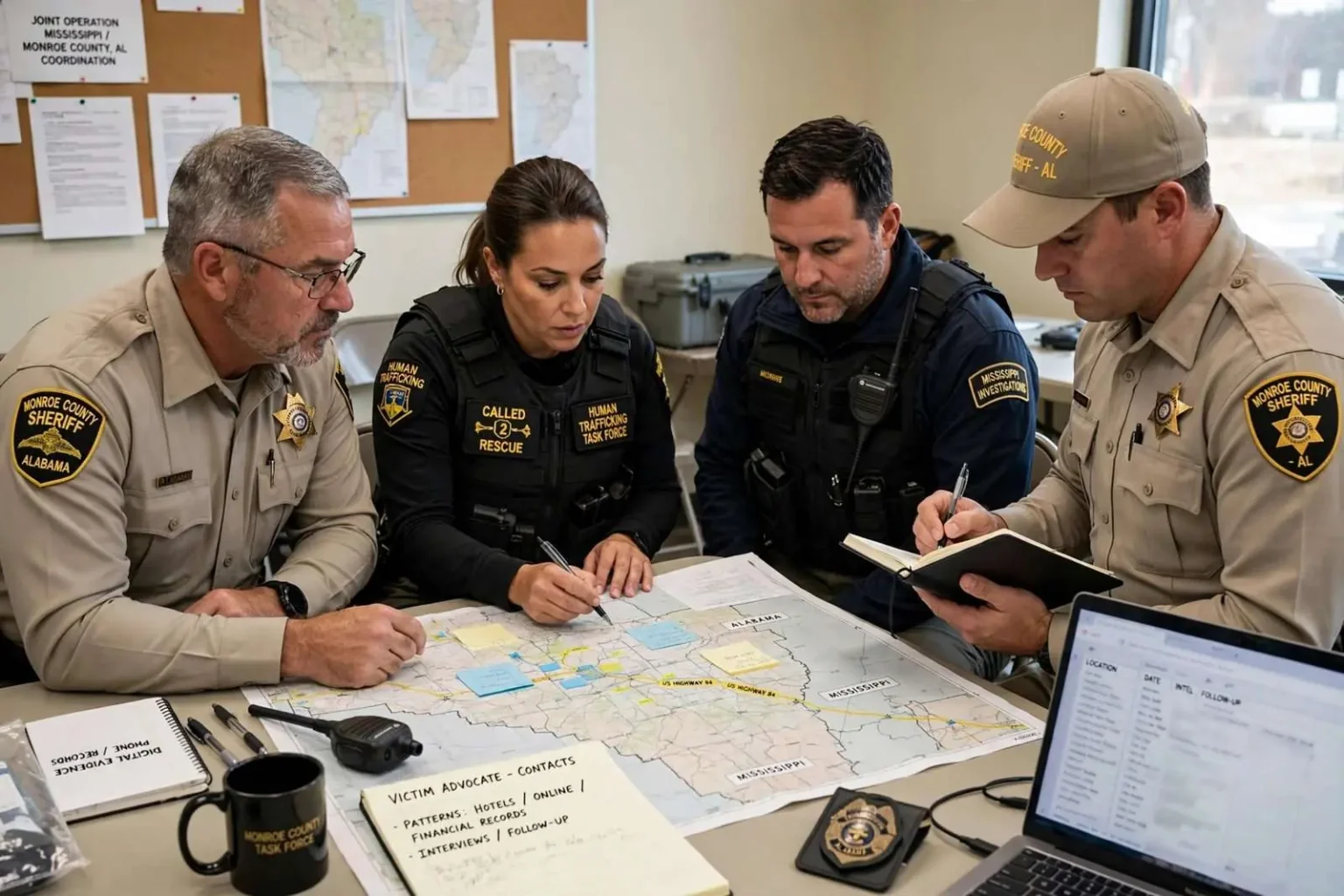
MONROE COUNTY, Ala. — Members of the Monroe County Human Trafficking Task Force took part in a human trafficking enforcement operation in Mississippi, an assignment the sheriff’s office says was intended to give local investigators hands-on experience they can bring back home. Rather than send deputies to a classroom seminar, the agency arranged for its people to work a real operation alongside experienced investigators, learning the trade under live conditions.
Sheriff Tom Boatwright said the task force was invited to participate through Called 2 Rescue, an organization that works on trafficking cases, and that members volunteered for the assignment. Voluntary participation matters in work of this kind: trafficking investigations demand long, irregular hours, discretion, and a tolerance for disturbing material, and agencies have found that investigators who choose the assignment tend to stay with it and build the kind of expertise rural counties struggle to develop on their own.
What the Assignment Was Meant to Build
According to the sheriff’s office, working alongside investigators in another state gave Monroe County personnel a direct look at how trafficking investigations are built and carried out. Unlike many crimes, trafficking cases rarely begin with a single dramatic event; they are assembled from patterns — repeated visits to the same locations, online solicitation activity, financial records, testimony developed over time, and the slow work of identifying who is a perpetrator, who is a victim, and who is both. Learning how experienced investigators organize that work is the core of what a joint operation can teach.
The agency said the assignment also opens access to resources that track the methods and patterns traffickers are using. Those resources include databases and analytical tools that connect cases across jurisdictions, intelligence about the routes and tactics moving victims through the region, and networks of specialists — forensic interviewers, victim advocates, digital evidence examiners — that no single rural county could maintain on its own.
Boatwright said the tactics learned during the operation will be applied locally, both in enforcement work and in efforts to educate residents about how trafficking operates. Public education is a pillar of most county-level task forces: teaching hotel staff, truck drivers, healthcare workers and school personnel to recognize the indicators of trafficking multiplies the eyes available to investigators, because the crime hides in plain sight far more often than it announces itself.
The sheriff described the crimes the task force targets as heinous, and framed the training as part of a broader push to suppress criminal activity in the county. The sheriff’s office did not release details about arrests or the scope of the Mississippi operation itself, describing the county’s role as assisting the agencies that led it — a posture that reflects both operational security and the sensitivity of cases involving victims who are often minors or otherwise vulnerable.
Why Rural Alabama Counties Fight a Regional Crime
Monroe County sits in south-central Alabama, anchored by Monroeville and crossed by U.S. Highway 84, one of the east-west corridors that carries traffic between the Interstate 65 and Interstate 10 systems. That geography is central to the problem: human trafficking moves along the highway network the same way commerce does, and communities within a few hours’ drive of major interstates — which is to say, nearly all of them — find themselves on routes traffickers use. The sheriff’s office noted that this kind of work often crosses state lines because the activity itself moves along regional highway corridors, linking small Alabama counties to operations in Mississippi, Florida, Louisiana and beyond.
Monroe County’s task force is one of several county-level units in Alabama that coordinate with outside agencies and nonprofit groups on trafficking cases. The structure has become common across the state because trafficking investigations overwhelm the resources of any single sheriff’s office: a case that starts with a tip in Monroeville may involve victims located in Mobile, suspects residing across the state line, and digital evidence scattered across the country. Formal coordination — through task forces, memoranda of understanding and standing partnerships with organizations like Called 2 Rescue — makes those multi-jurisdiction cases workable.
Nonprofit organizations play an outsize role in this field. They bring training curricula, victim services, funding streams and operational experience that local government budgets rarely cover, and groups specializing in anti-trafficking work often maintain relationships with federal partners, shelters and recovery programs that law enforcement can call on when a case surfaces. The invitation that brought Monroe County investigators into the Mississippi operation is the kind of relationship-building that pays dividends years later, when a local case needs expertise the county does not have on staff.
What Residents Should Know
Trafficking does not look like the kidnapping scenarios of film and television. More often it is exploitation that unfolds gradually — coercion, debt, threats and manipulation that keep victims bound to their traffickers without physical restraints, frequently in ordinary hotels, restaurants, neighborhoods and businesses. Victims may be runaways, people experiencing homelessness, individuals with substance dependence, or minors recruited through social media. That reality shapes both the enforcement tactics investigators study and the educational messages task forces carry to the public.
Residents who suspect trafficking are encouraged to report it rather than investigate it themselves, providing what they observed — locations, vehicles, times, descriptions — to law enforcement or the national human trafficking hotline. Investigators emphasize that a single credible observation from a citizen can be the thread that unravels a case, particularly when deputies already know what patterns to look for.
For Monroe County, the Mississippi assignment represents an investment in capability: local deputies who have worked a real multi-agency trafficking operation return with contacts, methods and hard-won judgment that no amount of paperwork training provides. The sheriff’s office says the lessons learned will now be put to work at home, in investigations and in the public education effort that keeps the community alert to a crime that depends on going unnoticed.
The Anatomy of a Joint Operation
Multi-agency trafficking operations typically unfold over several days in a defined area, combining undercover activity, surveillance, intelligence analysis and traditional patrol work. Investigators from different departments are assigned complementary roles so that each brings a capability the others lack — one team managing online sources, another handling field contacts, another conducting interviews and connecting people they encounter with services. Coordinators track everything in real time, building the case file as the operation progresses rather than reconstructing it afterward.
Participating in one, even in a supporting role, compresses years of learning into days. A deputy sees how a contact is approached safely, what questions separate a trafficking victim from a willing participant in another offense, how evidence is preserved so charges survive in court, and how quickly a seemingly small lead can expand into multiple suspects and jurisdictions. Those lessons transfer directly to Monroe County’s own caseload, where small offices often handle their first trafficking case with little institutional memory to draw on.
The joint model also protects the officers and the victims. Working alongside seasoned investigators reduces the risk of mistakes that could compromise a prosecution or re-traumatize a victim during an interview. It also builds the personal relationships — phone numbers known, trust established — that make the next case move faster, because in interagency work the informal network is often as important as the formal agreement.
Building a Local Framework That Lasts
The sheriff’s office has framed the task force’s work as ongoing rather than episodic, with enforcement and education running as parallel tracks. Enforcement without education leaves the community unaware of the problem; education without enforcement leaves victims without recourse. Task forces that succeed nationally tend to sustain both: regular public outreach to schools, hotels and civic groups, paired with investigators who keep their skills current through joint operations, federal task force attachments and continuing training.
For a county the size of Monroe, staffing such work is the central challenge. Deputies assigned to the task force still carry their regular duties, and trafficking investigations compete with every other demand on a rural sheriff’s office — from methamphetamine enforcement to courthouse security. That is why volunteer participation in operations like the Mississippi assignment matters: it builds capability without requiring the county to create positions it cannot fund, and it relies on the commitment of investigators willing to take on some of the most difficult work in policing.
The office has not announced what comes next for the task force, but the pattern in Alabama counties that run similar units is consistent: continued coordination with neighboring agencies, participation in regional operations when invited, and a growing public-facing role in teaching residents what trafficking looks like and how to respond. Each operation a member joins adds to the store of local experience — and each case that ends with a trafficker charged and a victim connected to services makes the next one a little easier to find.