

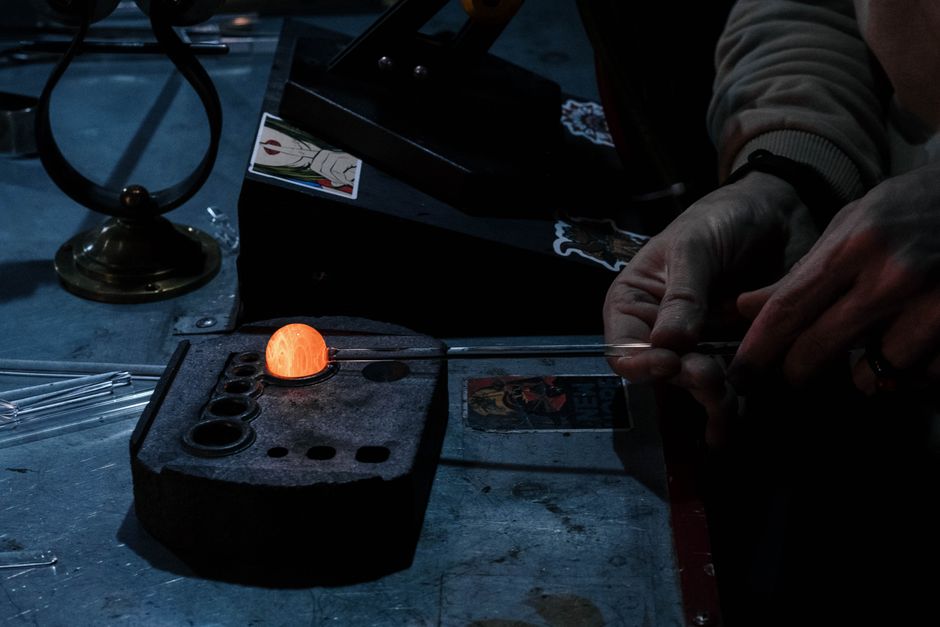
Sometimes the most consequential decision of a career starts as the path of least resistance. For two lifelong friends from Mobile, a glassblowing class at the University of South Alabama began as nothing more than one more humanities credit needed to finish a degree. Today, that elective has become Muffinjaw Designs, a hand-blown glass business whose furnaces fire at festivals, museums, and art centers from New Orleans to DeFuniak Springs, Florida.
Freddie Blanche and Tres Johns, both Mobile natives, make up two-thirds of the Muffinjaw team, alongside Gage Nobles, a fellow South Alabama student a couple of years behind them who found his way to the same studio. All three eventually earned Bachelor of Fine Arts degrees from the university with a concentration in glass and a secondary focus in sculpting, training through the Department of Art and Art History.
A course unlike most others
As Blanche tells it, neither friend expected what they found behind the studio door. Glass programs are rare at the college level, and Blanche assumed the class would be lampworking — the small-torch craft familiar from mall kiosks. Johns, for his part, had been curious about molten glass ever since seeing a glassblower at work at Dollywood. Instead, the professor walked the class into the “Hot Shop,” the room where furnaces run around the clock, every day of the year, and opened the doors. The two friends were, in Blanche’s words, drawn in like moths to a flame.
The medium itself has a short institutional history. The American studio glass movement only began in the early 1960s, when artists first started blowing glass outside factory settings. Blanche describes the craft as a kind of dance with physics — an applied science where molten material stiffens by the second and every move must be planned before the pipe leaves the furnace. In that first semester class, sixteen students learned the fundamentals together, and Blanche and Johns were lab partners, a necessity in a discipline that is nearly impossible to practice alone.
Even the materials carry lessons. Glass blowing starts with clear soda lime glass, with color added later, and colored glass has always been expensive — running anywhere from $30 to $70 a kilo, with the base material at the time produced only in Germany and New Zealand. Early in the program, each student was assigned to buy a specific color that would mark their work as their own. The students pooled their colors back to the professor at the end of the first class, then had to sheepishly ask for them again so they wouldn’t have to buy them twice. It was an early lesson in the economics of the art.
A furnace in the backyard
The real turning point for the future business was technological. A company called Mobile Glassblowing Studios, based in Americus, Georgia, pioneered commercially available portable, gas-fired glassblowing furnaces — self-contained units that combine the furnace, glory hole, and pipe warmer in one wheeled machine. Before that, a glassblower needed access to a stationary hot shop like the one at South Alabama. After it, an individual artist could set up a studio in a backyard and take the whole operation on the road.
In 2017, while Blanche was still in school, he sold his car and, with matching funds from his father, bought a Baby Dragon furnace from the Georgia company and set up shop at home. The Baby Dragon holds roughly 30 pounds of molten glass, runs on propane, and can be towed to festivals and demonstrations — exactly the machine that made a traveling glass business possible. The learning curve was steep and the mistakes were constant. Blanche is matter-of-fact about it: they messed up in every way possible, and most of their first pieces doubled as paperweights. But the failures taught the craft. There are no shortcuts in glass, he says — you will pay for them — and a blower must concentrate on the task at hand while thinking through the next twenty steps in sequence.
The apprenticeship in Missouri wine country
After graduation came the question that faces most art graduates in the Gulf region: what do you do with this? The trio hit the road instead of leaving the area for day jobs, traveling the country’s music and craft festivals, setting up shop, demonstrating the craft, and selling their work. Their first gig was the South Sounds Music and Arts Festival in downtown Mobile.
Along the way, Blanche met a couple at the New Orleans Jazz and Heritage Festival who had run the Augusta Glass Studio in Augusta, Missouri — outside St. Louis, in the Missouri Rhineland wine country shaped by German settlers — since 1992. The studio belongs to Sam Stang, a Washington University graduate who studied with glass masters Fritz Dreisbach at Penland School of Craft and Lino Tagliapietra at Haystack Mountain School of Crafts, and was a founding partner of Ibex Glass Studio before opening his own shop with his wife, the glassmaker Kaeko Maehata. Stang works in traditional European techniques, shaping every piece at the furnace without molds, glue, or paint.
When the couple mentioned they were looking for an assistant, Blanche interviewed on the spot and got the job. The plan was a two-year apprenticeship; the pandemic cut it off at a year and a half, when festivals and craft shows were canceled and revenue dried up. He moved home in 2020. He still credits that time in Missouri with giving him the experience to run his own furnace — and with a lesson he now demonstrates for a living: because a portable furnace can travel, the public can actually watch glass being made, and make it themselves.
Blow your own glass
In 2020, Blanche relaunched Muffinjaw Designs. Within months of restrictions lifting, the trio was back at festivals, producing hand-blown flowers, small vases, barware, and drinking glasses for retail shops — and trying a new idea: short, affordable sessions where visitors blow their own piece. The concept took off. People are fascinated by the chance to shape molten glass, Blanche says, and no two pieces ever come out the same.
Today the team hauls their Mini Dragon furnace across the country for festivals and arts and crafts shows, but closer to home they are regulars at museums and art centers along the coast, offering 10-to-20-minute “Blow Your Own Glass” sessions on weekends at places like the Eastern Shore Art Center and the Mobile Museum of Art. Visitors reserve a slot, choose from one or two items such as drinkware or seasonal decorations, and blow. If a guest can’t manage the lungpower, a blood pressure pump stands in — so anyone from a 4-year-old to a 104-year-old can put a hand, figuratively, on their own keepsake. The finished work must cool slowly, which keeps customers on site for an hour to ninety minutes, a window that conveniently overlaps with the galleries and shops nearby.
Heat management is the quiet discipline behind all of it. Molten glass exits the furnace at temperatures above 2,000 degrees, and the furnaces themselves idle at high heat for days at a time during an event weekend. The team schedules breaks in rotation so each blower can hydrate, cool down, and stay sharp, because fatigue around molten glass is not a risk worth taking. Even the cooling is engineered: finished pieces go into an annealer, an oven that lets glass cool slowly over hours so internal stresses do not crack the finished piece later.
Private events are a bigger production. Setting up takes 10 to 12 hours, the furnace needs a covered space to protect equipment and hot glass from rain, and anywhere from 12 to 24 guests can each create a piece during about four hours of glass work. Corporate events add branding: logos can be worked into customized items, with color palettes matched to a company’s identity.
A business in thirds
The work splits roughly into thirds. About a third of Muffinjaw’s time goes to creating blown-glass art for retail shelves; another third goes to scheduled “Blow Your Own Glass” events from New Orleans to DeFuniak Springs, Florida. Around 30 percent of their output is sold wholesale — to gift shops and breweries, and as corporate gifts — and their glass can be found at 13 retailers across the region, a number that keeps growing. The rest is the festival circuit, where the three artists rotate through scheduled breaks to stay safe in the heat and keep the assembly line of molten glass moving. For shoppers, the through-line is the same whether the piece comes off a retail shelf or out of a first-timer’s lungs: every item carries the small irregularities that mark it unmistakably as made by human hands, one gathering of molten glass at a time.
Each partner brings a different artistic skill set, and the operation has, as Blanche puts it, been refined into a science. Growth has come the slow, durable way — word of mouth and social media, one blown ornament and one amazed first-timer at a time. For a business born from a scheduling gap in a college degree plan, Muffinjaw Designs has proven that the humanities credit was money well spent.