

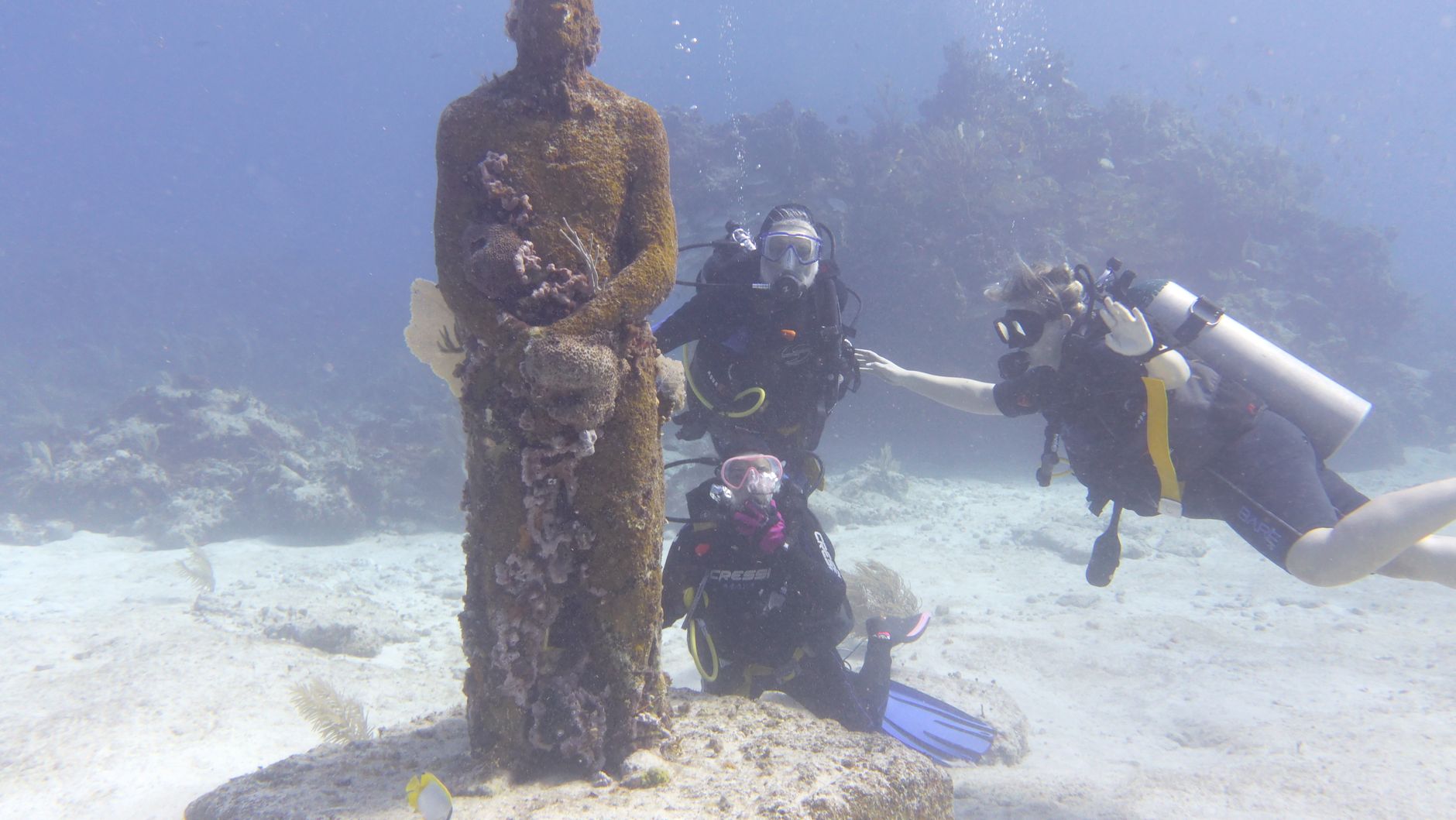
Mobile-born sculptor Raine Bedsole has spent a lifetime turning barnacles, frozen elephant ears, webworm silk and welded steel into art that ends up in museums and public plazas across the South. In early 2024 her work headed somewhere new: to the bottom of the Gulf of Mexico. Bedsole was chosen as one of nine artists, selected from a field of more than 250 applicants, to create a sculpture for the Underwater Museum of Art, a submerged sculpture garden that sits less than a mile off the powdery white sand of Grayton Beach, Florida.
For an artist whose career began by sinking metal frames into Mobile Bay and waiting to see what the water would grow on them, the commission felt less like a departure than a homecoming of sorts. Her piece, titled Reef Goddess, was designed from the start to be claimed by the sea.
An Art Museum Built for Fish
The Underwater Museum of Art is a partnership between Visit South Walton, the Cultural Arts Alliance of Walton County and the South Walton Artificial Reef Association. The concept, which first opened to divers in 2018, blends two ideas that are familiar along the northern Gulf Coast: public art and artificial reefs. Each sculpture is engineered to be stable on the sandy bottom and to give marine life hard surfaces to colonize, creating habitat in a place where there previously was only open sand.
The 2024 round was the museum’s sixth installation. Its nine new sculptures were set to bring the total collection to 50 pieces, adding to a growing protective and biologically productive reef habitat in the Gulf.
The site lies roughly 0.93 miles offshore from Grayton Beach State Park, in about 60 feet of water. Divers typically reach it by boat, and local outfitters such as Dive 30-A book excursions to the site. Visitors who make the descent can encounter schools of baitfish, grouper, sea turtles and sometimes dolphins moving among the sculptures.
Artificial reefs are nothing new to the region. Alabama and Northwest Florida have some of the most active artificial reef programs in the country, using everything from purpose-built concrete modules to decommissioned ships to create fishing and diving habitat. What makes the Grayton Beach project different is that every structure is also a work of art, meant to be experienced by divers and to change over time as algae, sponges, corals and fish take up residence.
Roots in Mobile and the Bay
Bedsole was born in Mobile and attended St. Paul’s Episcopal School before earning a degree in fine art at Auburn University. After college she set up a studio in a home she owned at Mullet Point, on the eastern shore of Mobile Bay in Baldwin County. It was there that her unusual relationship with water and natural materials began.
She would place metal structures in the bay and leave them long enough for barnacles and other marine organisms to attach. Then she would pull the frames out and build artwork from what nature had added. That practice started her gradual shift from painting toward more sculptural work.
Her first solo exhibition came at Cumberland Gallery in Nashville. Three years after leaving Auburn, she moved to San Francisco to pursue a master’s degree in fine art. While there she taught art to adults through the University of California, Berkeley, and through an art collective at Fort Mason, the historic former Army post on the San Francisco waterfront that has become a cultural center.
About three years later she returned to Mullet Point. Back on the Eastern Shore, she taught children at the Whiting Gallery of the Eastern Shore Art Center in Fairhope and worked as a framer at Page & Palette, the downtown Fairhope bookstore. “I was making a lot of art to sell at festivals in South Florida, and my evolution towards sculpture continued,” she said.
Boats, Webs and Welding
Some of Bedsole’s best-known work grew out of accidents of nature. After a freeze hit her mother’s farm, she gathered the large elephant ear leaves that had died back and shaped them into her first “boat sculpture.” The vessel form became a signature for her, and her boat pieces have been sought after by collectors and museums.
Another idea came at her family’s farm in Clarke County, north of Mobile. In the fall she noticed the large silken tents fall webworms spin in pecan trees. She built a small metal form and repeatedly wound the sticky webbing around it. A year later, those pieces were shown at a gallery in New Orleans, and Bedsole decided to make the city her home. She continued to experiment, making collages from natural materials and painting on wood rather than canvas.
“I like physical art and materials. I moved to metal and took a welding course at Delgado Community College. There, I discovered the magic of putting things together instantly that stayed permanently,” she said.
The welding class also produced one of her favorite stories. “In New Orleans, I was constantly called for jury duty for some reason, possibly because I was on the voting register twice. My first time serving, three of my classmates were also there. Strange coincidence!”
From Galleries to Public Art
Bedsole has said the hardest thing for any artist is landing that first gallery show. After Nashville, her exhibitions spread across the country. Her work is held in the collections of the Mobile Museum of Art, the South Carolina Museum of Art and the New Orleans Museum of Art. She spent a month as a visiting artist at the American Academy in Rome and has served as a visiting teacher at Kent State University in Ohio.
After Hurricane Katrina, commissions for large-scale public art began to come her way. For those projects she works with foundries in New Mexico and Oklahoma, which translate her small models, or maquettes, into full-size works. The pieces are either cast in sections and welded together on site or cast in bronze.
One of those works is Nomad, created for the Helis Foundation in New Orleans. It features branches that form a ladder climbing toward a vessel suspended in the air. “It is about the journey we are each on and the inspiration to keep climbing,” she said.
For many years she has held a show every other year at Callan Contemporary, a gallery on the Poydras Street sculpture corridor in New Orleans, and she had another show there on the calendar for October 2024. Asked whether that recurring deadline is stressful, she was candid. “It is, but I need deadlines.” Galleries, she explained, need to know an artist will finish a series on schedule. “I work hard and they know I’m going to finish the work.”
Closer to home, one of her boat sculptures stands at the entrance to the federal courthouse in Mobile, a fitting spot, friends joke, for someone who has answered so many jury summonses.
Fire, Earth, Water and Air
Bedsole describes her creative life as a passage through the classical elements. “I see art as a journey through the elements. Fire was my youth and passion stage. Earth was having and raising kids. Water was freedom and living an open life. Air, that’s the last stage to come.”
What she hopes viewers take from her work is harder to pin down, and she describes it in terms of energy. “Something happens in the process of making art. It creates an energy that resonates within me, like a tuning fork vibration that inspires me, and connects with other people.” She keeps work by other artists throughout her home, and looking at those pieces, she says, shifts her perspective and pushes her to make more.
Her working hours follow the quiet. “I like early mornings when it’s quiet. I have peaceful thoughts and ideas and then I turn them into something. I also like working at night when there’s not so much static in the air or things to distract.”
She and her husband, Duke, divide their time among Grayton Beach, where they moved during the COVID-19 pandemic; a loft in New Orleans; Mobile; and the family farm in Gosport, in Clarke County near Monroeville.
Building Reef Goddess
Bedsole learned about the Underwater Museum of Art’s call for new sculptures after attending a Cultural Arts Alliance celebration in Santa Rosa Beach. She applied, learned in December 2023 that she had been selected, and faced a deadline of April 2024 to complete the piece.
Working in concrete was new territory, and she got practical advice from the staff at Frank’s Cash and Carry Hardware, around the corner from her Grayton Beach home. The museum’s requirements were specific: each sculpture had to weigh at least 500 pounds and be delivered to Walter Marine/Reefmaker in Orange Beach, the Alabama company known for building artificial reef structures. There, a base would be added to keep the work upright once it was lowered to the Gulf floor.
A lifelong diver, Bedsole found part of her inspiration on a trip she and Duke took the previous year to a coral reef restoration project in Key Largo. “They are growing new coral by hanging it on trees underwater and then adhering it to the coral reefs that have died in hopes that they will make a comeback,” she said. “The water temperature is too high and the coral is dying, but these people are giving the reefs new life.”
The location was another draw. The sculpture garden is practically in her backyard, and she and Duke can reach the area by kayak. As she described it, Reef Goddess would measure 4 feet by 4 feet at its base and rise 9 feet from the sea floor, with raindrop shapes cut through it so fish can swim through the form. “I can’t wait to see it all covered in algae and becoming a reef,” she said.
How to See the Underwater Museum and Bedsole’s Work
For readers interested in experiencing the sculpture garden or tracking down Bedsole’s art, a few practical notes:
- Diving the museum: The Underwater Museum of Art sits in about 60 feet of water off Grayton Beach State Park, a depth that generally calls for open-water scuba certification. Local dive operators, including Dive 30-A, run boat trips to the site. Conditions vary with weather and season, so check with operators before planning a trip.
- Getting there: Grayton Beach is on Scenic Highway 30A in South Walton, roughly a two-and-a-half to three-hour drive east of Mobile via Interstate 10.
- Seeing her work on land: Callan Contemporary on Poydras Street in New Orleans has long represented Bedsole, and her pieces are in the collections of the Mobile Museum of Art and the New Orleans Museum of Art. One of her boat sculptures greets visitors at the federal courthouse in downtown Mobile.
- Artificial reefs close to home: Alabama’s own offshore reef zones, many built with structures from Orange Beach fabricators, are popular with anglers and divers. The Alabama Department of Conservation and Natural Resources publishes reef locations for the public.
From barnacle-encrusted frames at Mullet Point to a nine-foot concrete goddess settling into the sand off Grayton Beach, Bedsole’s art has always been about letting the natural world finish the job. With Reef Goddess, the fish, sponges and algae get the final say.