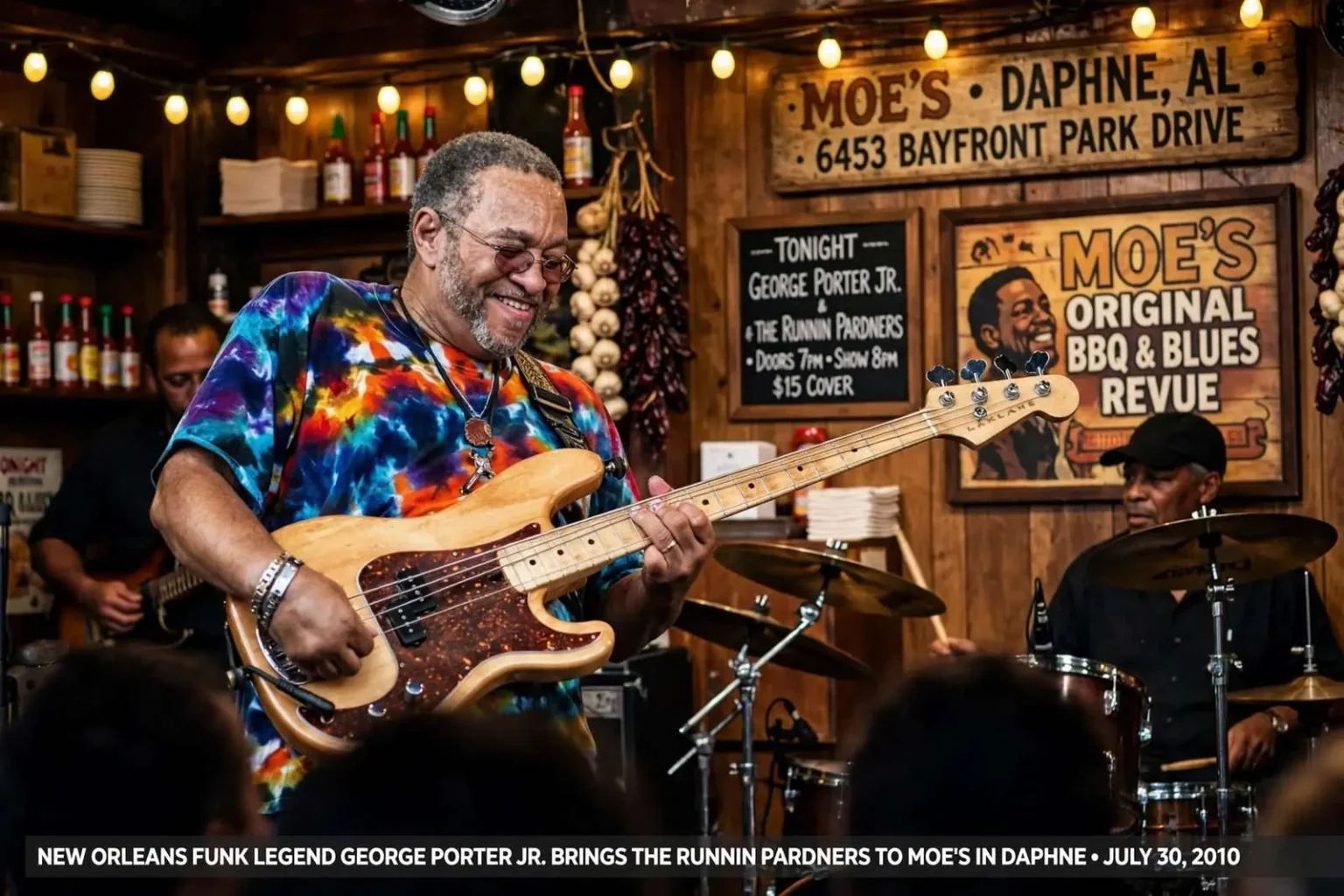
On Friday, July 30, 2010, one of the founding fathers of funk brought his band to the Eastern Shore when George Porter Jr. and the Runnin Pardners played Moe’s Original BBQ & Blues Revue in Daphne, at 6453 Bayfront Park Drive. Doors opened at 7 p.m. with the show following at 8, and tickets ran fifteen dollars — a modest cover for a bassist whose resume stretches across five decades of American music. For fans of New Orleans rhythm and blues along the Alabama Gulf Coast, the date was a rare chance to catch a genuine architect of funk in a small-room setting, a short drive across Mobile Bay rather than a trip into the city where the sound was born.
Moe’s Original BBQ & Blues Revue had built a reputation as one of the Eastern Shore’s reliable rooms for touring roots music, pairing barbecue and blues in a venue whose Bayfront Park Drive address puts it close to the Daphne waterfront. Rooms like Moe’s fill an important niche on the Gulf Coast music map: big enough to bring in national acts, small enough that the audience stands within a few feet of the stage. A musician of Porter’s stature headlining a club of that size was the kind of booking that local music fans circle on the calendar well in advance.
The man behind The Meters’ sound
Porter is best known as the bassist and singer of The Meters, the New Orleans group he formed with Art Neville in the mid-1960s and which came to be recognized as one of the progenitors of funk. The Meters’ instrumentation — Porter’s deep, melodic bass lines locked with the drums, Neville’s keyboards and Leo Nocentelli’s guitar — defined a groove-first approach to rhythm and blues that influenced generations of players far beyond New Orleans. Their recordings from the late 1960s and early 1970s became foundational texts for funk, hip-hop sampling and jam-band audiences alike, and the band’s second-line-inflected style carried the sound of the city’s streets into American popular music.
The Meters disbanded in 1977 but reformed in 1989; today the group tours as the Funky Meters, with Porter still on board. That longevity is itself remarkable in an industry built around shorter arcs, and it reflects the enduring demand for the band’s sound. In the years between the original run and the reunion, the individual members became even more prolific, and Porter in particular built a reputation as one of the hardest-working bassists in American music, moving fluidly between his own projects, studio sessions and guest appearances across genres.
Beyond his own band the Runnin Pardners, Porter’s projects have included the Trio with Johnny Vidacovich, the New Orleans Social Club and Deep Fried, along with his work in Porter Batiste Stoltz. Each of those configurations showcases a different side of his playing. The Runnin Pardners, his longtime working band, lean toward the funk and R&B repertoire he knows best; the Trio with drummer Vidacovich strips the music down to conversational interplay; the New Orleans Social Club gathers veteran Crescent City players for socially minded soul; and Porter Batiste Stoltz — with guitarist Brian Stoltz and drummer Russell Batiste — digs into extended, jam-oriented funk. The breadth of those projects explains why a single summer night in Daphne promised a different experience than a Funky Meters show or a festival set.
A roll call of collaborators
His studio and stage collaborations read like a roll call of popular music: Dr. John, Paul McCartney, Robbie Robertson, Robert Palmer, Patti LaBelle, Jimmy Buffett, David Byrne, Warren Haynes and many more. That range — from British rock royalty to Gulf Coast troubadours to jam-scene guitarists — traces the reach of New Orleans rhythm across American music. Producers and artists have long sought out Porter for the same quality that made The Meters famous: a bass approach that doesn’t just keep time but drives the arrangement, sitting in the pocket with a looseness that players spend careers trying to imitate.
For Daphne, the date was a rare chance to catch a genuine architect of New Orleans funk in a small-room setting on the Alabama Gulf Coast. The Eastern Shore’s proximity to New Orleans — roughly an hour’s drive west — has always shaped its cultural ties, and touring musicians moving along the I-10 corridor between New Orleans and the Florida panhandle frequently pass through Mobile and Baldwin counties. But a Friday night appearance by a musician of Porter’s historical standing elevated the usual club circuit, and the fifteen-dollar ticket price underscored how accessible the show was by any standard.
Shows like the July 30, 2010 date also highlight the role that Baldwin County venues play in the regional music economy. While Mobile’s clubs and theaters have historically drawn the larger touring acts, the Eastern Shore has developed its own loyal audience for roots, blues, funk and jam music, and venues that host touring veterans give local players and fans alike a connection to the broader tradition. Moe’s location near Bayfront Park places it in the heart of that scene, and its combination of barbecue, blues and Gulf Coast hospitality makes it a natural stop for a New Orleans band working the corridor.
Why the New Orleans connection runs deep on the Gulf Coast
The cultural ties between New Orleans and the Alabama Gulf Coast run deeper than the interstate that links them. Families, food, radio and festival circuits have moved back and forth across the coastal corridor for generations, and the music of New Orleans — second-line rhythms, Mardi Gras Indians, funk and blues — has long been a shared inheritance along the northern Gulf. Baldwin County audiences grew up hearing The Meters on turntables and in cover sets, which is why a bassist who helped invent the vocabulary of funk commands the kind of respect here that might otherwise be reserved for hometown heroes. A show like Porter’s at Moe’s is less a novelty than a natural extension of that connection.
Porter’s career also illustrates the durability of the New Orleans music tradition itself. The city has produced a disproportionate share of American popular music’s foundational figures, and its working musicians sustain an ecosystem of clubs, festivals and session work unlike anywhere else in the country. Porter grew up in that ecosystem, came up through its church and street traditions, and became one of its ambassadors — a player whose feel is recognizable within a few bars to anyone who has ever heard a New Orleans groove. When that sensibility lands in a Daphne barbecue joint on a Friday night, it carries the whole tradition with it.
For the Runnin Pardners, dates along the Gulf Coast are a staple of the touring calendar. The band’s repertoire draws on the deep well of Meters material alongside Porter’s own songs and the funk and R&B standards he has played for decades, delivered with the loose authority of a group that has spent years on the road together. Audiences at small rooms like Moe’s typically get what festival crowds often miss: extended grooves, bandstand banter and the kind of improvisational detours that only happen when the venue and the audience are close enough to feel like part of the show.
The July 30, 2010 date now stands as one of those nights that local music watchers remember — a founding father of funk, fifteen dollars at the door, doors at 7 and the band at 8, in a barbecue-and-blues room on Bayfront Park Drive in Daphne. It was a reminder that the Eastern Shore doesn’t have to travel for world-class music; sometimes the tradition rolls east on I-10 and walks through the door, bass in hand, ready to play.
The fifteen-dollar ticket deserves a note of its own, because it says something about how the Gulf Coast values its live music. In an era when arena tours carry three-digit price tags, a cover charge of that size for a musician of Porter’s pedigree reflected the economics of the club circuit: modest guarantees, walk-up sales and a split of the door that keeps both the venue and the band working. Those economics are precisely what allow rooms like Moe’s to book national acts and what allow fans in smaller markets to see legends at close range. The arrangement has long been symbiotic — the venue gets a marquee name, the band gets an engaged room on a Friday night, and the audience gets a history lesson delivered at full volume.
Johnny Vidacovich, Porter’s partner in the Trio project, is himself a New Orleans institution, a drummer whose conversational style has anchored countless sessions and club dates across the city. That Porter maintains parallel projects with players of that caliber speaks to the depth of the New Orleans scene: the same handful of musicians circulate through one another’s bands, festivals and studios, cross-pollinating styles and keeping the city’s sound in constant motion. A listener who follows Porter’s various lineups effectively gets a guided tour of that scene, from the tight funk of the Runnin Pardners to the wide-open interplay of the Trio.
The Meters’ lasting influence
It is difficult to overstate The Meters’ influence on the music that followed them. Their grooves have been sampled by generations of hip-hop producers, covered by rock and jam bands, and studied by bassists and drummers as the definition of pocket playing. The band’s blend of second-line rhythm, blues and R&B created a template that runs through American funk to this day, and Porter’s bass lines are the thread that runs through all of it — melodic, unhurried and relentlessly in the pocket. For younger musicians in the audience at Moe’s, seeing one of the originators play the same music at club volume is the kind of education no recording can provide.
As the Funky Meters continue to tour with Porter aboard, and as the Runnin Pardners work clubs across the Gulf South, the tradition he helped create keeps finding new listeners. The July 30, 2010 date at Moe’s Original BBQ & Blues Revue in Daphne was a small stop on that long road, but a fitting one — a New Orleans legend in a Eastern Shore room that prizes exactly what he has spent five decades perfecting: the groove, the barbecue and the blues, all under one roof, with the doors at seven and the music at eight.