Northwest Florida Johnson & Johnson vaccine clinics switching to Moderna this week
Northwest Florida Johnson & Johnson vaccine clinics in Milton and Pensacola are switching to Moderna this week after the CDC recommended a pause.
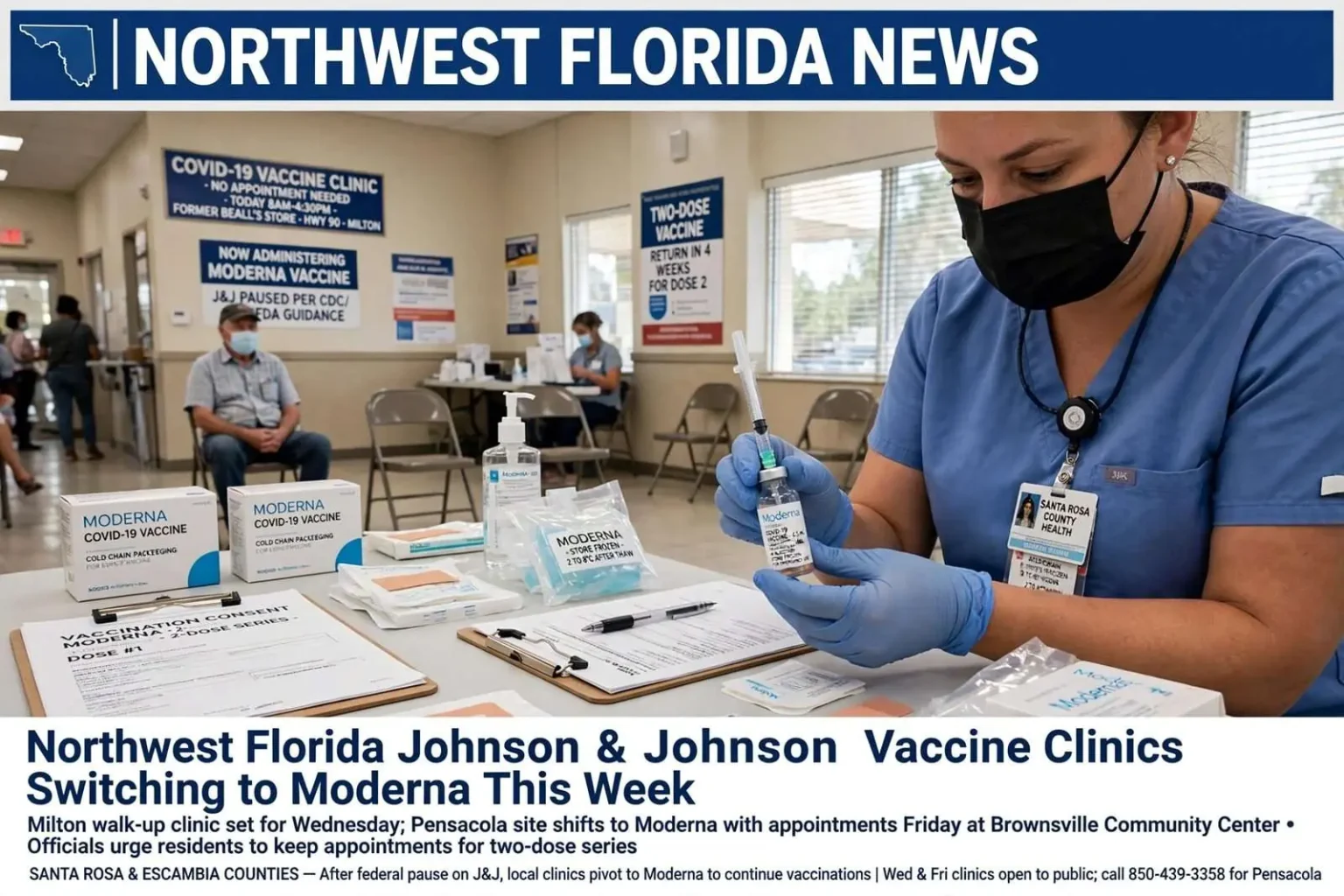
Two COVID-19 vaccination clinics in Northwest Florida are switching from the Johnson & Johnson shot to Moderna after federal health officials recommended a pause on the one-dose vaccine. The first clinic is set for Wednesday in Milton, at the former Beall’s store on Highway 90, from 8 a.m. to 4:30 p.m. No appointment is necessary. The second is Friday at the Brownsville Community Center on DeSoto Street in Pensacola, from 8 a.m. to 3 p.m. Appointments are required; those interested can call (850) 439-3358.
The change affects people who had been counting on the convenience of a single visit. Recipients of the Moderna vaccine will need to return in four weeks for their second dose, adding a scheduling step that the Johnson & Johnson product — prized precisely because it required only one shot — did not demand. Health officials urged residents not to let the extra visit deter them, stressing that both vaccines authorized for wider use at the time were highly effective at preventing severe disease, hospitalization and death from COVID-19.
For organizers in Santa Rosa and Escambia counties, the switch meant reworking logistics on short notice: different cold-storage requirements, different dosing schedules and new patient paperwork. The Moderna vaccine must be kept frozen for longer-term storage and comes in multi-dose vials, arrangements that differ from the Johnson & Johnson shipments clinics had been preparing to receive.
Why the Pause Was Called
Federal health officials recommended the pause on the Johnson & Johnson vaccine out of caution while they examined a small number of reports of a rare and severe type of blood clot among people who had received the shot within the preceding weeks. The Centers for Disease Control and Prevention and the Food and Drug Administration jointly announced the recommendation, directing states to hold off on new doses while the cases were reviewed.
The recommendation affected a vaccine that had been central to reaching hard-to-reach populations. Because it required only one dose and was easier to transport and store than the two-dose mRNA vaccines from Moderna and Pfizer-BioNTech, the Johnson & Johnson shot had been widely used at mobile clinics, homebound vaccination programs and other settings where a return visit was difficult. Health departments across the country had built outreach plans around its convenience.
In Northwest Florida, that meant clinics like the ones in Milton and Pensacola had to pivot to Moderna to keep their operations moving. Local officials emphasized that anyone who had already received the Johnson & Johnson vaccine and had not developed unusual symptoms in the weeks afterward had no reason to be alarmed, and that residents with questions could contact their health care provider or the state health department.
DeSantis Urges Calm
Gov. Ron DeSantis said the state had been planning for one of its smallest shipments of Johnson & Johnson vaccine and does not expect the pause to significantly disrupt the vaccination effort. He encouraged calm, noting he received the Johnson & Johnson shot himself.
“I got J&J,” DeSantis said. “I think my arm was sore for 45 minutes then that was that. So I think the track record thus far in Florida has been good.”
The governor said Florida is following the U.S. Centers for Disease Control and Prevention recommendation to pause use of the Johnson & Johnson vaccine, while noting the one-shot option remains valuable. His comments reflected the balancing act facing governors across the country: defer to federal regulators on safety questions while trying to keep the state’s vaccination campaign from losing momentum, particularly in communities where hesitancy was already a challenge.
How the Local Clinics Work
The Milton clinic, staged at the former Beall’s store on Highway 90, followed the pattern many Florida communities adopted during the vaccination campaign: large, familiar retail spaces converted into high-throughput vaccination sites where residents could drive or walk up, register on site and be observed for a short period afterward. The no-appointment format was designed to lower barriers for residents who could not easily schedule ahead, including older residents and workers with inflexible shifts.
The Brownsville Community Center clinic in Pensacola served a different purpose. Brownsville, a historic neighborhood west of downtown Pensacola, had been a focus of outreach efforts aimed at closing gaps in vaccination access, and community centers across the city had been used as neighborhood-scale sites that residents could reach without traveling across town. The Friday clinic required appointments, and organizers directed those interested to call (850) 439-3358 to reserve a dose.
Because the Moderna series requires two doses spaced four weeks apart, both clinics had to build follow-up scheduling into the visit itself. Patients leaving the Milton and Brownsville sites left with their second-dose arrangements in hand, a step health officials said was essential to making sure the two-dose regimen delivered its full protection. Health workers also reminded recipients that side effects — sore arm, fatigue, headache or mild fever — were more common after the second dose and typically passed within a day or two.
The View From the Coast
Northwest Florida’s vaccination push had unfolded against the backdrop of a region that saw some of the state’s heaviest COVID-19 burdens during the pandemic’s surges. Hospitals in Escambia and Santa Rosa counties spent much of the previous year managing waves of patients, and public health officials had repeatedly pointed to vaccination as the path back to normal school schedules, tourist seasons and community events along the Panhandle.
The pause on Johnson & Johnson doses arrived as the state was working to vaccinate its large senior population and had recently broadened eligibility to younger adults. Florida’s supply of Moderna and Pfizer-BioNTech doses was substantial, which is why DeSantis and state health officials expressed confidence that the pause would not meaningfully slow the campaign. The trade-off was convenience rather than capacity: residents who might have taken a single shot now faced a two-dose schedule, and clinics had to explain the change clearly to avoid confusion at the door.
Local health leaders also used the moment to reinforce basic messages about how the vaccines work. None of the authorized vaccines can give a recipient COVID-19, and the side effects reported after vaccination are signs of the immune system responding rather than illness. Officials encouraged residents who had deferred vaccination to take advantage of the walk-up availability in Milton and the appointment-based clinic in Brownsville while doses were available.
What Comes Next for the One-Dose Option
Federal officials framed the pause as a temporary measure, saying it would last only as long as needed to review the rare clotting reports and determine whether any warning or restriction was warranted for the Johnson & Johnson vaccine. In the meantime, the two-dose mRNA vaccines carried the full weight of the national campaign, including the clinics across Northwest Florida that switched their supply this week.
For residents of Milton, Pensacola and the surrounding communities, the practical guidance was straightforward: the Wednesday clinic in Milton remained open to walk-ins from 8 a.m. to 4:30 p.m., the Friday clinic at the Brownsville Community Center ran from 8 a.m. to 3 p.m. with appointments available at (850) 439-3358, and anyone who received a Moderna dose needed to plan for a return visit four weeks later.
Health officials in both counties continued to urge residents to treat vaccination as the state’s most reliable route out of the pandemic, whatever brand of vaccine arrived in the cooler. The pause on one product, they stressed, reflected a system designed to catch even vanishingly rare problems — and the appearance of Moderna doses at two familiar local sites was proof that the region’s campaign intended to keep moving.
Across Florida, the Johnson & Johnson pause also carried political weight. The governor had frequently highlighted the one-dose vaccine as a practical tool for reaching residents in rural counties, homebound seniors and other populations where a second appointment posed a real obstacle. Pausing its use removed one option from that toolbox, even as state officials insisted the overall supply picture remained strong enough to absorb the change without missing targets.
Community organizations in the Pensacola area continued to play a central role in the outreach. Churches, civic groups and neighborhood associations had spent months helping residents sign up for appointments, arranging transportation to sites and countering misinformation that spread online. Those networks shifted quickly as the clinic details changed, passing along the new Moderna schedule and the four-week return requirement so that no one who came for a Johnson & Johnson dose left empty-handed or confused about what to expect.
Health officials reminded the public that the review of the Johnson & Johnson vaccine was itself a sign the safety monitoring was functioning as intended. With millions of doses administered nationwide, regulators were watching for adverse events at a level of scrutiny no previous vaccination campaign had faced, and a pause of this kind meant the system was catching questions early rather than after the fact. Residents with appointments at either Northwest Florida clinic were encouraged to keep them.