One Dead in Citronelle Party Shooting; Police Cite Early Signs of Self-Defense
Marvin Buckley, 34, was killed in a shooting at a Citronelle party. Police say early signs point to self-defense; case heads to a grand jury.
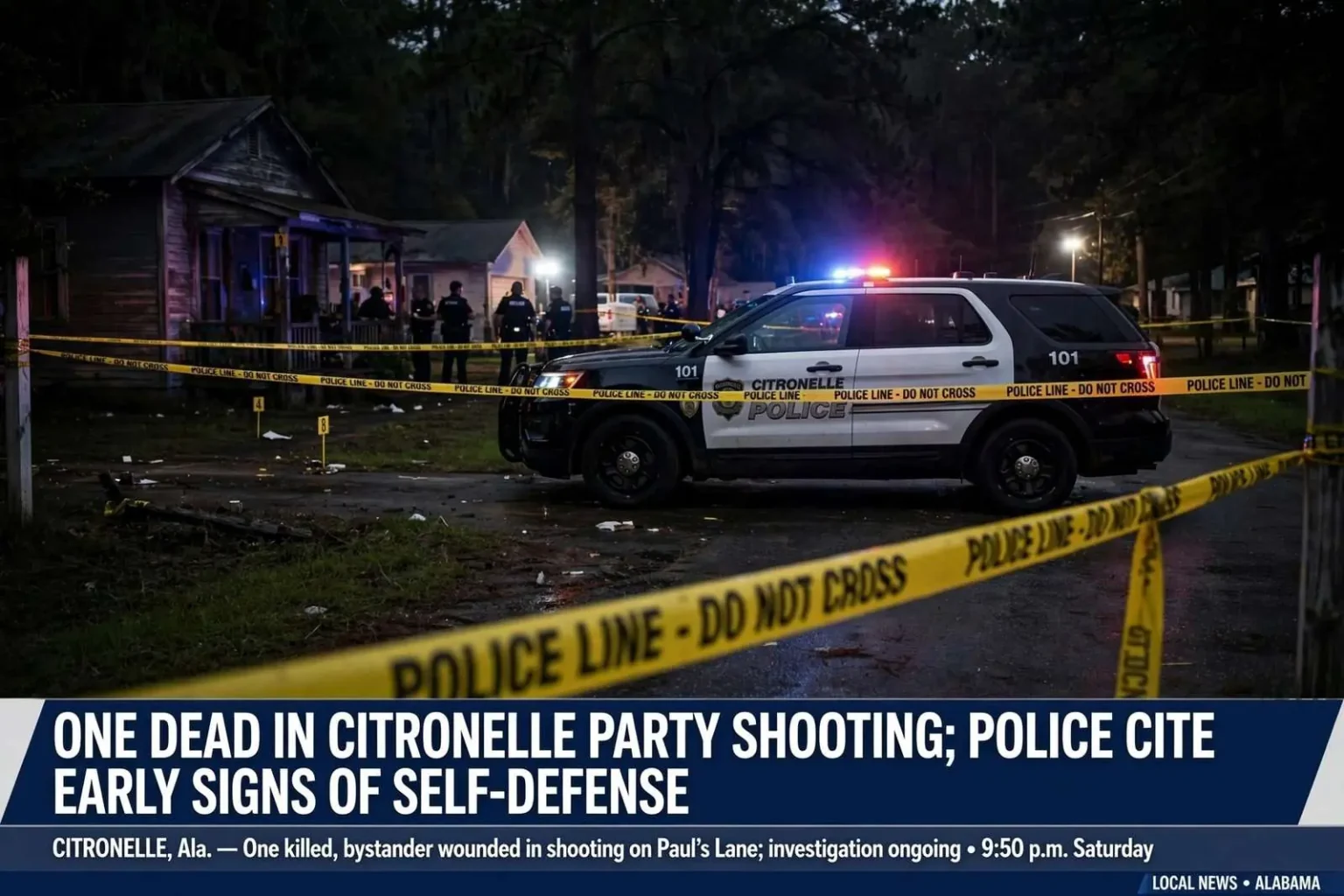
CITRONELLE, Ala. — One person was killed and a bystander wounded in a shooting at a party on Paul’s Lane in Citronelle, and police say early indications point to possible self-defense as the investigation continues.
Citronelle Police Chief Tyler Norris said officers were called to a fight involving a gun at a party around 9:50 p.m. Saturday. What began, according to police, as a verbal confrontation between two intoxicated individuals quickly turned physical, with a knife and a shotgun involved in the escalating violence.
One of the two men shot the other with the shotgun, inflicting fatal injuries. A bystander who tried to break up the fight was shot in the hand and was treated at USA Medical Center, police said. The wounded bystander’s injuries, while serious, were not life-threatening, according to the information police released.
The victims and the investigation
Police identified Marvin Buckley, 34, as the man killed in the shooting. The other person involved in the confrontation was identified as 18-year-old Gabriel Johnson. No charges had been filed as the investigation continued, and Chief Norris emphasized that the case remains open.
“The incident is still under investigation and will be presented to the Mobile County grand jury for consideration,” Norris said, adding that everyone involved has been cooperative and that the investigation is developing as expected. The grand jury presentation means prosecutors will lay out the evidence before a panel of citizens who will decide whether criminal charges are warranted.
That process is standard in Alabama for deaths that may have been justified. When early evidence suggests self-defense, investigators document the scene thoroughly and refer the case to the grand jury rather than making an immediate arrest, allowing the citizen panel to weigh the circumstances before charges are filed.
How the night unfolded
The call came in late Saturday evening, and by the time officers arrived on Paul’s Lane, the fight had already produced one death and one injury. Police described a sequence in which two intoxicated individuals argued, the argument turned physical, and weapons — a knife on one side, a shotgun on the other — entered the picture as the confrontation escalated.
Citronelle police responded within their city limits, and the Mobile County Sheriff’s Office and other county agencies routinely assist municipal departments in cases involving serious injury or death. The scene was processed for evidence, witnesses were interviewed, and the accounts gathered that night formed the basis of the report that will go before the grand jury.
Parties in rural communities like Citronelle often draw attendees from across the surrounding area, and officers investigating the shooting worked to sort out who was present, what was said, and in what order the violence unfolded. The chief’s account of a verbal confrontation between two intoxicated men, ending in a shotgun discharge, represents the working timeline as police have reconstructed it.
Self-defense and the grand jury process
Alabama law recognizes the right to use deadly force in self-defense, and the state’s Stand Your Ground statute removes the duty to retreat when a person reasonably believes deadly force is necessary to prevent death or serious bodily harm. Where a confrontation involves weapons on both sides — as police describe here, with a knife and a shotgun involved — the question of who was the aggressor and who was defending becomes the central issue for prosecutors.
The Mobile County grand jury sits in Mobile and hears evidence in felony cases from across the county, including the outlying municipalities and rural communities. The panel meets in secret, hears testimony and evidence presented by the District Attorney’s Office, and decides whether probable cause exists to indict. A presentation like this one will include the crime scene evidence, witness statements and the autopsy findings.
No charges had been filed in the days after the shooting, which aligns with how such cases typically proceed. If the grand jury declines to indict, the matter ends without criminal charges; if it returns an indictment, the case moves to circuit court for arraignment and trial. Either way, the decision rests with the citizen panel rather than with police officers at the scene.
Citronelle and policing in north Mobile County
Citronelle is a small city in the northern reaches of Mobile County, a community of roughly 4,000 people surrounded by timberland and rural countryside near the Washington County line. The city maintains its own police department, which handles calls within the city limits, and residents rely on that department for everything from traffic enforcement to the rare emergencies that shake a small town.
Nighttime calls involving weapons test a small department’s capacity in ways routine policing does not. Officers must secure a scene, coordinate with county investigators and the coroner’s office, and begin collecting witness accounts while memories are fresh. Chief Norris’s public updates have emphasized transparency as the case develops, including the early indication that the shooting may have been an act of self-defense.
The shooting on Paul’s Lane stands out in a community where violent deaths are rare, and word of the incident spread quickly through the city over the weekend. The department’s handling of the case — from the initial 9:50 p.m. Saturday response to the grand jury presentation — will determine how the legal side of this night is resolved.
When bystanders get hurt breaking up fights
The wounding of a bystander who tried to intervene is one of the recurring tragedies of fights that escalate to gunfire. In this case, police said the person who stepped into the altercation was shot in the hand and taken to USA Medical Center, the University of South Alabama’s trauma hospital in Mobile, which treats the most serious injuries from across the region. The intervening party’s decision to break up the fight placed them directly in the line of fire.
Safety experts and police departments have long advised against physically intervening in fights involving weapons, precisely because a confrontation that involves a knife or a gun can injure anyone within reach in seconds. The Citronelle shooting illustrates the point: a person trying to do the right thing ended up at a trauma center in Mobile, and the person who fired the shotgun now faces grand jury scrutiny even if the shooting was defensive.
The injury also complicates the legal picture. Prosecutors and grand jurors will consider the bystander’s account of who did what and when, and that testimony may bear directly on whether the fatal shot was justified. In cases where accounts conflict, physical evidence — shell casings, wound patterns, distances — becomes decisive.
Alcohol and small-town violence
Police described both men in the confrontation as intoxicated, a detail that recurs in the great majority of serious altercations in communities of every size. Alcohol lowers inhibitions, sharpens grievances and turns insults into fights, and when weapons are present — as they commonly are in rural Alabama — the distance from a shoving match to a killing is very short.
For Citronelle, the case is a familiar pattern playing out close to home: a party, alcohol, an argument between two people who knew each other, weapons drawn, and a death that no one present can undo. Police chiefs across rural Alabama spend considerable energy on the consequences of exactly this sequence, and Chief Norris’s description of the night tracked the pattern precisely.
The cooperation the chief described — everyone involved speaking with investigators as the case develops — is also typical of cases that end in grand jury review rather than immediate arrest. When the people present acknowledge the sequence of events, investigators can focus on verifying the physical evidence rather than untangling competing stories.
What happens next
In the coming weeks, the file assembled by Citronelle police and county investigators will go to the Mobile County District Attorney’s Office, which will present the case to the grand jury. The panel will hear the evidence and decide whether the 18-year-old identified in the shooting should face any charges, or whether the evidence supports a finding that the shooting was an act of self-defense under Alabama law.
If an indictment is returned, the case would proceed in Mobile County circuit court, where felony trials from the county’s municipalities and rural areas are heard. If no indictment follows, the investigation formally closes with no charges, as happens in a portion of the self-defense cases presented statewide.
For the family of Marvin Buckley, the process will bring painful weeks of waiting. For the 18-year-old whose shotgun ended the fight, it will determine whether the shooting is judged a crime or a defense. And for Citronelle, a small city unaccustomed to headlines about killing, the case on Paul’s Lane is a sobering reminder of how quickly a Saturday night party can become a coroner’s case.