Orange Beach Mother Pushes to Create Support Program for Students Facing Drug Suspensions
An Orange Beach mother is building a community intervention program to support students suspended under the school system's drug testing policy, after school leaders declined a formal partnership.
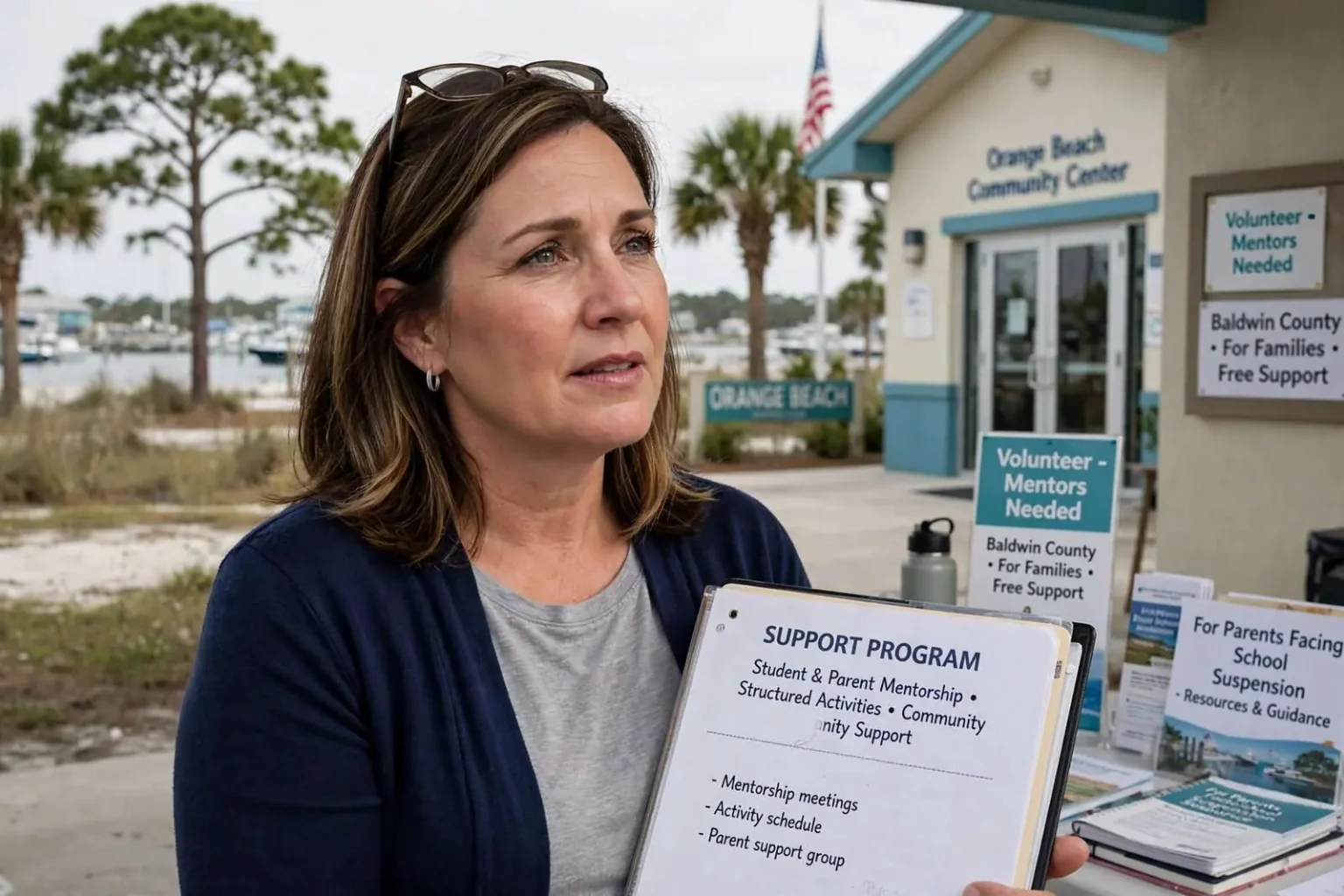
An Orange Beach resident is working to launch a community-based intervention program aimed at supporting students who test positive for drugs under the school system’s hair follicle testing policy, offering an outlet she says was missing when her own family faced a similar crisis. Neelli Faulkner said the idea grew out of a painful personal experience. Her son, then a student at a high school in central Alabama, tested positive during a school-administered drug test. He was subsequently placed in an alternative school alongside students who had been suspended for other offenses, and Faulkner said she watched him spiral in the aftermath. He was eventually incarcerated at age 24.
At the time, Faulkner said she could not find resources to help her navigate the situation or get her son the support he needed. Now living in Orange Beach, she wants to make sure other parents facing the same circumstances have somewhere to turn. Faulkner has already recruited more than 20 people to help build the program, which would focus on two main goals: keeping students who lose extracurricular privileges from sitting idle during their suspension, and creating mentorship opportunities that involve both students and their parents.
“I just don’t want another parent to have to go through something like what we went through,” Faulkner said. “I have the utmost respect for the superintendent and the board and everything they do. I just want there to be an additional resource in place for parents to talk to, bounce ideas off of and help kids hopefully realize the path they might be going down.”
A policy under scrutiny
The push comes as Orange Beach Schools’ relatively new drug testing policy continues to draw scrutiny from some residents, who have raised concerns about both the accuracy of hair follicle testing and student privacy. Hair follicle testing differs from the urine-based screens most Alabama districts have traditionally used: rather than detecting recent use over a few days, a hair sample can register drug use going back roughly 90 days, which makes it far more likely to catch occasional use that a urine test would miss. Critics argue that broader detection window also increases the chances of flagging students for conduct that happened weeks before the test and long after any immediate danger has passed, while supporters counter that the longer window is exactly the point of a deterrent policy.
Privacy questions have followed the same debate. School drug testing programs nationally operate in a narrow legal space carved out by the U.S. Supreme Court, which has upheld random testing of students who participate in athletics and other competitive extracurricular activities but has not authorized testing of the general student body. Alabama districts that test typically tie the program to parking privileges, athletics and clubs — the categories that courts have allowed — which means the students swept into the program are often the school’s most active teenagers rather than its most troubled ones.
Under the Orange Beach policy, students who test positive lose access to extracurricular activities as well as their on-campus driving and parking privileges. The penalties are significant in a coastal community where students often drive themselves to school and where athletics, band and other activities anchor social life. Faulkner said she personally has reservations about the school system testing students at all, and she does not support the specific method being used. But she said her greater concern is what happens to students once they are sidelined from sports, clubs and other activities.
“When these kids get suspended from those extracurricular activities, it’s the perfect opportunity for them to have idle hands and potentially get involved more with whatever they were doing that led to them being suspended,” Faulkner said. Her program would respond to that gap directly — structured activity and adult mentorship during precisely the months when a sanctioned student has lost the routines that kept him or her busy.
The school system declines a partnership
Faulkner initially hoped her organization could formally partner with Orange Beach Schools to give families a structured resource alongside the district’s policy. She brought the proposal to Superintendent Randy Wilkes and several board members, but Wilkes ultimately ruled out an official partnership. “We appreciate those in the community wishing to assist those in need of intervention,” Wilkes wrote in an email responding to the proposal. “As this matter relates to the board’s drug policy we cannot make a recommendation for use.”
The superintendent’s reasoning reflects the careful line school systems walk around discipline programs. A district that formally endorses a private intervention provider effectively attaches its authority to the provider’s methods, screening and results — and, in the view of many school attorneys, takes on exposure if the outside program fails or harms a student. Keeping the drug policy and any outside support separate lets the board administer its discipline while leaving families free to seek help on their own.
Faulkner said that after speaking with Wilkes about his decision, she came to understand his reasoning and does not fault the district for declining to formally endorse the program. The distinction matters for how the effort will operate: rather than a referral system run through the school, the program will have to reach families through churches, youth sports organizations and word of mouth — slower channels, but ones that preserve the district’s distance.
Building a program without the schools
Even without a school system partnership, she said several other organizations across Baldwin County have expressed interest in helping fund the effort going forward. Baldwin County’s network of nonprofits, ministries and youth-serving agencies has grown along with the county’s population, and Faulkner’s proposal fits a recognized niche: most community drug intervention resources are built for families in crisis, not for the awkward middle stage of a student who has been sanctioned at school but has not yet entered the justice system.
The design of the program draws on what Faulkner wishes had existed for her own son. Students losing extracurricular privileges would be offered structured activities and accountability during the suspension period, while mentors would work with both the student and the parents — an acknowledgment, she said, that the family is navigating the discipline together, and that parents often need guidance as much as the teenagers do. The parent-to-parent element, connecting families who have been through the same experience, mirrors the support-group model that has proven durable in other communities.
Faulkner said she plans to continue building out the program’s structure and recruiting volunteers in the coming months, with the goal of having a functioning support network in place for students and families who need it. Her argument to the community is simple and difficult to dispute: the school system has chosen its policy, and whether or not residents agree with hair testing or the penalties attached to it, the students who test positive are still the community’s children. What happens to them during the weeks they are off the team and out of the parking lot, she says, should not be left to chance.
What hair follicle testing actually measures
Part of the debate over the Orange Beach policy turns on how the technology works, and Faulkner’s reservations about the method are shared by drug-testing experts on both sides of the school-testing question. A hair sample reflects drug use over the growth cycle of the hair itself — roughly the previous 90 days for a standard head-hair sample. Metabolites enter the hair shaft through the bloodstream and remain detectable long after any impairment has passed. That makes hair testing an effective deterrent tool, in the view of its supporters, because a student cannot simply stop using for a weekend to pass a Friday test.
The same property is what critics find troubling. A student who experimented once at a party in July can test positive for a team in September, and the record carries no distinction between a single lapse and a sustained problem. External contamination, hair treatments and natural variations in hair chemistry have also been raised as accuracy concerns in legal challenges to hair testing over the years. None of this makes the technology useless, but it underscores why the consequences attached to a positive result — a semester without sports, without band, without driving to school — are disproportionate in the eyes of some parents.
Alabama districts that adopted expanded testing programs in recent years have generally done so with an eye on the state’s broader struggle with youth substance use, including the wave of vaping and THC products that reached schools statewide. The programs are pitched as a reason to say no: a student who knows a random test could cost a spot on the roster has a ready-made excuse to refuse. Where districts differ is in what happens after a positive test — some route students to counseling with a path back to eligibility, while others impose flat suspensions from activities. The support program Faulkner envisions exists to fill whatever gap a district’s own policy leaves.
A community answer to a community problem
The Orange Beach debate is unfolding in a school system that is still young and closely watched. The city broke away from the Baldwin County Public Schools system to form its own district, a move that gave Orange Beach residents direct control over their schools’ budget, curriculum and policies — and, with it, a school board whose decisions now draw the kind of public scrutiny that a larger county system sometimes diffuses. Drug testing is one of the first policies of the new district to generate sustained public pushback, which is one reason the superintendent’s response to Faulkner’s proposal was weighed so carefully.
Faulkner’s approach — build the program outside the schools, fund it through community organizations and recruit volunteers — mirrors how similar efforts have taken root in other Baldwin County communities. Church youth programs, mentoring organizations and recovery-support groups already serve teenagers in the county, but few are designed specifically for students navigating school discipline connected to drug testing. That specificity is the program’s niche and, potentially, its strength: a family that receives a positive test result would have somewhere concrete to go, staffed by people who understand exactly what the sanction means.
The open questions are practical rather than philosophical. Where will the program meet students? Who screens the mentors, and how will parents be connected to them? Faulkner’s 20-plus recruits and the interest from county organizations suggest the volunteer base exists; the coming months are about converting it into an organization with a phone number families can call. Her measure of success is equally concrete: that the next family facing a positive hair test has somewhere to turn before the idle weeks compound — and that no other parent watches a sanctioned student drift, as hers did, all the way to a prison cell by 24.