Sonar Skiffs, a Knuckle-Boom Barge and Dive Teams: Orange Beach Has Pulled 65,000 Pounds of Debris This Year
Orange Beach's Waterways and Shoreline Enhancement Program has removed 65,000 pounds of debris from more than 46 miles of shoreline this year, on top of 242,320 pounds collected by the Leave Only Footprints beach initiative. The GOMESA-funded program has topped 400,000 pounds since 2014.
ORANGE BEACH, Ala. — A long-running marine cleanup effort in Orange Beach is posting strong numbers again.
The city’s Waterways and Shoreline Enhancement Program has already collected 65,000 pounds of debris from local waterways and shorelines this year. The program covers more than 46 miles of beach, marsh and coastal shoreline, and it remains one of the most active coastal cleanup operations along the Alabama Gulf Coast.
What the Program Is For
Orange Beach launched WSEP in 2014 as a pilot program to systematically identify and remove marine debris from coastal and intertidal environments. The targets are specific: derelict docks and piers, abandoned fishing gear, marine debris mats and other human-made material that accumulates along the shoreline.
Marine debris is not simply an eyesore. It threatens coastal habitats and wildlife, creates navigation hazards, and degrades the appearance of the shoreline in a community whose economy depends on how that shoreline looks.
Each of the program’s target categories carries a distinct problem.
Derelict docks and piers. A structure that fails in place does not disappear. Pilings, decking and hardware break apart over successive storms and distribute themselves across the bottom and along the marsh edge. Older structures may involve treated lumber, and the fasteners and framing that come loose create both navigation hazards and puncture risks.
Abandoned fishing gear. This is the category with the most direct wildlife consequence. Lost crab traps continue to catch — a phenomenon called ghost fishing, in which a trap keeps capturing animals that die and then serve as bait for the next ones, cycling indefinitely. Monofilament line entangles birds, turtles and marine mammals and persists in the environment for decades.
Marine debris mats. Accumulations of tangled material that collect in marsh and shoreline areas, smothering the vegetation underneath. Coastal marsh is among the most productive habitat in the Gulf, serving as nursery ground for a large share of commercially and recreationally important species, and material that sits on top of it kills it.
The Money Comes From Offshore Energy
Funding for the program comes from the Gulf of Mexico Energy Security Act, commonly known as GOMESA. That federal funding supports full-time staff and the vessels used for cleanup operations, and the program’s scale would not be possible without it.
GOMESA directs a share of revenue from offshore oil and gas leasing in the Gulf back to the four Gulf producing states and their coastal political subdivisions, restricted to a defined set of uses: coastal protection and restoration, mitigation of damage to natural resources, and related conservation and infrastructure work.
What makes GOMESA unusual among funding sources is that it is recurring rather than one-time. A great deal of Gulf Coast restoration money in the past decade arrived as settlement funds tied to the Deepwater Horizon disaster — large sums, but finite and expiring. GOMESA revenue continues, which is what allows a city to hire permanent staff and buy vessels rather than run a project until the grant runs out.
That distinction shows in the results. A program with permanent staff and equipment accumulates institutional knowledge about where debris collects, which is worth more over a decade than any single cleanup event.
How the Work Gets Done
Daily operations combine three methods: vessel-based shoreline assessments, community reporting and side-scan sonar surveys.
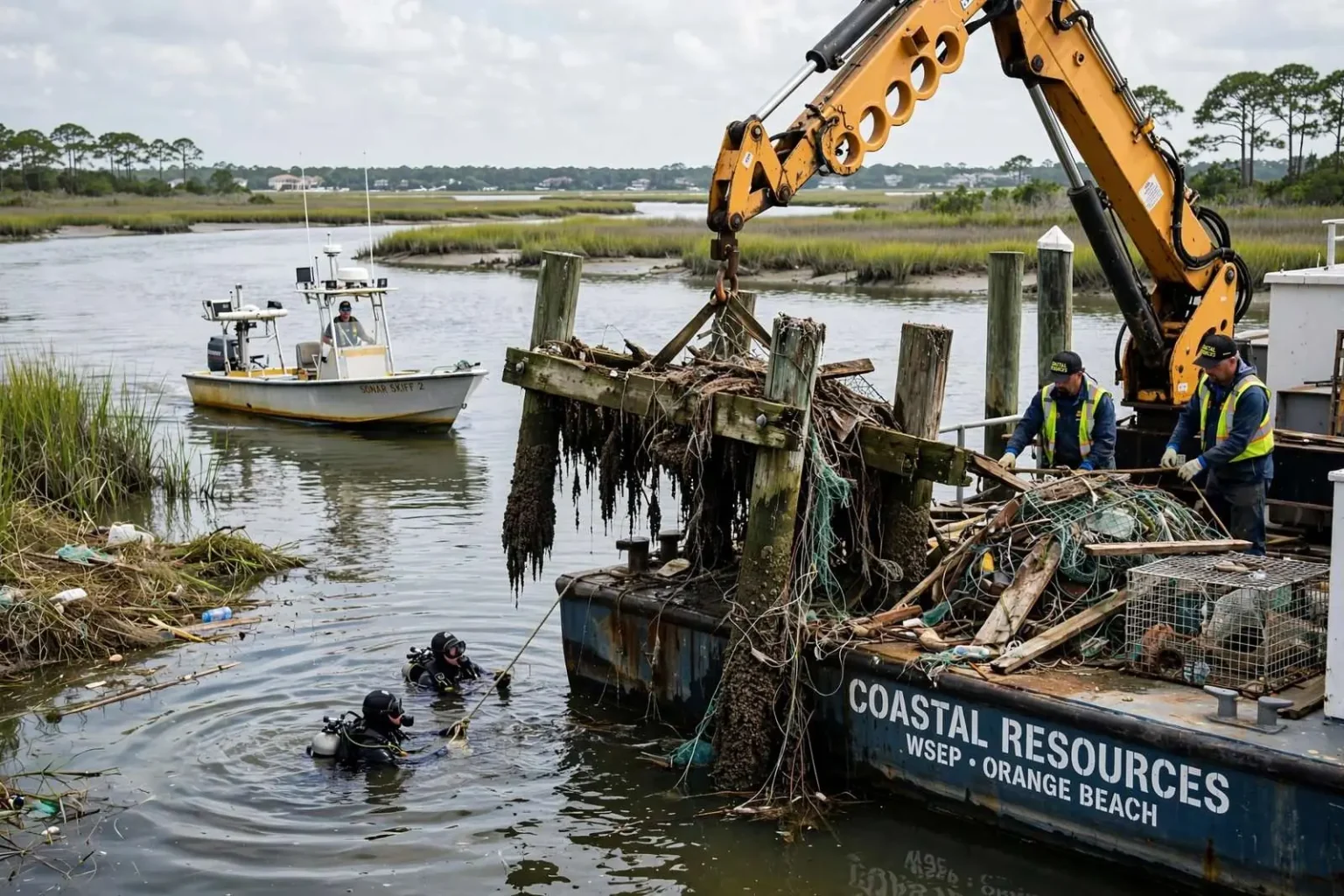
Two sonar-equipped skiffs patrol the waterways five days a week. Side-scan sonar is the key technology here — it produces an image of the bottom by sweeping acoustic beams out to either side of the vessel, revealing sunken objects that surface observation cannot detect. In the turbid water typical of bays and back bays along this coast, visual searching from the surface is close to useless below a few feet. Sonar is what turns an unknown bottom into a mapped one.
Larger debris and navigation hazards are handled by a work barge fitted with a knuckle-boom crane capable of lifting heavy material. A knuckle-boom — an articulated crane that folds at a joint rather than telescoping straight out — is the right tool for this work because it can reach over and around obstacles and place a load precisely on a deck, which matters when the object being lifted is a waterlogged dock section of uncertain weight.
Trained dive teams also play a central role. Divers periodically locate and rig underwater debris for removal, restoring the seafloor and reducing hazards to wildlife and boat traffic. Diving in low-visibility coastal water to rig unknown submerged objects is genuinely difficult and hazardous work, performed largely by feel.
The combination of surface and underwater operations is what allows crews to reach debris that would otherwise never be found.
More Than 400,000 Pounds Since 2014
Since the program began, WSEP has removed more than 400,000 pounds of marine trash and debris from Orange Beach’s waterways and shorelines. That total reflects more than a decade of sustained work by Coastal Resources staff.
Two hundred tons is a substantial figure for a single municipality, and the arithmetic is worth pausing on: it represents roughly 36,000 pounds a year on average, which means this year’s 65,000 pounds is well ahead of the long-run pace.
The Beach Program Is Bigger Still
Alongside WSEP, the Leave Only Footprints initiative continues to have a major impact on Gulf beaches. That program has collected 242,320 pounds of debris from Orange Beach beaches so far this year.
The scale difference between the two programs is instructive. Leave Only Footprints has collected nearly four times as much material this year as the waterways program, which reflects the different nature of the debris. Beach debris is largely visitor-generated and continuously replenished — chairs, tents, umbrellas, coolers, toys and litter left behind daily during the season, along with material that washes ashore. Waterway debris is heavier per piece, harder to find and slower to accumulate.
Together the two programs represent a significant municipal commitment to coastal environmental protection, and they address complementary problems: one manages an ongoing daily stream, the other removes a legacy accumulation.
How Residents Can Contribute
Community reporting is one of the three inputs the program relies on. Residents and boaters who encounter debris, a derelict structure, abandoned gear or a submerged hazard can report it to the city’s Coastal Resources department, and those reports feed directly into the crews’ work planning.
Boaters are especially valuable here, because they cover water that patrol skiffs may not reach on a given week and because they are the people most likely to encounter a hazard the hard way.
The People Doing It
City officials singled out the field staff.
“A sincere thank you goes out to all the Coastal Resources staff, who are the heartbeat of these programs,” the city said in a statement.
Their daily work keeps Orange Beach’s waterways and beaches cleaner for residents and visitors alike — a service most people experience only as the absence of a problem.
Why Marine Debris Persists
The reason a program like this has to run continuously rather than finishing a job comes down to materials.
Most of what accumulates on a shoreline now is plastic in some form, and plastic in the marine environment does not decompose so much as fragment. Ultraviolet light and mechanical action break larger items into progressively smaller pieces, which become harder to collect at every stage. Material that is not removed while it is still recognizable eventually becomes microplastic distributed through sediment and the water column, where no cleanup program can reach it.
That is the practical argument for a program that patrols weekly rather than holding an annual cleanup day. Collection is dramatically more efficient when debris is still intact and still where it landed.
Storms complicate the arithmetic. A single significant tropical system can deposit more material along a shoreline in a day than a program removes in a year — destroyed docks, displaced vessels, structural debris from upland properties, and everything that was floating anywhere in the system. Coastal cleanup totals in the Gulf are therefore lumpy by nature, spiking in the year after a storm and settling in quiet years.
Ghost Gear, in Particular
Of everything WSEP targets, abandoned fishing gear does the most biological damage per pound.
A derelict crab trap continues to function exactly as designed. Animals enter, cannot exit, and die. Their remains attract the next round. The cycle can continue for years until the trap degrades or is removed, and a single lost trap can account for a substantial number of crabs and incidental species over its lifespan. Multiply by the number of traps lost across a bay system in a season and the cumulative effect on a fishery becomes meaningful.
Many jurisdictions now require escape panels secured with degradable fasteners, so that a lost trap eventually opens itself. That helps at the margin; it does not address gear already on the bottom.
Monofilament line is the other persistent category. It is nearly invisible in water, extremely strong, and takes an extraordinarily long time to break down. It entangles birds at the surface, turtles and marine mammals in the water column, and it wraps propellers. Recycling bins for used line have become standard at piers and boat ramps throughout the region for exactly this reason.
What Boaters Can Do
The program relies on community reporting as one of its three inputs, and boaters are the most valuable reporters because they cover water that patrol skiffs may not reach every week.
- Report what you find. Location, description and a photograph if possible. Submerged hazards, derelict structures and abandoned vessels all matter.
- Retrieve what you safely can. A floating line or a piece of debris on the surface is easier to remove now than after it sinks.
- Use monofilament recycling stations. They are at most public ramps and piers in the area.
- Mark and maintain your own gear. Traps lost because of poor marking or degraded line become someone else’s problem for years.
- Deal with an aging dock before it fails. A structure removed deliberately costs a fraction of what it costs the public to recover after a storm distributes it across a marsh.
The Broader Regional Effort
Orange Beach’s program is one piece of a larger coastal cleanup picture in Alabama. This newsroom reported earlier this month that a multi-agency partnership involving the Gulf of America Alliance, the Alabama Law Enforcement Agency and Mississippi State University’s Coastal and Marine Extension removed 42 abandoned and derelict vessels and nearly 175 tons of debris from Alabama’s coastal waters over the past year, working in Bon Secour Bay, south Mobile County, the Mobile-Tensaw Delta and the Perdido River and Bay area.
Those efforts are complementary rather than duplicative. A municipal program handles the shoreline and waterways within a city’s jurisdiction on a continuous basis; a multi-agency partnership addresses larger vessels and areas outside any single municipality’s reach.
Update: Program Totals Pass 400,000 Pounds Since 2014
Orange Beach Coastal Resources reports that the Waterways and Shoreline Enhancement Program has now removed more than 400,000 pounds of marine trash and debris from local waterways and shorelines since its launch — a cumulative figure that puts this year’s 65,000 pounds in context.
The program’s staffing and equipment are funded through the Gulf of Mexico Energy Security Act, which directs a share of federal offshore energy revenue to Gulf states and coastal political subdivisions. GOMESA money supports two full-time staff members along with a vessel and a work barge.
Leave Only Footprints Adds Another 242,320 Pounds
WSEP is not the city’s only debris effort. The separate Leave Only Footprints initiative, which targets material left on the Gulf beaches themselves, has collected 242,320 pounds so far this year in Orange Beach.
Taken together, the two programs account for well over 300,000 pounds of material removed from Orange Beach shorelines and waters in 2026 alone.
A Model Built to Be Copied
City officials describe the approach as a template other coastal communities can adapt: sustained municipal investment, specialized equipment, trained personnel, community reporting and coordination with regulatory agencies, combined into a single framework for addressing marine debris.
Coastal Resources staff, the city noted, are “the heartbeat of these programs.”