Pascagoula declares local emergency as Tropical Storm Cristobal approaches
Pascagoula declared a local emergency ahead of Tropical Storm Cristobal, opening self-service sandbag stations at the Jackson County Fairgrounds for.
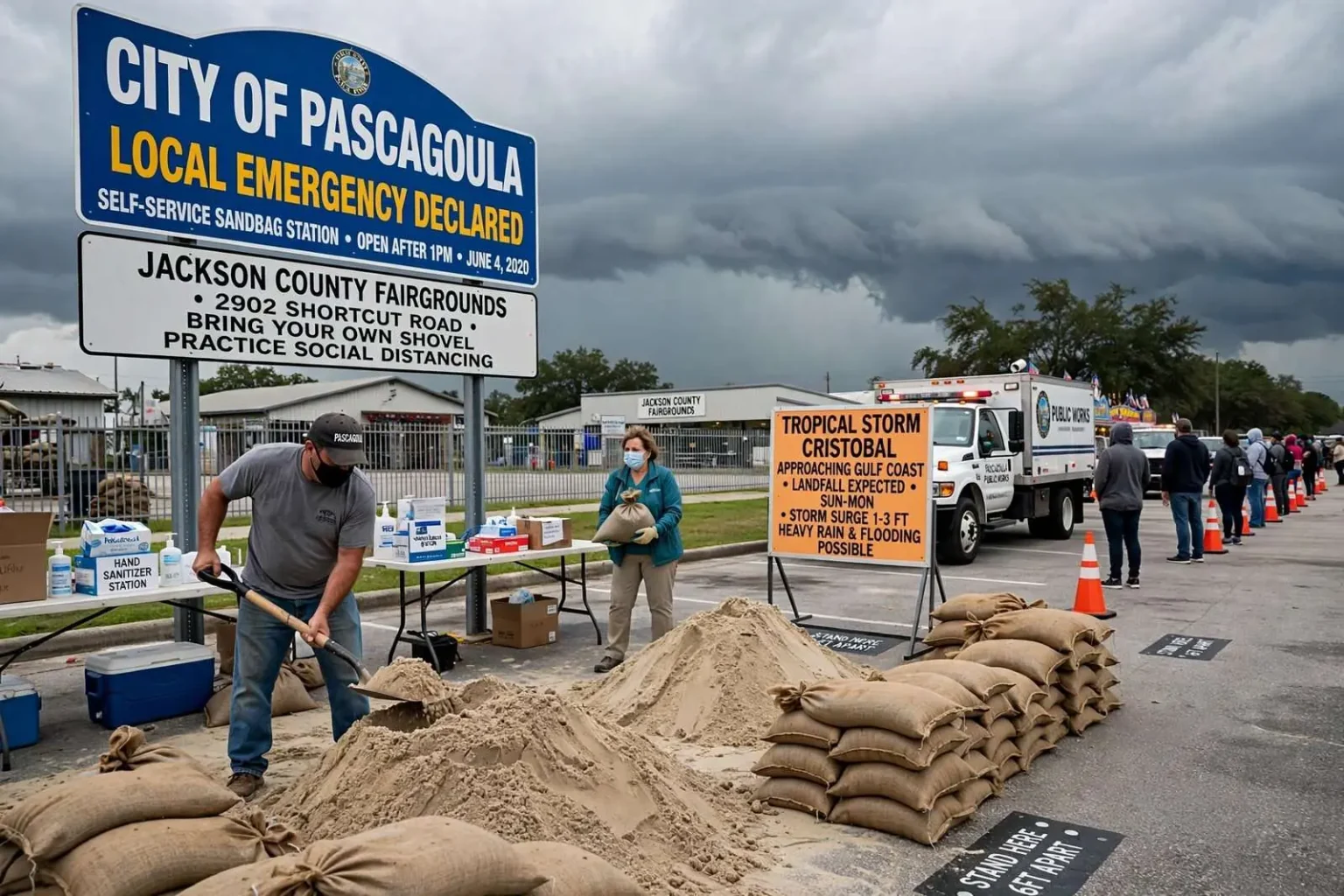
PASCAGOULA, Miss. — The City of Pascagoula declared a local emergency as Tropical Storm Cristobal approached the Gulf Coast, opening self-service sandbag stations so residents could prepare for possible flooding. The declaration, one of the standard first moves a Gulf Coast city makes when a tropical system threatens, freed up emergency procedures and signaled to residents that preparation time was running short.
Mayor Steve Demetropoulos announced that sandbags would be available at the Jackson County Fairgrounds, located at 2902 Shortcut Road, beginning after 1 p.m. on June 4. Residents were asked to bring their own shovels to fill the bags themselves and to practice social distancing while doing so, a requirement that marked the storm season of 2020 as unlike any other on the Mississippi Gulf Coast.
A storm tracked into an unusual year
Cristobal was already a record-setter by the time it turned toward the northern Gulf of Mexico. Forming in late May and early June 2020, the system became the earliest third named storm of an Atlantic hurricane season on record, an ominous start to what would become one of the busiest seasons in history. The storm spent days over Mexico and Central America, dumping heavy rain and causing fatal flooding, before moving north over the Bay of Campeche and into the Gulf.
Forecasts at the time indicated Cristobal could reach the Gulf Coast late Sunday into Monday, with the central Gulf Coast — from southeast Louisiana across the Mississippi Sound to the Alabama line — squarely in the forecast cone. For Pascagoula, a city built on low ground along the Pascagoula River and the sound, the primary threats were storm surge, torrential rain and the tidal flooding that comes with persistent southerly winds pushing water into the bays and bayous that thread through the city.
City officials urged residents to monitor the weather closely as the storm approached, and the local emergency declaration put city departments on the same footing for storm response. Declarations of this kind allow municipalities to mobilize resources quickly, coordinate with county emergency management and position themselves for any state assistance that might be needed if damage occurs.
Sandbags: the Gulf Coast’s first line of defense
The sandbag operation at the fairgrounds followed a ritual familiar to everyone who lives along the Mississippi coast. When a tropical system enters the Gulf, cities and counties open fill sites where residents can load their own bags, taking them home to stack across garage doors, door thresholds and driveways that slope toward the street. The bags do not stop a serious storm surge, but they are remarkably effective against the nuisance flooding — a foot or two of water driven by wind and tide — that damages floors, doors and vehicles in low-lying neighborhoods.
Pascagoula’s geography makes such preparation more than a formality. The city sits between the Pascagoula River, one of the largest free-flowing rivers in the continental United States, and the Mississippi Sound, with bayous and drainage canals running through residential areas. Easterly winds ahead of a Gulf storm push water up the sound and into the river system, and streets near the waterfront and along the bayous can flood even when the storm center makes landfall far to the west, as was expected with Cristobal.
Residents who came to the Jackson County Fairgrounds on June 4 were asked to bring their own shovels because the self-service model relies on people filling bags at the pile rather than a crew distributing filled ones. The arrangement lets a city serve hundreds of households in a few hours with limited staff, and it is standard practice across Jackson County and the rest of the coast when a storm threatens.
Preparing in a pandemic
The call for social distancing at the sandbag site reflected the reality of June 2020, when the coronavirus pandemic was still shaping nearly every public activity. Emergency managers along the Gulf Coast spent the spring reworking hurricane plans to account for the virus, adding precautions at shelters, distribution points and sandbag sites. Residents lining up at the fairgrounds were asked to keep their distance from one another, a small but telling reminder that even the routine chores of storm season had acquired new rules that year.
City officials urged residents to keep watching the forecast over the weekend, since tropical systems in the Gulf frequently shift east or west in their final 48 hours and small changes in track can mean large differences in local impact. With landfall expected late Sunday into Monday, the city’s message was straightforward: get sandbags down, secure loose items outdoors, and be ready for heavy rain, gusty winds and water on low-lying streets beginning as early as Saturday.
What residents were watching for
By the time sandbags were flowing at the fairgrounds, forecasters had a reasonably clear picture of Cristobal’s expected behavior. The storm was large, with rain and wind fields stretching hundreds of miles from its center, meaning its effects would arrive well before landfall and spread far from the point where the eye came ashore. Bands of rain were expected to sweep across coastal Mississippi ahead of the center, and water levels in the sound were projected to rise through the weekend.
Storm surge forecasts for the central Gulf Coast put water levels one to three feet above normal tide levels in vulnerable areas, with the exact height depending on where the center crossed and how strong the system was at landfall. Cristobal was expected to remain a tropical storm rather than intensify into a hurricane, but emergency managers on the Mississippi coast consistently warned that flooding — not wind — is the threat most likely to damage homes in Pascagoula during a weak Gulf storm.
Residents of flood-prone streets also had the usual checklist to work through: moving vehicles to higher ground, clearing storm drains of debris, securing trash cans and lawn furniture, and checking on neighbors who might need help, particularly elderly residents living alone. Schools and government offices along the coast watched the forecast for Monday closures, and businesses in low-lying commercial districts made their own arrangements to protect inventory.
Jackson County’s emergency network
Pascagoula is the county seat of Jackson County, and its emergency operations mesh with the county’s emergency management agency, which coordinates sandbag sites, shelters and storm communications across communities including Ocean Springs, Gautier, Moss Point and the unincorporated areas. The Jackson County Fairgrounds on Shortcut Road is a familiar staging location, large enough to handle heavy equipment and hundreds of vehicles while leaving room for residents to fill bags and load them safely.
The county’s position on the coast means its emergency plans draw on hard experience. Hurricane Katrina in 2005 devastated the Mississippi Gulf Coast, and storms including Gustav, Isaac and Nate have since forced evacuations, closures and flood response across Jackson County. Each event has refined the playbook that cities like Pascagoula follow: declare early, get sandbags out, communicate clearly and keep residents informed with verified information rather than rumor.
June storms and a long season ahead
A tropical storm threatening the coast in early June is unusual, and Cristobal’s arrival so early in the season reinforced what meteorologists had been saying for years: the Gulf Coast’s storm season starts earlier and ends later than it once did. The 2020 season would go on to exhaust the regular list of storm names and move deep into the Greek alphabet, producing a record thirty named systems and making early preparation a necessity rather than a suggestion.
For Pascagoula residents, the practical lesson of the Cristobal approach was the same one coastal Mississippi teaches with every storm. Water is the enemy in a weak system, sandbags are cheap insurance, and the hours between a forecast and landfall are the time to act. The city’s emergency declaration and the fairgrounds sandbag site gave residents a concrete way to do exactly that before Cristobal’s rain bands reached the Mississippi Sound.
As the weekend approached, the city planned to keep residents updated through its official channels, and emergency managers reminded everyone that the same information is broadcast by local media and the National Weather Service office in New Orleans/Baton Rouge area serving the Mississippi coast. The advice at the center of every update was unchanged: monitor the weather, take the flooding threat seriously, and finish preparations before conditions deteriorate.
The days after: cleanup and lessons
Once a system like Cristobal passes, the work shifts from preparation to recovery. Low-lying streets that took water are inspected, storm drains are cleared of the debris the surge leaves behind, and public works crews collect the sandbags residents set out. City officials typically ask residents to document any flood damage with photographs before discarding ruined materials, both for insurance purposes and for any disaster assistance that might become available if damage is widespread enough to trigger a state or federal declaration.
Emergency managers also use each storm to refine the next response. Sandbag demand, traffic flow at distribution sites and the timing of public notifications are all reviewed after the fact, and the precautions added during the 2020 season — from distancing at fill sites to changes in sheltering plans — became a permanent part of how Gulf Coast cities think about storm operations.
For now, the story of Cristobal’s approach in Pascagoula is the story the Gulf Coast knows best: a declaration signed, shovels in hand at the fairgrounds, bags stacked against garage doors across the city, and everyone watching the radar as the storm crawled north toward landfall late Sunday into Monday. Preparation, done early, is what turns a tropical storm from a potential disaster into a messy weekend — and Pascagoula gave its residents every chance to get it done.