PenAir Credit Union Promotes Ryan Vann to Senior Vice President and Chief Lending Officer
PenAir Credit Union has promoted Ryan Vann to senior vice president and chief lending officer, overseeing consumer, mortgage, commercial and indirect lending.
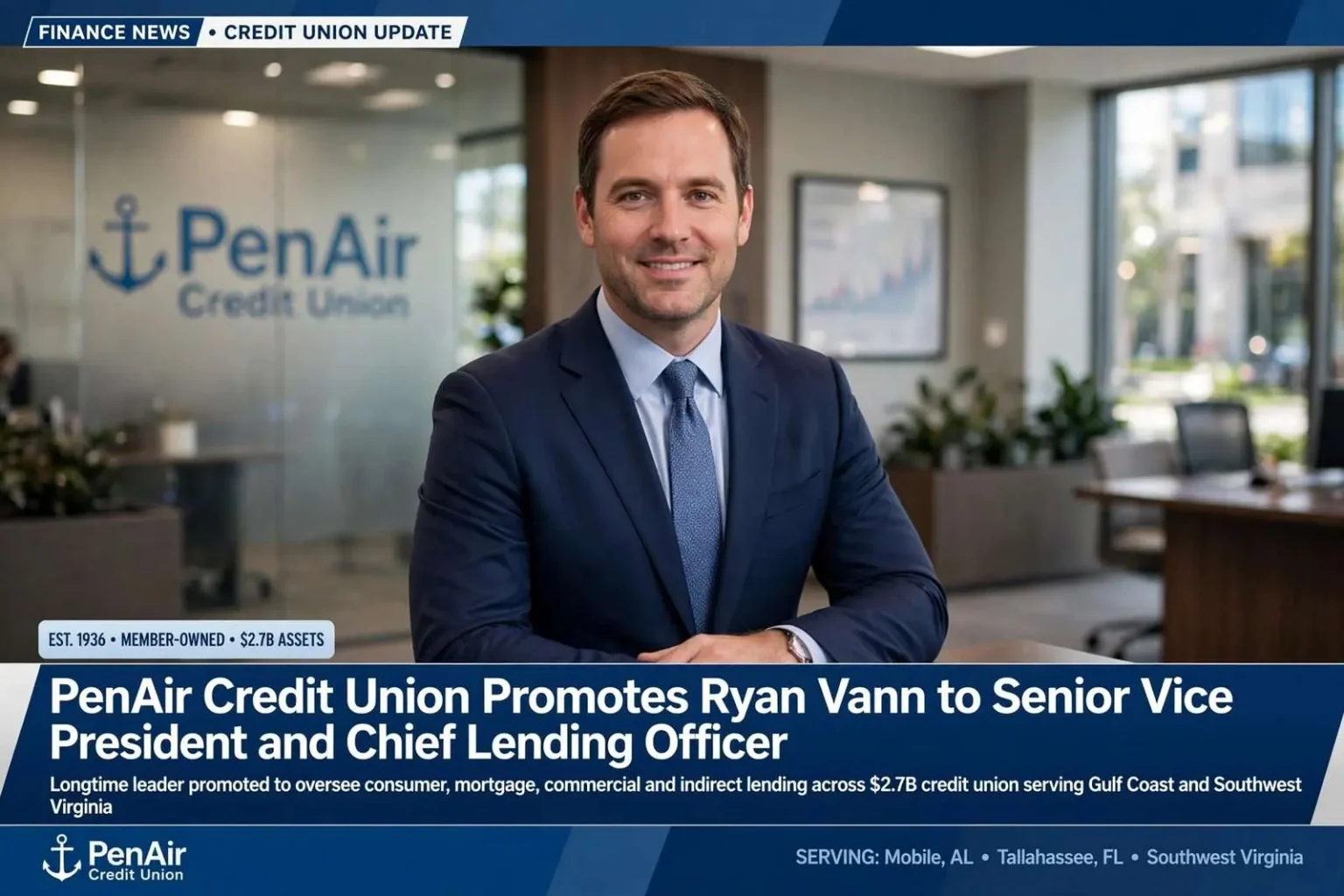
PenAir Credit Union has named Ryan Vann as its senior vice president and chief lending officer, promoting a longtime leader within the $2.7 billion institution that serves members from Mobile, Alabama, to Tallahassee, Florida, and Southwest Virginia.
Vann has spent his career climbing through leadership roles at PenAir, earning a reputation for building strong teams, embracing innovation and delivering results for both members and the organization. Under his leadership, PenAir has expanded its lending reach, strengthened portfolio performance and improved the systems and processes that support members throughout their borrowing journey.
CEO Praises ‘Clear Choice’
PenAir President and CEO Lee Morgan said Vann’s track record made the decision straightforward.
“Ryan’s leadership, strategic mindset, and deep understanding of our members and markets made him the clear choice for this role,” Morgan said. “He has helped shape the success of our lending organization for many years, and I am confident he will continue building on that foundation while leading us into the next chapter of growth.”
Having grown up through the organization’s leadership ranks, Vann brings deep institutional knowledge and a forward-looking perspective to the role. He has worked closely with teams across the credit union to strengthen operations, improve the member experience and advance strategic initiatives.
What the Role Covers
In his new position, Vann will provide strategic leadership for the credit union’s full lending lineup, including consumer, mortgage, commercial and indirect lending. He will work alongside executive leadership to drive PenAir’s growth strategy while maintaining the responsible lending standards the organization says are central to helping members reach their financial goals.
“Lending is about more than loans. It’s about helping people move forward with confidence during some of life’s most important moments,” Vann said. “Whether someone is purchasing a vehicle, buying a home, growing a business, or pursuing a personal goal, we have an opportunity to make a meaningful difference. I’m honored to step into this role and continue working with our talented teams to serve our members and communities.”
A 1936 Institution Still Growing
Established in 1936, PenAir Credit Union has grown into one of the region’s larger member-owned financial institutions, with assets surpassing $2.7 billion. The credit union says it remains focused on building strong leadership, fostering innovation and delivering financial solutions across its Gulf Coast and Virginia markets, while also contributing to community growth through education, development projects and charitable work.
As PenAir continues to expand across those markets, the promotion of a homegrown leader to its top lending post signals a continuation of the strategy the organization credits for its recent growth.
What a Chief Lending Officer Actually Does
The chief lending officer title Vann now holds sits among the most consequential executive roles at any bank or credit union, since lending is typically the primary way a financial institution generates revenue and, at the same time, the area carrying the greatest financial risk if managed poorly. A chief lending officer is generally responsible for setting the institution’s overall lending strategy and risk appetite — deciding, in broad terms, how aggressively the organization will pursue growth in categories like auto loans, mortgages, business lending, and indirect lending arranged through car dealerships and other third parties — while also overseeing the underwriting standards, staffing, and systems that turn that strategy into day-to-day loan decisions across the entire footprint. The role requires balancing two often competing priorities: growing the loan portfolio to generate the interest income that funds the institution’s operations and member services, and maintaining underwriting discipline strict enough to avoid the kind of loan losses that can erode an institution’s capital, particularly during economic downturns when borrowers across a portfolio can struggle simultaneously. That balancing act is part of why PenAir’s announcement specifically credits Vann’s tenure with both expanding lending reach and strengthening portfolio performance — the two metrics that, taken together, indicate a lending division growing responsibly rather than simply growing.
How Credit Unions Differ From Banks
PenAir’s structure as a credit union rather than a bank shapes how it operates in ways that matter to understanding an executive move like this one. Credit unions are member-owned, not-for-profit financial cooperatives: rather than answering to outside shareholders seeking to maximize stock returns, a credit union is technically owned by its depositors, who are called members, and any earnings beyond what is needed for operations and reserves are generally returned to members in the form of better interest rates, lower fees, or reinvestment in products and services. This structural difference is why credit unions have historically marketed themselves around member benefit rather than profit maximization, and it is also why executive appointments at credit unions are often framed, as PenAir’s is here, around the theme of serving members and communities rather than purely around growth or shareholder value. Credit unions are regulated primarily by the National Credit Union Administration, a federal agency that insures member deposits up to the same $250,000 threshold the FDIC insures bank deposits, giving members a comparable safety net to what bank depositors receive.
The Credit Union Movement’s Depression-Era Roots
PenAir’s founding year, 1936, places it squarely within the wave of credit unions established in the wake of the Federal Credit Union Act of 1934, federal legislation passed during the Great Depression specifically to expand Americans’ access to affordable credit at a time when many working people, including federal employees and members of the armed services, had limited access to traditional bank lending. Many of the country’s older, larger credit unions trace their roots to that era and to affinity groups — often employees of a specific company, government agency, or, as PenAir’s name suggests, military installation — who pooled deposits to lend to one another under terms more favorable than commercial banks of the era typically offered. Over the following decades, many of these institutions gradually expanded their membership eligibility rules beyond their original affinity group, a process that has allowed credit unions like PenAir to grow into multi-state institutions serving general community membership across broad geographic footprints, while retaining the cooperative, not-for-profit structure that traces directly back to their Depression-era origins.
Why Multi-State Growth Has Become Common Among Credit Unions
PenAir’s footprint spanning Gulf Coast Alabama and Florida communities along with Southwest Virginia reflects a broader consolidation and expansion trend that has reshaped the credit union industry over the past two decades. Regulatory changes have gradually loosened the geographic and membership restrictions that once confined most credit unions to a single city, employer, or region, while rising compliance costs and technology investment requirements — the expense of building modern online banking, mobile apps, and fraud-detection systems — have pushed many smaller, single-market credit unions to merge into larger regional or multi-state institutions capable of spreading those fixed costs across a bigger membership base. The result has been a steady decline in the total number of credit unions nationally even as the assets held by the surviving, larger institutions have grown substantially, a pattern industry analysts often describe as consolidation without contraction: fewer institutions, but a system serving roughly the same or a growing number of members overall. PenAir’s growth to $2.7 billion in assets across three states situates it as one of the beneficiaries of that consolidation trend.
Promoting From Within as a Succession Strategy
The decision to elevate a leader who, as PenAir describes it, has spent his “career climbing through leadership roles” at the institution reflects a succession approach that many banks and credit unions favor for senior lending roles specifically, given how much institutional knowledge the position requires. A chief lending officer needs deep familiarity with the specific markets an institution serves, its existing loan portfolio’s risk characteristics, and the internal relationships across underwriting, branch, and executive teams that make coordinated decision-making possible — all things an external hire would need considerable time to build from scratch. Financial industry recruiters and governance researchers generally note that internal promotions to top lending posts tend to produce smoother transitions and lower near-term disruption to loan approval timelines and underwriting consistency than external hires, which is likely part of why Morgan’s statement frames the choice as “clear” given Vann’s tenure managing the very lending functions he will now oversee at the executive level.
The Different Lending Lines Under One Executive
Vann’s new mandate spans consumer, mortgage, commercial, and indirect lending, four distinct business lines that each carry their own risk profile, regulatory requirements, and customer relationship model. Consumer lending — auto loans, personal loans, and credit cards — typically involves high transaction volume and relatively standardized underwriting, often supported heavily by automated decisioning. Mortgage lending operates under its own dense layer of federal regulation, including disclosure and underwriting rules tied to agencies like the Consumer Financial Protection Bureau, and usually requires longer processing timelines given the appraisal, title, and documentation steps involved in financing a home. Commercial lending, by contrast, tends to be far more individualized, since business borrowers vary enormously in size, industry, and financial complexity, requiring loan officers with specialized skill in analyzing business financial statements and cash flow rather than the more standardized criteria used for consumer loans. Indirect lending — loans originated through third parties such as auto dealerships rather than directly with the credit union — adds yet another dimension, since it requires managing relationships with dealer networks and monitoring loan quality from origination points the institution does not directly control. Overseeing all four lines simultaneously, as PenAir’s chief lending officer role requires, demands a breadth of expertise that reinforces why institutions generally prefer candidates with extensive internal experience across multiple lending functions rather than a specialist promoted from a single line of business.