Pensacola architects near final plans to improve downtown Main Street
Pensacola architects are nearing final designs to make downtown Main Street safer for walkers and cyclists, with separated bike lanes and pedestrian paths.
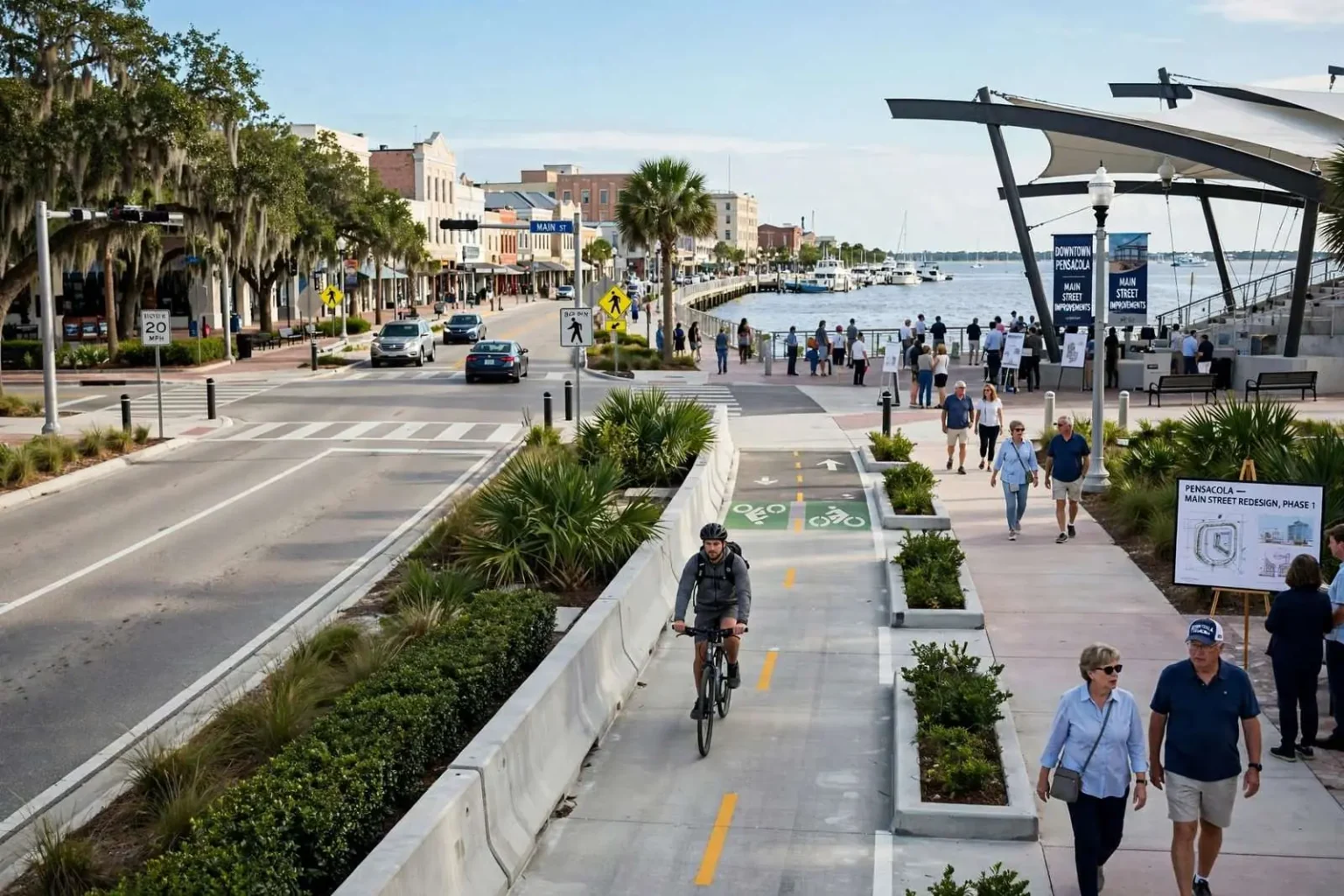
PENSACOLA, Fla. — The City of Pensacola is working to make downtown safer for people who walk and ride bicycles, and architects are close to finishing the first set of plans for Main Street, the waterfront road that separates the historic district from Pensacola Bay. Residents gave their input Wednesday evening alongside the city and the architecture firm Scape at the Community Maritime Amphitheater, where several dozen neighbors turned out to review the designs and question the team behind them.
The first phase of the project focuses on Main Street, an area that sees heavy traffic, pedestrians and cyclists during the day. The street serves as the front door to some of the city’s most-visited waterfront attractions, and its mix of through traffic, tour buses, joggers and fishing traffic has long made it one of downtown’s least comfortable corridors for anyone not inside a car. The redesign aims to slow vehicles down and give walkers and riders their own protected space along the bay.
“It’s exciting,” said Pat Meusel, one of the neighbors who came to review the designs. “The fact that we have bike lanes and pedestrian paths, yeah, it seems like a solid plan,” Meusel said. The sentiment at the amphitheater leaned favorable, though residents pressed the design team on details — crossings, driveways and how the plan handles the street’s busiest blocks — before the drawings are finalized.
A dangerous record on Florida roads
The urgency is not abstract. Florida leads the nation in pedestrian deaths, a distinction the state has held repeatedly as its roads have grown faster and its communities more spread out. Just in the past week, two pedestrians were killed after being struck by vehicles in Escambia County, deaths that hung over the meeting as residents examined the drawings.
“It’s kinda heartbreaking and it’s sad,” said Dannrya Moorer. Many hope the redesign will prevent future deaths and injuries, and the numbers behind that hope are stark: nationwide, pedestrian fatalities have risen sharply over the past decade, and Florida’s metro areas routinely rank among the deadliest in the country for people on foot. Local projects like the Main Street plan are part of a broader push by Florida cities to retrofit streets that were engineered primarily for moving cars quickly.
The plan includes a physical barrier separating bike lanes from vehicle traffic — a design choice that separates it from ordinary painted bike lanes, which offer no protection when a driver drifts across the stripe. Protected lanes, paired with slower design speeds and better crossings, are the approach transportation safety advocates have urged cities to adopt for streets like Main.
“Put people at ease and make them feel more calm and safer about going downtown riding the bike or driving your car,” Moorer said.
From the amphitheater to the water’s edge
The Community Maritime Amphitheater, the venue for Wednesday’s open house, is itself a product of the waterfront planning era the Main Street project is extending. The amphitheater sits at the heart of the city’s maritime park, the stretch of public shoreline that Pensacola has spent years assembling from former industrial land along Pensacola Bay. Main Street runs along that park’s southern edge, which is why planners see the road as the connective tissue between downtown and the water — currently a barrier for pedestrians, potentially a front porch.
Mayor Grover Robinson said that while safety is the immediate priority, the city believes the improvements will eventually bring more economic development east and west along the waterfront. “We think when you slow traffic down, when you get bikers and pedestrians, you will eventually get more retail,” Robinson said. “We’ve seen that happen on Palafox. We believe the same thing can happen on Main Street.”
The Palafox comparison carries weight locally. Palafox Street, Pensacola’s main downtown corridor, has become the city’s showcase for what pedestrian-oriented design can do: widened sidewalks, outdoor dining, festivals and a stretch of restaurants and shops that anchors the downtown economy. City leaders have repeatedly cited the street’s turnaround as evidence that investing in the pedestrian experience pays for itself in private investment nearby.
What comes next
Scape’s first set of plans is expected to be finalized soon, after which the project would move into engineering, cost estimation and construction phasing — stages that will determine how much of the vision can be built at once and how long downtown’s waterfront road will be a construction zone. Residents who attended Wednesday’s session were encouraged to keep offering comments as the drawings advance, and the city has treated the amphitheater meeting as the start of a longer conversation rather than a single hearing.
The stakes extend beyond one street. Main Street’s redesign is part of a larger question facing Pensacola and other Gulf Coast cities: whether their waterfronts, long dominated by working industry and fast roads, can be converted into public space that residents use daily. Every improvement that makes the bayfront easier to walk or ride increases the value of the land around it, and city officials are counting on that dynamic to repeat along Main Street what Palafox demonstrated in the heart of downtown.
For the neighbors who filled the amphitheater, the plans represent a rare chance to fix a road they cross every day. The designs on display Wednesday — protected bike lanes, separated pedestrian paths and slower traffic — drew broad approval from the crowd, and the two recent deaths in Escambia County gave the project’s safety arguments an urgency no rendering could. The city now moves from public input to final plans, with the goal of turning a corridor that residents tolerate into one they seek out.
The architecture firm Scape, which the city hired to lead the design, has specialized in exactly this kind of work: public-realm projects that treat streets as places rather than pipes for traffic. The firm’s team spent the public session walking residents through the drawings, answering questions about how the physical barrier would be constructed, where the crossings would land and how deliveries and parking would be handled along a street that still serves businesses and event crowds. Designers emphasized that the details on display were close to final but not frozen — comment cards and follow-up meetings remain part of the process until the plan set is complete.
For cyclists, the protected-lane design addresses the single biggest deterrent to riding downtown. Painted lanes put riders between moving traffic and parked cars, where they are exposed to both passing vehicles and opening doors; a physical barrier — whether a curb, a planted median or a solid separator — removes most of that exposure and makes the route usable for families and casual riders, not just confident commuters. Transportation planners have found that protected infrastructure draws a far broader range of users than paint alone, which is why cities across Florida have begun retrofitting their most dangerous corridors.
Pedestrians stand to gain even more. Main Street’s wide crossings and long signal cycles have historically forced people on foot to sprint or wait through multiple light changes, particularly during event evenings when the waterfront park draws large crowds. The plan’s slower design speeds and shorter crossing distances are meant to make the walk from the historic district to the bay — a trip of a few hundred feet that currently feels much longer — comfortable for children and older residents alike.
The economic bet behind the safety plan
City officials have been explicit that safety is only the first payoff they expect. The blocks east and west of the maritime park along the waterfront include properties and parcels that have waited for the kind of foot traffic that transformed Palafox, and Robinson’s argument — that slowing traffic and adding riders and walkers grows retail — reflects a now-standard playbook in downtown revitalization. Slower streets shorten the perceived distance between shops, outdoor dining extends the hours storefronts feel active, and the waterfront itself becomes a destination rather than a view drivers glimpse at speed.
The approach also matches the city’s broader waterfront investments, from the maritime park’s concerts and festivals to the commanding views across Pensacola Bay. Each improvement that connects the park to downtown multiplies the return on the others: a concertgoer who can walk safely from Palafox to the amphitheater spends money on both ends of the trip. Planners describe Main Street as the missing link in that chain.
Completion of the first plan set will move the project from concept into the harder questions of funding and sequencing. But for the residents who reviewed the drawings Wednesday evening, the direction is already set: a street built for people rather than throughput, in a city that has watched the model work on Palafox and seen what happens — in Escambia County and across Florida — when streets stay engineered for speed alone.