Pensacola City Council is majority women for the first time
For the first time in its history, women hold the majority on the Pensacola City Council after four new members were sworn in at City Hall.
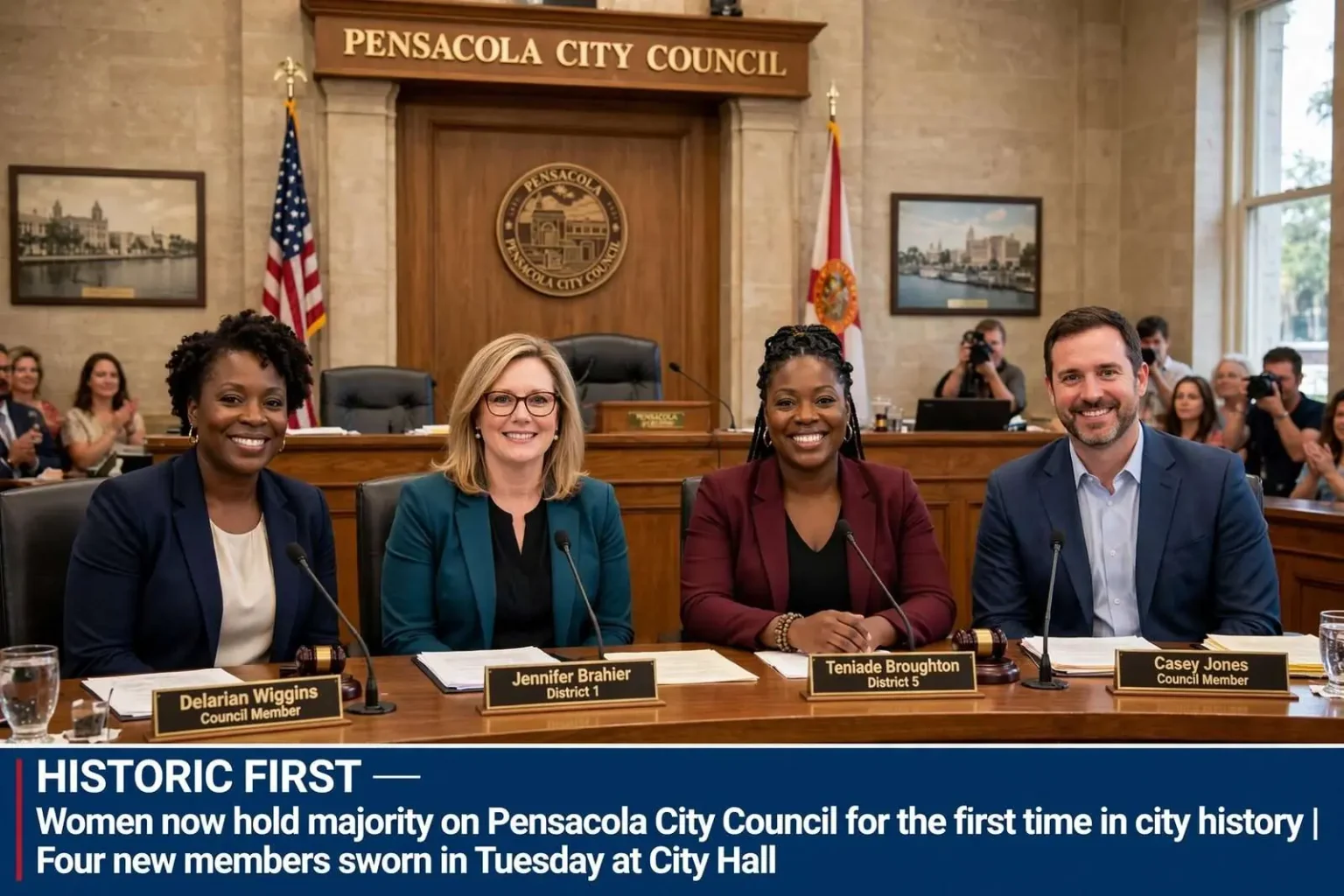
PENSACOLA, Fla. — For the first time in the city’s history, women make up the majority of the Pensacola City Council after four new members were sworn in Tuesday at City Hall. The ceremony marked a historic threshold for a governing body that has served Florida’s westernmost city since the nineteenth century, and it drew family members, supporters and city staff to the council chamber for the formal installation of the incoming class.
The new members — Delarian Wiggins, Jennifer Brahier, Teniade Broughton and Casey Jones — joined the council as the body crossed its historic majority-women mark. Each of the four took the oath of office at the dais, greeted constituents in the chamber, and offered brief remarks after being administered the oath. The additions bring new voices to a council that has long been led predominantly by men, a shift local observers say reflects both the city’s changing electorate and the growing pipeline of women seeking elected office along the Gulf Coast.
City Hall, the beige stone building overlooking Plaza Ferdinand VII in downtown Pensacola, has been the setting for council inaugurations for generations. Tuesday’s session followed the familiar rhythm of a Pensacola swearing-in: an invocation, the administration of oaths, applause from the gallery, and then the new members’ first words as elected officials. Unlike statewide inaugurations that rotate through large venues, Pensacola installs its council in the same room where the body will meet for its regular meetings, giving residents who packed the chamber an early look at how their new representatives carry themselves in the seat.
Each new member thanked constituents and family members during the ceremony. The remarks were personal rather than programmatic, in keeping with the tone of local swearing-ins, and they offered the first public hints of how each of the four views the job ahead.
Wiggins pledges focus on residents
Delarian Wiggins said she looks forward to working with colleagues to ensure the community and its residents are taken care of. Her framing of the job — service first, in cooperation with the rest of the dais — echoed the themes she carried through her campaign, and she described the work of the council in practical terms: streets, neighborhoods, and the day-to-day quality of life for the people who call Pensacola home.
Wiggins joins the council at a moment when the city is managing steady growth along its waterfront and in its outlying neighborhoods, with development pressure along Bayou Texar, the rejuvenated blocks around Palafox Street, and the corridors leading to Pensacola Beach all recurring topics at council meetings. New members traditionally spend their first months in office on the receiving end of a crash course in the city budget, capital projects and the intergovernmental relationships that tie Pensacola to Escambia County and the state.
Jennifer Brahier said she is eager to represent District 1, the council district she will serve. District 1 covers a broad stretch of the city’s northern and western neighborhoods, an area where residents have pressed for attention to aging infrastructure, code enforcement and stormwater drainage — familiar themes for any Pensacola council district, but ones that take on particular weight for a member who campaigned door to door across her district.
Brahier’s remarks underscored the district-based accountability that shapes Pensacola’s council service. Even as members consider citywide policy, each is closely tied to the neighborhoods that elected them, and the first statements new members make typically signal the local priorities they intend to carry into budget season.
Broughton honors family legacy in District 5
Teniade Broughton thanked the voters of District 5 and her mother, who ran for the seat two decades earlier. The family connection gave Tuesday’s ceremony one of its most resonant moments: a daughter completing a campaign her mother once waged, on a dais her mother once sought, in a city that had never before seated a women-majority council.
District 5 encompasses parts of Pensacola’s east side, including long-established neighborhoods with deep civic traditions and a strong network of neighborhood associations. Broughton’s victory there was the final piece of the council’s new composition, and her first remarks made clear that the district’s voters — and the woman who blazed the trail before her — will be part of how she measures her own service.
The two-decade gap between the mother’s campaign and the daughter’s win is a reminder of how slowly the pipeline to local office has filled for women in the Pensacola area, and of how much has changed in the years between. Tuesday’s majority is the product of individual campaigns, each decided on its own merits, that collectively crossed a line the city had never crossed before.
Jones thanks family as he takes office
Casey Jones expressed gratitude to his wife and family, closing out the round of remarks from the incoming class. The nod to the people behind an election — the evenings knocked, the weekends sacrificed, the households that absorb a campaign — is a standard feature of Pensacola swearing-ins, and Jones’s acknowledgment drew warm response from the gallery.
Jones joins a body that will spend the coming year balancing the city’s operating budget, overseeing public safety and infrastructure spending, and weighing land-use decisions that arrive before the council nearly every meeting night. The rhythm of Pensacola council service is demanding: regular voting meetings, committee work, and a steady stream of constituent matters that follow each member home to their district.
A milestone in Gulf Coast local government
The new majority arrives amid a broader pattern across the Florida Panhandle and the broader Gulf Coast, where women have increasingly sought and won seats on city councils, county commissions and school boards. Local government is often described as the entry point for political leadership — the level closest to potholes, zoning maps and public safety budgets — and the composition of a council can shape which priorities rise to the top of an agenda.
For Pensacola, the majority-women council follows a period of transition in which several longtime members departed, opening multiple seats at once and making a single election the hinge for a historic shift. Such coincidences of open seats are common in municipal government, where term limits, retirements and redistricting can reshape a body quickly, but they rarely land on a threshold this visible.
The four new members now step into the practical work that follows any inauguration: orientation briefings from city staff, assignment to council committees, and the first regular meetings where votes replace rhetoric. Pensacola’s council operates under the city’s mayor-council form of government, with the mayor serving as the city’s chief administrator and the council holding legislative authority — meaning the new members’ influence will show up first in ordinances, budget amendments and land-use votes rather than in the day-to-day operations of city hall.
Residents of District 1 and District 5 will have the most direct read on the new members, whose districts they serve, while all of Pensacola will watch a council that now looks more like the city it governs. The swearing-in ended the campaign season that produced it; the governing season begins at the next regular meeting.
The ceremonial bookends of Tuesday’s installation — the oaths at City Hall and the personal thanks offered from the dais — will give way quickly to the substance of council work. Pensacola’s calendar is built around a schedule of regular meetings, agenda reviews and committee sessions, and the incoming class will face its first votes within weeks of taking the oath. City staff traditionally walk new members through the mechanics of the position in the days after a swearing-in: how items reach the agenda, how the city’s budget process moves through the year, and how constituent requests route from the council office to the departments that answer them.
The historic nature of the new composition was not lost on those in the chamber. Council bodies across the Gulf Coast have historically skewed male, and the few women who served in earlier generations of Pensacola government often did so as the only woman on the dais at a given time. A majority changes the arithmetic entirely: committee assignments, the tenor of debate, and the range of life experiences represented when development, public safety and neighborhood quality-of-life questions come to the floor.
Turnout and engagement from neighborhood associations in the new members’ districts are likely to rise as constituents test the accessibility of their new representatives. District 1 and District 5 both have active civic networks, and first-year members typically find their district mailboxes — literal and electronic — fuller than they expected once residents learn whom to call about drainage complaints, street repairs and zoning notices posted along their blocks.
For the council as an institution, the transition also means a reset in dynamics. Longtime members set much of the body’s rhythm, and a class of four arriving at once shifts the balance of familiarity toward the newcomers. Early votes will reveal alliances and priorities, but Tuesday’s ceremony belonged to the milestone itself: a Pensacola council that, for the first time in the city’s history, counts women as the majority of its membership, sworn in at City Hall by the people who elected them.