Pensacola man found shot dead months after ex-wife’s gunpoint divorce arrest
Escambia County investigators are reviewing whether a fatal Pensacola shooting falls under Florida's Stand Your Ground law; the victim was identified.
Investigators in Escambia County are working to determine whether a fatal shooting in a Pensacola subdivision falls under Florida’s “Stand Your Ground” law, after a man was found dead of a gunshot wound roughly four months after his former wife was arrested in a case involving the couple’s divorce paperwork.
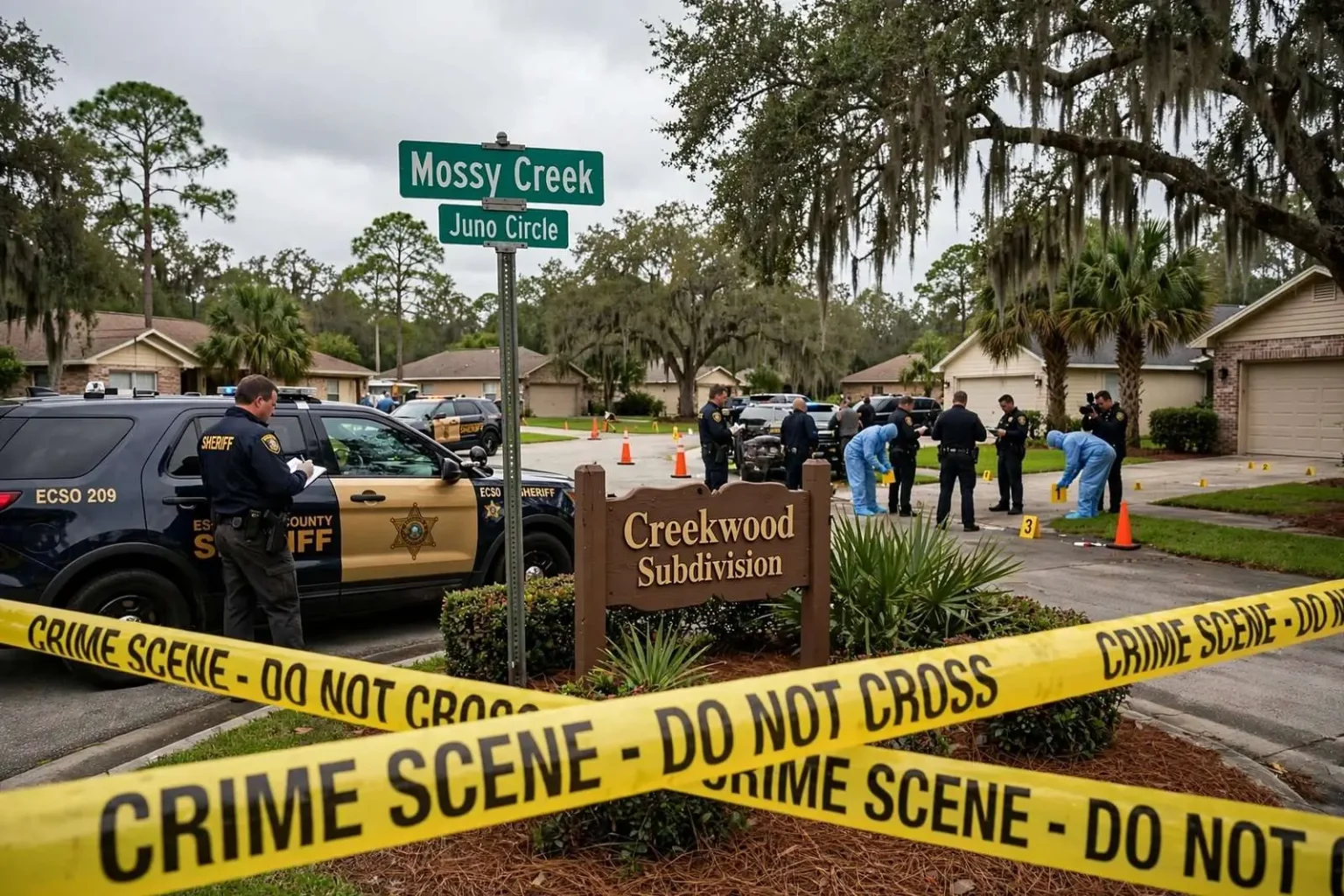
The Escambia County Sheriff’s Office said the man was found in the Creekwood Subdivision, in the area of Mossy Creek and Juno Circle. Deputies identified him as 47-year-old Jeffrey Sherbrook.
The discovery brought deputies to a residential neighborhood of homes and quiet streets west of Pensacola’s core, where the presence of an active death investigation — marked by patrol cars, crime scene tape and detectives working the area — unsettled residents who reported little more than the ordinary comings and goings of subdivision life in the hours before.
Investigation Underway
According to the Sheriff’s Office, the agency is investigating the death jointly with the State Attorney’s Office. Officials said one of the questions before investigators is whether the shooting qualifies as a justified use of force under Florida’s self-defense statute, a determination that ultimately rests with prosecutors rather than with the responding agency.
That arrangement is standard in cases where a self-defense claim may be in play. Sheriff’s investigators gather the facts — the scene, the physical evidence, the statements of anyone who was present or nearby — while the State Attorney’s Office evaluates what those facts mean under Florida law. The distinction matters: a sheriff’s office investigates and arrests, but whether a killing was justified is a legal conclusion that belongs to the prosecutors who would have to defend the decision, either by filing charges or by declining to.
Authorities did not release additional details about the circumstances of the shooting, and no charging decision had been announced as of the initial report.
The silence left open the most basic questions: who fired the shot, whether more than one person was present, what led up to the moment of the shooting, and how the victim came to be found in the neighborhood where he died. In self-defense reviews, officials routinely withhold such details while the evidence is still being gathered, both to protect the integrity of any eventual prosecution and because early accounts frequently change.
An Earlier Arrest
Court and arrest records show that in October, 45-year-old Millanie Sherbrook was taken into custody in connection with an alleged incident involving the couple’s divorce. Investigators alleged at the time that she pointed a firearm at Jeffrey Sherbrook and pressured him into signing divorce documents. Jeffrey Sherbrook told investigators he had wanted the matter settled through the court system.
Those allegations were pending at the time of his death and had not been resolved in court.
The earlier arrest outlined a relationship that had already turned dangerous before the fatal shooting — a couple in the middle of a divorce, a confrontation at gunpoint, and a document signed under duress, according to the allegations. Domestic cases with firearms raise particular concerns for investigators, who know that violence between current or former partners is among the most predictable categories of lethal harm. Whether the October case and the shooting were connected remained, officially, an open question.
Authorities have not publicly stated what connection, if any, exists between the October case and the fatal shooting, and the Sheriff’s Office characterized the death as an active investigation.
The gap of roughly four months between the arrest and the death left investigators sorting through timelines, relationships and circumstances without presuming an answer. In any case where a prior domestic incident exists, detectives examine everything from protection orders and court dates to recent contacts between the parties, building a record that prosecutors will need if the shooting ultimately results in charges.
Stand Your Ground Reviews in Florida
Florida’s self-defense law allows a person who reasonably believes they face death or great bodily harm to use force without a duty to retreat. When a shooting death is flagged for that review, prosecutors examine physical evidence, witness accounts and the sequence of events before deciding whether criminal charges are warranted.
Those reviews can take weeks or longer to complete.
Florida’s law, among the earliest and most far-reaching of its kind in the nation, changed the landscape of self-defense cases when it took effect in 2005. Before the statute, a person claiming self-defense generally had to show they had tried to retreat from danger if they safely could. Stand Your Ground removed that duty in any place a person lawfully has a right to be, and it created a path to immunity from prosecution for those whose use of force is found justified. The practical effect is that prosecutors must evaluate a self-defense claim before — not after — deciding whether to file charges, since a charging decision that ignores a valid claim can be overturned later.
The review process is exacting. Detectives reconstruct the scene, collect shell casings and other physical evidence, canvass for surveillance video and doorbell cameras, and interview witnesses whose accounts may conflict. Forensic analysis establishes distances, angles and sequences of fire. Only when that picture is complete do prosecutors weigh whether the person who used force reasonably believed they faced death or great bodily harm — the standard at the heart of the statute — and whether any of the law’s exceptions apply.
The stakes of the determination are absolute. A finding of justification ends the criminal inquiry entirely, while a decision to charge sends the case toward the courts, where the self-defense claim can be raised again — first at an immunity hearing, and later before a jury if the case goes to trial. Either path begins with the same evidence, which is why the joint review moves deliberately before anyone announces a result.
The case remains under investigation, and officials said additional information would be released as the review progresses.
For the residents of the Creekwood Subdivision, the weeks ahead will mean living alongside an unanswered question: what happened in their neighborhood, and why. Escambia County, which wraps around Pensacola and reaches to the Santa Rosa County line, has seen its share of cases where self-defense claims shaped the outcome, and the reviews in such cases routinely outlast the initial news coverage. When the State Attorney’s Office reaches its conclusion — charges filed, or a determination that the force was justified — the decision will become public, and the full account of what happened near Mossy Creek and Juno Circle will finally begin to emerge.
The October arrest that preceded the shooting followed the standard sequence for a felony domestic case in Florida. After being taken into custody, a defendant appears before a judge for first appearance, where the charges are read, bond is addressed, and conditions of release — including no-contact orders — are typically imposed. Cases built on allegations like the ones investigators described move forward through sworn complaints, witness statements and any physical evidence collected, and they remain pending until resolved by plea, dismissal or trial. Millanie Sherbrook’s case had reached none of those endpoints when Jeffrey Sherbrook was found dead.
Divorce disputes that turn violent occupy a grim category in American crime statistics, and law enforcement agencies train officers to treat the period surrounding separation as the most dangerous stretch in an abusive relationship. The presence of a firearm in a confrontation over documents — as alleged in the October case — escalates the stakes of every subsequent encounter between the parties. Advocates and investigators alike urge people navigating hostile separations to route communications through attorneys, document every contact, and report any threat or brandishing immediately, both for their own safety and to build the record courts need.
The joint investigation announced by the Sheriff’s Office and the State Attorney’s Office reflects how Escambia County handles potential self-defense cases. Pooling resources from the outset avoids the problem of detectives building an arrest case that prosecutors cannot sustain, and it signals to the public that the review is being conducted with an eye toward the legal standard that will govern the outcome. In cases that end without charges, prosecutors typically issue a written decision explaining the basis, a document that becomes part of the public record even though no courtroom proceeding follows.
Until then, the facts that can be reported are the ones investigators have released: a 47-year-old man found dead of a gunshot wound in his subdivision; a law enforcement agency and a prosecutor’s office working the case together; a question under Florida law about whether the use of force was justified; and an unresolved arrest, four months earlier, involving the same couple. Everything beyond that — the circumstances of the shooting, the identities of anyone else involved, and the eventual legal determination — awaits the work still underway.