Pensacola Nonprofit Gives Double Amputee a Home Makeover to Restore Her Independence
Pensacola Habitat for Humanity and Publix Charities renovated Deborah Allen's kitchen, bathroom and laundry room after peripheral artery disease left her wheelchair-bound.
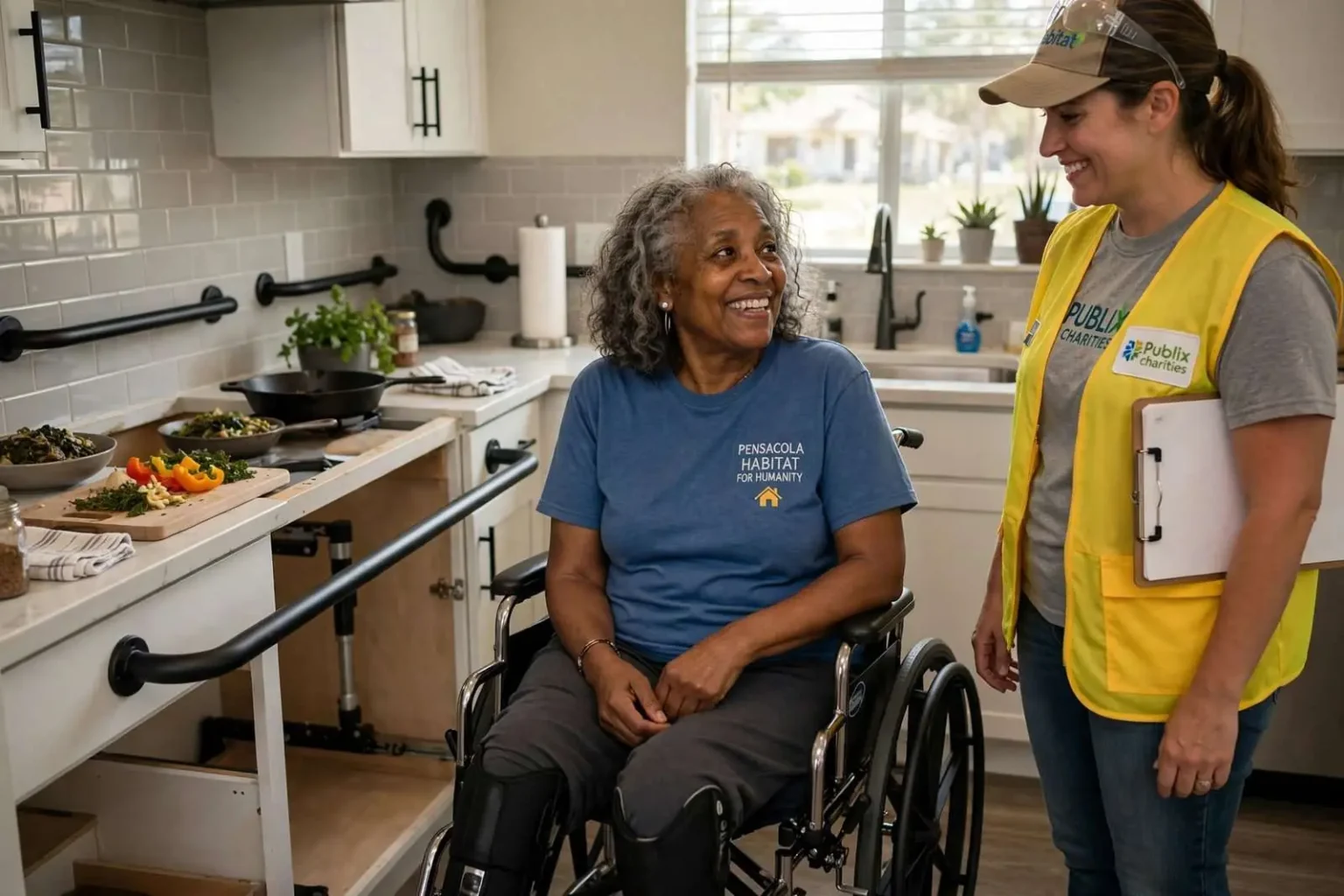
A Pensacola woman whose life was upended by a health crisis is getting some of her independence back, thanks to a series of home modifications from a local nonprofit. Deborah Allen became wheelchair-bound several years ago after being diagnosed with peripheral artery disease, which cut off blood flow to her legs. The diagnosis forced her to relearn basic daily tasks, and the house she lives in — like most homes built without accessibility in mind — became a landscape of obstacles where she once moved without thinking.
Peripheral artery disease, often called PAD, develops when narrowed blood vessels restrict circulation to the limbs, most commonly the legs. Left untreated as blood flow diminishes, it can lead to tissue damage and amputation, which is how the disease transformed Allen’s life. The condition is widespread across the Gulf South, where rates of the diabetes, smoking history, and vascular disease that drive it run high, and it often advances quietly until mobility is suddenly and permanently changed. For Allen, the progression led to the loss of both legs and a new reality navigated from a wheelchair.
“It was horrible,” Allen said. “I had to stand up on the cabinets and pull myself up, hold on with one hand and try to reach up in the cabinet to grab what I needed and flop back down in the chair. It was really, really difficult.”
That description captures what accessibility experts call the gap between a person and their environment: nothing about Allen’s determination changed when her health did — only the house around her, which was never designed for someone living her new reality. Every kitchen shelf, every bathroom fixture, every doorway became a problem to be solved with strength and risk, multiple times a day, in a home that offered no help.
A Kitchen Rebuilt for Real Life
Allen, who has always loved to cook, recently received a kitchen overhaul made possible by a Publix Charities donation through Pensacola Habitat for Humanity. The renovation has let her get back to preparing the Sunday dinners she enjoys making for her family after church — a ritual that is about far more than food, particularly in a region where the Sunday meal is a cornerstone of family and faith life. Regaining the kitchen meant regaining a role in her family’s weekly rhythm that her disability had taken from her.
The nonprofit also updated her bathroom and laundry room, installing a wall-mounted showerhead and grab bars that allow her to bathe and do household chores without assistance for the first time in years. Those rooms are where accessibility failures cause the most harm: bathrooms are the most dangerous rooms in any home for someone with limited mobility, and a slip in an ordinary tub can produce injuries that compound an existing disability. A wall-mounted showerhead and properly placed grab bars are inexpensive compared to the cost of a single fall, but they change what a person can safely do alone.
“The grab bars is a life saver because they surround me so everywhere I reach is a grab bar,” Allen said. The detail in that description — grab bars placed densely enough that support is always within reach — reflects the difference between token accessibility features and a home genuinely adapted to its resident. A single grab bar beside a toilet is a gesture; a bathroom where every reach finds support is independence.
The Nonprofits Behind the Work
The project pairs two organizations whose roles complement each other. Pensacola Habitat for Humanity, part of the international Habitat network that has built and repaired homes across Escambia County for decades, supplies the construction capacity — volunteers, project management, and skilled coordination that most homeowners could never assemble alone. Its repair and modification programs serve existing homeowners who need their houses to work for them, a mission that has grown as the region’s housing stock ages and as more residents live with disabilities.
Publix Charities, the philanthropic arm of the grocery chain deeply rooted across the Southeast, supplied the funding that made the work possible. Corporate giving of this kind flows into exactly the gap between what a homeowner needs and what insurance or public programs will pay for: home modifications are rarely covered as medical necessities, leaving low-income homeowners with disabilities to improvise or go without. A supermarket foundation underwriting kitchen and bathroom modifications is a quiet but concrete example of how corporate philanthropy reaches daily life in communities like Pensacola.
For Allen, the combined effect is a home that finally matches her life. Cooking again after church on Sundays. Bathing and doing laundry without waiting for help. Small acts of self-sufficiency that most people never think about, restored through construction work that took a matter of days.
Independence as a Health Outcome
There is a broader lesson in Allen’s story about what home modification actually accomplishes. For people with disabilities, the home environment is a major determinant of health and dignity: a house that blocks daily tasks forces dependence on caregivers for everything from hygiene to meals, and dependence at that scale wears on mental health, family finances, and physical safety alike. The research on aging and disability consistently finds that falls and injuries at home drive hospitalizations and lost independence — and that modest modifications, grab bars chief among them, prevent them.
The Sunday dinner detail resonates beyond sentiment. Participation in family rituals is a recognized marker of quality of life for people living with disability, and the kitchen is where those rituals live in most Southern households. When a renovation restores someone’s ability to cook the family meal, it restores a role, not just a function. Allen’s own framing of the renovation — centered on the Sunday dinners she loves making — makes that distinction plain.
“You can do this,” she said. “I did, and I thought it was going to be hard, but one step at a time, one minute at a time, one day at a time. There’s help out there.”
A Message to Others Facing the Same Fight
Allen said she is grateful for the resources available in the Pensacola community and hopes her story encourages others facing similar health struggles to seek help. That message matters because the most common response to a life-altering diagnosis is isolation — the assumption that no assistance exists, or that asking for it is surrender. Organizations like Habitat exist precisely because the need is real and the community response is possible, and stories like hers circulate to close the gap between people struggling alone and the services waiting to be used.
Pensacola’s network of nonprofits has developed a particular strength in this space, from the region’s long-established Habitat affiliate to the faith communities and service groups that supply volunteers and referrals. The Gulf Coast’s repeated experiences with hurricanes have also built a culture of repair-and-rebuild capacity, and that infrastructure — crews, tools, coordination know-how — transfers naturally to accessibility work in ordinary times.
What Her Story Says About Community
The transformation of Deborah Allen’s home was measured in rooms — a kitchen, a bathroom, a laundry area — but its effects reach every part of her days. She can cook the meals that define her family’s Sundays. She can bathe on her own schedule, without assistance, for the first time in years. She can reach, steady herself, and move through her house without planning every step around the risk of a fall. None of that required a miracle; it required grab bars, a showerhead, counters within reach, and organizations willing to fund and do the work.
That is the practical takeaway for other families navigating a new disability: the barrier is often not money or technology but information — not knowing that help exists or that a house can be changed. Home modification programs operate across the Gulf Coast, and the entry point is usually a phone call to a local Habitat affiliate, an area agency on aging, or a disability services organization. Wait lists exist, but the alternative — years of struggling against an unmodified house — is measurably worse, and as Allen’s story shows, the wait can end with a home that finally works.
Her advice to others facing a similar turn in life is stripped of pretense: take it one step at a time, one minute at a time, one day at a time, and reach for the help that is out there. It is advice she has lived, not just repeated. The woman who once had to pull herself up on her kitchen cabinets to reach a shelf now cooks her family’s Sunday dinners in a kitchen built for her, and the grab bars that surround her stand as a small monument to what a community can do when it decides someone’s independence is worth the cost of a few days of work.