Pensacola residents turn out for town hall on bridge closure lawsuit
Dozens of Pensacola residents packed a town hall at Blue Wahoos Stadium to learn about the lawsuit over the Pensacola Bay Bridge closure.
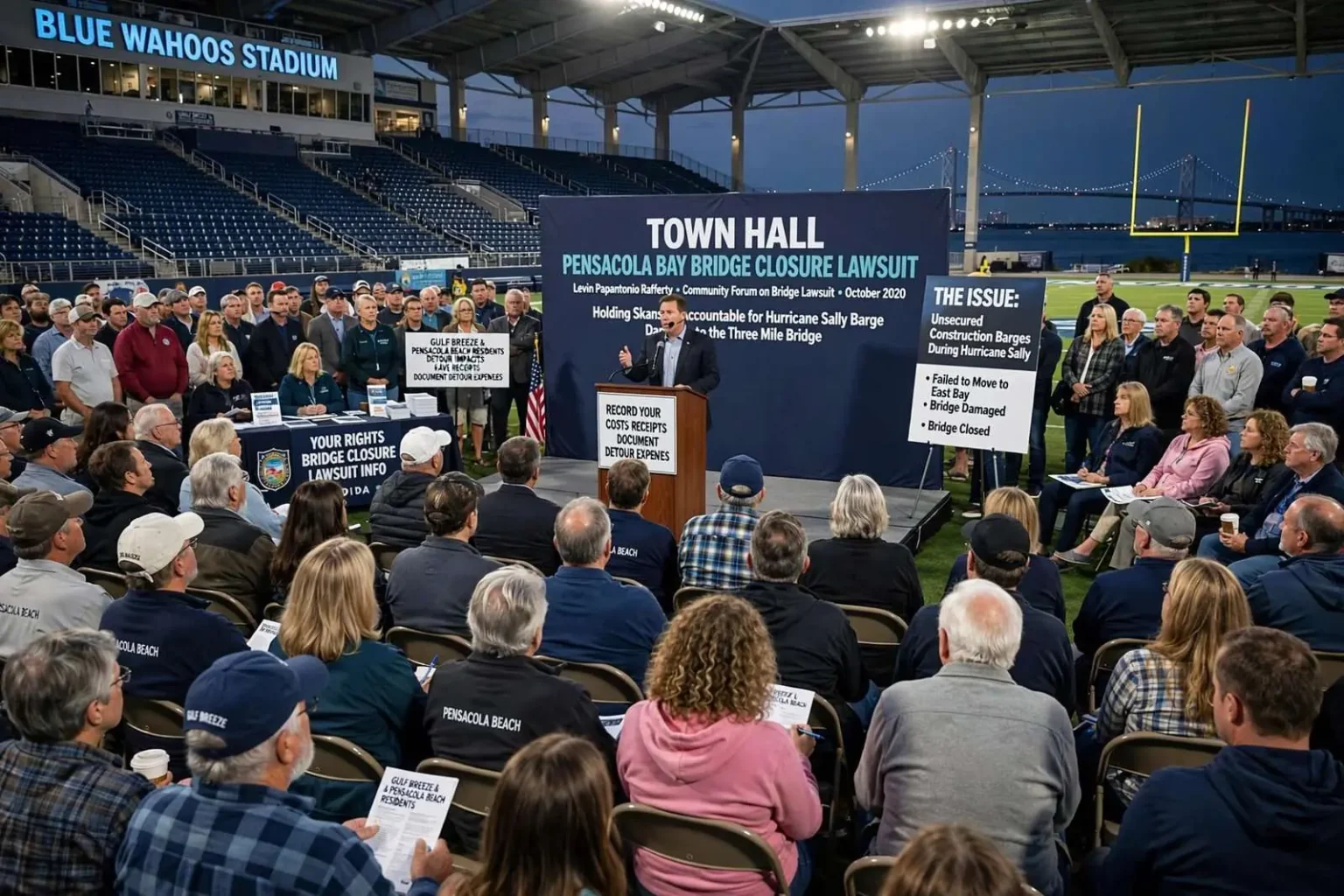
PENSACOLA, Fla. — Dozens of frustrated residents packed a town hall Thursday night at Blue Wahoos Stadium to learn more about the lawsuit against Skanska over the Pensacola Bay Bridge closure, a gathering that turned the downtown ballpark’s waterfront floor into a forum for one of the Gulf Coast’s most consequential infrastructure disputes.
The law firm Levin Papantonio Rafferty organized the gathering. The firm has filed suits accusing Skanska of failing to secure its barges during Hurricane Sally, causing damage to the Three Mile Bridge — the local name for the Pensacola Bay Bridge that spans the bay between Pensacola and Gulf Breeze.
“They were supposed to move those barges into East Bay. That’s where they were supposed to be. It’s not where they were and this is why we’re here,” attorney Brian Barr said. The statement went to the heart of the firm’s theory: that the construction barges working on the bridge project should have been relocated ahead of the storm’s arrival, and that their failure to move cost the region the use of its most important crossing.
How the closure happened
Hurricane Sally came ashore in the eastern Gulf in mid-September 2020, and while the storm’s landfall point sat west of Pensacola, its slow track and storm surge hammered the Panhandle. In Pensacola Bay, construction barges serving the bridge replacement project broke loose in the surge and wind. Debris and vessel strikes damaged spans of the nearly new bridge, and the crossing — opened to traffic only months earlier after a multi-year replacement project — was shut down entirely.
The timing magnified the damage. The old bridge it replaced had served the region for decades, and the new span was supposed to be a generational upgrade, four lanes with wider shoulders and a design built to modern hurricane standards. Instead, within months of its opening, the bridge sat closed while engineers assessed whether the damaged sections could be repaired or had to be rebuilt, and residents of Gulf Breeze and Pensacola Beach woke up to a commute that now detoured miles west, through Pensacola’s crowded inland arterials.
What the closure meant for the coast
The bridge is the main artery linking Pensacola, Gulf Breeze and Pensacola Beach, and businesses in those areas have been strained by the closure. Gulf Breeze is a residential city whose residents largely commute into Pensacola for work; Pensacola Beach is a resort economy that lives on visitors reaching the island. With the bridge out, both communities depended on the long detour through the Garcon Point area, a toll route that itself suffered storm damage, and on a passenger ferry service the state stood up to move people across the bay while repairs were underway.
The economic arithmetic was unforgiving. Beach restaurants, hotels and shops lost the easy flow of day visitors; workers who serviced the island’s businesses faced longer, costlier drives or had to find overnight arrangements; and emergency response times between the mainland and the beach stretched with the miles. Residents at the town hall — dozens of them, many from Gulf Breeze and the beach — have lived those consequences for months, which is why the ballpark meeting drew the crowd it did.
The case against Skanska
The lawsuits Levin Papantonio Rafferty has filed accuse Skanska of failing to secure its barges during Hurricane Sally, causing the damage to the Three Mile Bridge. The firm’s contention, as Barr put it to the crowd, is that the barges were supposed to be moved into East Bay — the more sheltered water northeast of the main bridge channel — ahead of the storm, and that they were not where they were supposed to be when Sally’s surge arrived.
Contractors on marine construction projects are generally expected to follow storm action plans that specify when equipment is secured, moved or evacuated as storms approach. Whether Skanska’s decisions met that standard, and whether the barge impacts that damaged the bridge can be traced to those decisions, will be the factual battleground of the litigation. Skanska USA is seeking total exoneration, but several local attorneys said they do not expect that to happen and believe the company will instead attempt to limit its liability.
That distinction — full exoneration versus limited liability — matters enormously to the businesses and residents watching the case. Total exoneration would mean no recovery from the contractor at all. A limited-liability outcome could still leave significant damages unpaid or apportioned among insurers, the contractor and other parties, which is why the plaintiffs’ bar in Pensacola has pressed the case so publicly and why the firm’s attorneys keep taking their argument to community meetings.
A united front at the ballpark
Attorney Troy Rafferty urged residents to stay united in holding the company accountable. The message reflected the realities of litigation against an international construction firm: cases of this scale are won on documentation, persistence and the collective weight of many plaintiffs’ claims, and they can drag on for years through motions, discovery and appeals. Residents who keep records — receipts showing lost business, logs of detour costs and commute times, photographs — strengthen the overall case far more than any single plaintiff could.
Blue Wahoos Stadium, the waterfront ballpark at the base of the bridge’s Pensacola landing, made an almost literal backdrop for the meeting: from its stands, residents could see the crossing whose closure has reordered their lives. The venue choice underscored that the lawsuit is not an abstraction but a local fight over a piece of infrastructure everyone in the room can point to from their seats.
What residents can expect next
Litigation over the bridge’s damage will proceed in the courts, not at town halls, but the gatherings serve a purpose in the case’s long arc: keeping the affected public informed, organized and documented while the filings and hearings run their course. Attorneys at the meeting indicated the firm expects a contested, multi-year fight — consistent with the scale of the damages the closure has inflicted and the resources of the company defending it.
For the businesses of Pensacola Beach and the commuters of Gulf Breeze, the immediate question remains the bridge itself — how quickly the repaired span returns to full service and how long the detour economy lasts. The lawsuit is the mechanism by which the region tries to recover what the closure cost it, and Thursday night’s turnout showed how much of the community is counting on it.
Until the courts rule, the facts as presented at the town hall stand as the plaintiffs’ account: barges that were supposed to move into East Bay and did not, a storm that turned unsecured equipment into a wrecking force against a brand-new bridge, and a region still paying, month after month, for the crossing it lost. Whether Skanska is ultimately held to account for all of it, some of it, or none of it will be decided in the pages of the case file the firm has opened — and the residents filling the ballpark floor intend to see that fight through.
The bridge project behind the dispute
The bridge that was damaged was itself the product of a years-long construction effort, and Skanska was the contractor on that project when the storm hit. The replacement span had been celebrated as a resilience upgrade for a crossing whose predecessor had grown functionally obsolete — narrow lanes, no shoulders and a deterioration that made full replacement the sensible choice. The irony at the center of the lawsuit is that a bridge designed to withstand Gulf hurricanes was disabled not by the storm’s winds on its structure but, the plaintiffs contend, by construction equipment that should never have been in position to strike it.
That is why the question of where the barges were supposed to be is not a technicality. East Bay’s more protected waters are exactly where marine contractors stage equipment when a hurricane tracks toward the region, and the plaintiffs’ argument treats the failure to move as the single decisive decision in the whole chain of events. If the barges had been in East Bay, the theory goes, the bridge would have ridden out Sally largely as designed — and the detour, the ferry, the lost beach season and the repair costs that followed would never have happened.
Voices of a strained region
The dozens of residents who filled the town hall represented the two sides of the bay the bridge connects. Gulf Breeze homeowners spoke to a commute that tripled in distance and time; beach business owners spoke to a season of lost traffic and razor-thin margins; and workers who serve both communities described the daily arithmetic of gas, tolls and time. For all of them, the town hall was less about legal theory than about the practical question of who pays for what the closure has cost.
Attorneys from the firm walked the crowd through the case’s basic structure: who the plaintiffs are, what the claims allege, how the litigation timeline is likely to unfold, and what residents can do now — keep records, preserve receipts, and stay connected as the case progresses. Barr’s line about the barges drew the meeting’s clearest applause, a sign of how completely the “they were supposed to move them” argument has landed with the public on both sides of the bay.
The meeting closed with the same emphasis Rafferty brought to it: unity. A case against a contractor of Skanska’s size will be measured in years, and the attorneys’ message was that the community’s staying power — its willingness to keep showing up, testifying and documenting — is part of what will hold the company’s feet to the fire until the lawsuit produces an answer.