Pet Tortoise Missing in Saraland: Family Asks Neighbors to Check Their Yards
A Saraland family's pet tortoise is missing near Big Lots. The three-year-old owner misses his best friend. A $100 reward is being offered.
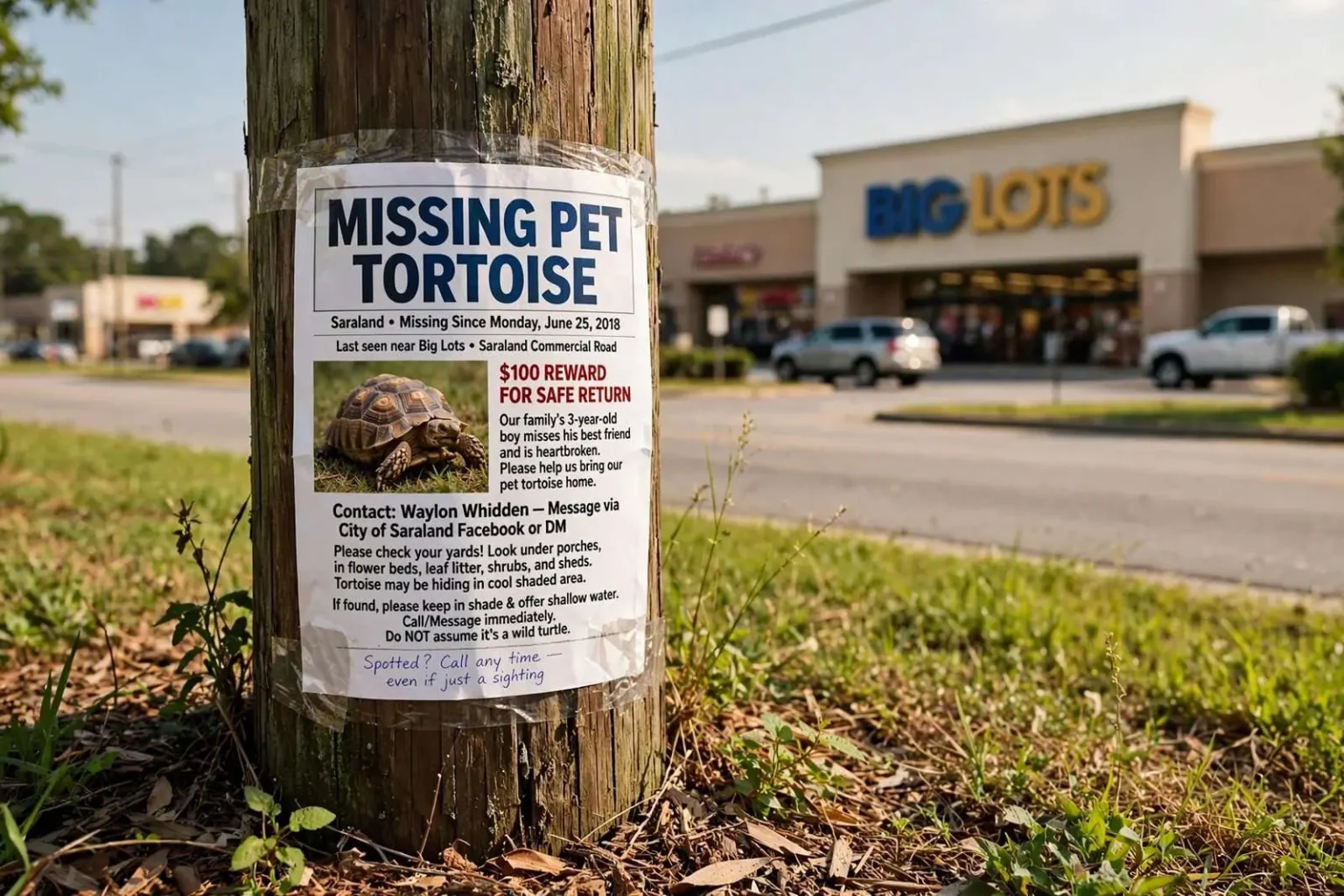
A Saraland family is asking for help finding their pet tortoise, which went missing near the Big Lots on Saraland’s main commercial road. The search has drawn attention across the city, with neighbors and strangers alike keeping an eye out for a wandering reptile that belongs to a family with a three-year-old boy who misses his pet dearly.
The tortoise’s family, including a three-year-old boy, is hoping for the safe return of their much-loved reptile. For a child that young, a pet tortoise can be a daily companion — something to check on in the yard every morning — and the family says the boy has been asking about his missing friend since the animal disappeared.
Waylon Whidden shared the appeal on social media, which was picked up and amplified by the City of Saraland’s official Facebook page. The city’s decision to share the post gave the search a significant boost, putting the notice in front of thousands of local residents who follow the page for news about road closures, events, and community announcements.
Disappeared Monday near Big Lots
The tortoise was last seen on Monday, June 25, 2018, in the area near Big Lots in the Saraland commercial corridor. The retail strip along the city’s main commercial road sees steady traffic throughout the day, with shoppers coming and going from the discount store and neighboring businesses from morning until well after dark.
In posts shared on Facebook, Whidden offered a $100 reward for the tortoise’s safe return and described how much his young son misses his best friend. The reward, he said, is a small price for getting the animal back home, and he has asked anyone who spots the tortoise to reach out rather than assume it is a wild turtle.
Roads in the area see heavy vehicle traffic during daytime hours, and residents familiar with tortoise roaming habits note that the animals can travel surprising distances from home if left unsupervised. A tortoise that seems slow and stationary one afternoon can be several blocks away by the next morning, especially in warm weather when the animals are most active.
Tortoises are also known to dig into leaf litter, mulch, or beneath sheds and porches — making yards and outdoor spaces in the surrounding neighborhood worth checking. A tortoise that finds a cool, shaded spot will often stay put for a day or more, which means the animal could be closer than anyone realizes, hidden under landscaping in a nearby yard.
Why tortoises wander — and where they hide
Pet tortoises are surprisingly capable escape artists. They can climb over low barriers, push through gaps under fences, and cover more ground than their reputation suggests. Once out of a yard, they tend to follow patterns that make them hard to spot: staying near ground level, tucking into vegetation, and moving mostly in the cooler hours of early morning and late evening.
During a Mobile County summer, midday heat drives the animals to seek shelter rather than roam. That instinct works in the family’s favor — a tortoise on the run from the June sun is likely holed up somewhere cool and damp, which is why searchers are being asked to look under porches, in flower beds, behind sheds, and inside dense shrubs near the commercial corridor.
Neighbors searching their own yards are advised to look slowly and listen as well as look. Tortoises moving through dry leaves or mulch make a faint rustling sound, and a shell bumping a fence or planter can give away a hiding spot that eyes alone might miss.
How to help
If you spot a tortoise in the Saraland area, particularly near the Big Lots shopping corridor, keep it in a safe, shaded area and contact the family through the City of Saraland’s Facebook page or reach out by direct message to Waylon Whidden. A cardboard box with air holes, or a shaded corner of a fenced yard, is enough to keep the animal secure while the family is contacted.
In hot weather, providing a shallow dish of water and shade can help keep the animal safe until it can be returned home. Tortoises can dehydrate quickly in the deep heat of a South Alabama summer, so access to shallow water — deep enough to drink from but not so deep the animal could tip over or drown — is the single most helpful thing a finder can provide.
With Mobile County’s warm summer temperatures, a well-hydrated tortoise can survive outdoors for weeks, but getting them back into care at home is the happy outcome everyone is rooting for. The longer the animal stays out, the greater the risk from traffic, predators, and dehydration, which is why the family is urging a quick response to any sighting.
A community known for rallying
Saraland residents have a history of coming together quickly for lost pets — and a three-year-old missing his best friend is exactly the sort of reason neighbors check their yards. In a city where community Facebook groups light up over missing dogs and found cats, a wandering tortoise has become the neighborhood cause of the week.
Saraland sits in southern Mobile County, just north of Mobile along the U.S. Route 43 corridor and near Interstate 65. Its main commercial strip, where the Big Lots is located, serves residents from across northern Mobile County, meaning shoppers from Satsuma, Creola, and beyond are all passing through the search area every day.
The city’s willingness to share the family’s appeal reflects how local governments across the Gulf Coast now use their social media pages — not just for official notices, but for the small, human stories that tie a community together. In this case, one share put a family’s search in front of an audience no backyard flyer could reach.
Local animal lovers have offered practical tips as well: leave a familiar food item near the edge of the family’s yard, check at dawn and dusk when tortoises are most likely to move, and avoid releasing the animal anywhere other than back to its home, since a displaced pet tortoise will simply wander again in an unfamiliar area.
What happens if the tortoise is found
Once the family is contacted, returning the animal is straightforward. Tortoises are hardy travelers, and a few days outdoors in June weather — provided the animal has access to shade and moisture — rarely causes lasting harm. The family says the reward will be paid to whoever finds the tortoise and helps get it home.
For the three-year-old at the center of the story, the search has become a daily ritual of checking the yard and asking whether his friend has come back. His family says a happy reunion is all the outcome they want, and the $100 reward is simply an extra reason for whoever spots the tortoise to make the call.
Anyone with information about the tortoise’s whereabouts is asked to message Waylon Whidden directly or comment through the City of Saraland’s Facebook page. Even a sighting that doesn’t lead to a capture helps — knowing where the animal was last seen narrows the search area and tells the family where to concentrate their looking next.
The June 25 disappearance is also a reminder to pet owners across the area that reptiles need secure outdoor enclosures just as dogs need fences. A tortoise pen should be checked regularly for gaps at ground level, and owners are encouraged to walk their fence line after heavy rain or yard work, when openings are most likely to appear.
Local veterinarians who see exotic pets note that a tortoise found wandering should be handled gently and kept upright. Picking one up by the shell edges — never by the tail or legs — and placing it in a shaded box with a damp towel is the safest approach while the owner is located.
Timing matters too. Sightings reported the same day give searchers a much smaller area to cover than sightings reported a week later. That is why the family and the city are asking residents to report even uncertain sightings immediately, rather than waiting to see whether the animal moves on.
Sightings of the tortoise should be reported even if the animal turns out to belong to someone else or appears to be a wild turtle. Cross-referencing reports helps the family and searchers separate true leads from false ones, and a quick photo from a phone is often enough to confirm whether a spotted tortoise is the missing pet.
In the meantime, the family says it is grateful for every share, every comment, and every neighbor walking the ditches and culverts along the commercial corridor. The response, they say, shows what kind of city Saraland is — one where a lost pet, however slow and however small, is treated as everyone’s business until it is back home.