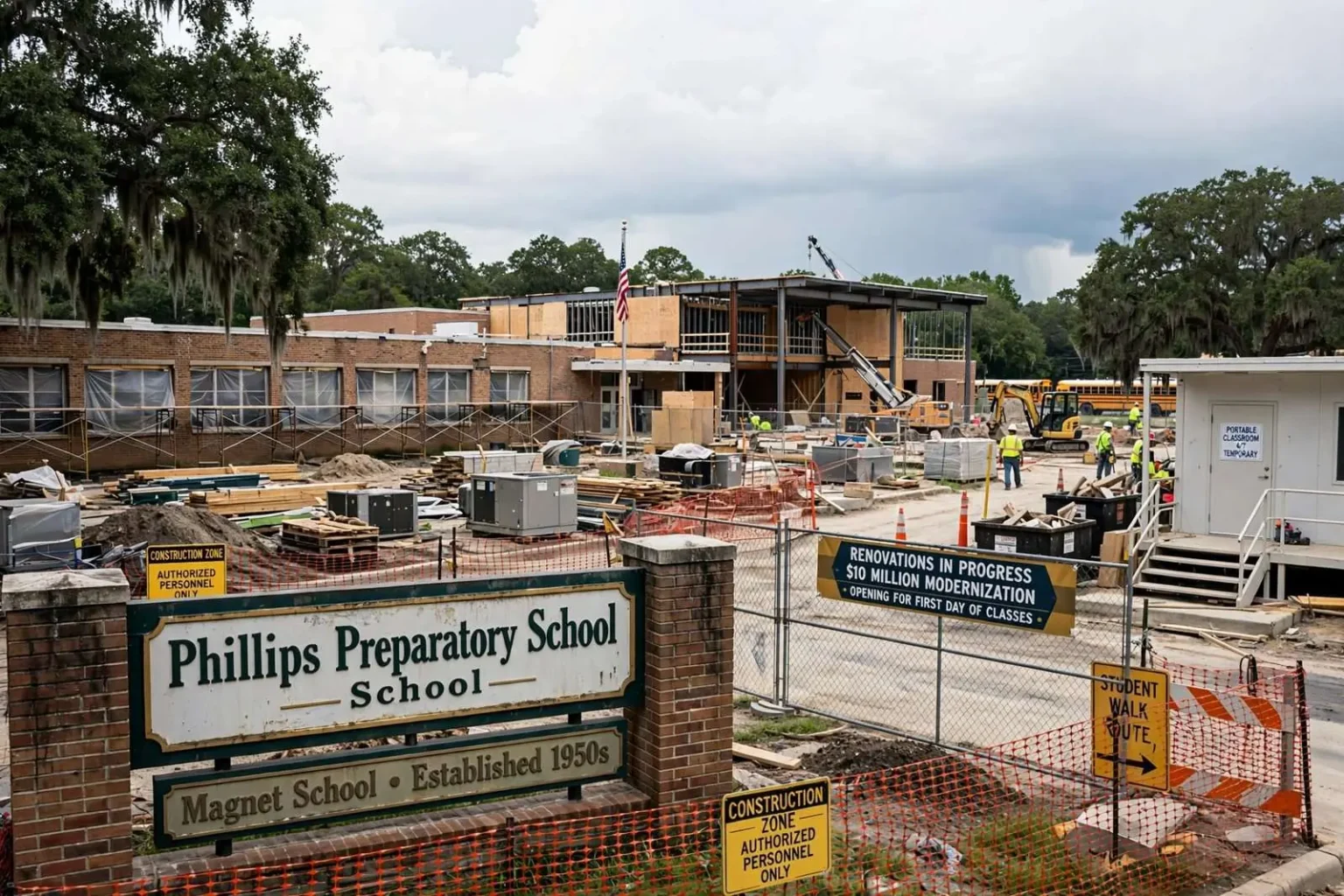
Construction crews spent the summer racing against the calendar to get Phillips Preparatory School in Mobile ready for the first day of classes, even as major renovation work continued right up to the opening bell. The scene at one of Mobile County’s most sought-after magnet schools offered a snapshot of a district racing to modernize its aging campuses while school stays in session around the work.
Since early June, the Old Shell Road campus had been overtaken by heavy equipment, piles of dirt and lumber, and more than 100 construction workers as part of a $10 million renovation project. School leaders acknowledged the scene looked chaotic, but insisted the disruption would not derail learning for the roughly 850 students enrolled at the magnet school.
The principal’s office itself had to relocate temporarily into the school library while the new administration building took shape at the front of the campus. Nearby, workers were also building a dedicated band room, a space the school had never had before. The absence of a real band room has been a longstanding limitation for a preparatory school whose arts programs have grown over the years, often forcing music instruction into borrowed and improvised spaces.
Last year, eighth-graders were shifted into portable classrooms while their regular hallway was closed for renovation; once that hallway reopens later this year, sixth- and seventh-graders will move into portables so their own hallway can be renovated next. The rotating shuffle has become a way of life on the campus, trading a year of inconvenience in one grade level at a time for a building that will be entirely renewed when the work is finished.
A Mobile County school system project manager overseeing the work said crews had been putting in 12-hour days, seven days a week, to keep the project on schedule despite a rainy summer. The Gulf Coast’s afternoon thunderstorms are a constant adversary for exterior construction, and the compressed timeline — tied to the school calendar in a way few commercial projects are — left little room for weather delays to accumulate.
Part of a $100 million push
The renovation is part of a broader $100 million construction push across Mobile County schools, and by the time work wraps up, officials said, nearly every part of the aging campus, which first opened in the 1950s, will be new. The district’s capital program has been working through decades of deferred maintenance at schools across the county, prioritizing campuses where enrollment remains strong and the buildings can serve students for generations once modernized.
Phillips Preparatory holds a distinctive place in the district. As a magnet school drawing students from across Mobile, its enrollment is chosen through application rather than strict zoning, and its academic reputation has made admission competitive. Parents who choose the school commit to its preparatory curriculum, and the campus’s midtown location on Old Shell Road places it among the city’s most established residential neighborhoods.
The campus’s 1950s origins show in its layout and infrastructure, from mechanical systems at the end of their useful lives to classroom configurations designed for a different era of instruction. Renovation projects of this scale address the invisible systems — electrical capacity, climate control, plumbing, roofing — as much as the visible ones, since a school can’t run modern technology or maintain air quality on 1950s bones.
The project is being completed in two phases. The current phase, nearing completion, covers the administration building, band room and cafeteria area, which is being expanded and will finally include air conditioning and an outdoor freezer for food service. The cafeteria details land with particular force in a mid-century school: food service spaces built in that era often lacked modern cooling and storage, and the addition of an outdoor freezer solves a storage constraint that has shaped menu planning and deliveries for years.
A second phase will tackle the gymnasium, locker rooms, the band room’s final buildout and the sixth- and seventh-grade hallway. Full completion is expected by spring 2016, meaning students and teachers will spend the current school year navigating a campus that is simultaneously in use and under construction, with the finish line visible at the end of the school year.
Running a school inside a job site
To keep students safe amid the active work zone, the school and the construction team have been operating under protocols that separate students from the work. Fencing, designated walk routes and staged construction zones are standard practice for school renovation projects, but the density of activity on the Phillips campus — with more than 100 workers on site during the summer — has required constant coordination between crews and school leadership.
The summer crunch was designed around exactly this trade-off: pushing the loudest and most disruptive work into the months when classrooms were empty, so that the school year could begin with the most disruptive phases complete. That is why the administration building, band room and cafeteria were front-loaded — they are the spaces a school needs on day one — while hallway renovations that can proceed behind barriers continue during the year.
For teachers, the renovation has meant flexibility in both directions. Materials and furniture had to be packed and moved out of classrooms entering renovation, temporary arrangements accepted for offices and storage, and routines adjusted around temporary entrances and routes. School staff have described the atmosphere as a shared sacrifice, with the promise of a fully modernized campus as the payoff.
Parents, too, have had to adapt. Magnet school families already build their routines around the campus, and a year of shifting entrances, portables and construction traffic adds friction to drop-off and pickup. School leaders have communicated changes as phases have shifted, and the district’s project managers have treated parent communication as part of the project schedule itself.
The band room’s arrival carries particular significance for the school community. Programs that have made do without a dedicated space for decades tend to treat such an addition as a milestone, and the final buildout scheduled in phase two will equip the space fully once the structural work is done. For a preparatory school that competes for students on the strength of its programs, a real band room is both a practical improvement and a signal of institutional investment.
What students will see this year
When classes begin, students will walk past a new administration building at the front of campus and into a cafeteria that finally has air conditioning, while their eighth-grade hallway reopens in renovated condition. Sixth- and seventh-graders will then trade places into portables as the work moves to their wing — the last major shuffle of a project that has been sequenced grade by grade.
By the time full completion arrives in spring 2016, with the gymnasium, locker rooms and remaining spaces finished, the school that opened in the 1950s will have been substantially rebuilt within its existing walls. District officials have pointed to Phillips as an example of what the $100 million program is meant to accomplish: not replacement of the county’s established schools, but renewal of them — keeping strong campuses in their neighborhoods while bringing their facilities up to the standard students and teachers are asked to meet.
The 12-hour days through a rainy summer were the price of that outcome on schedule. As the crews stand down from the first phase and the school year gets under way, the race against the calendar shifts to the pace of the school year itself, with the campus fully transformed by the time the year ends.
The $10 million investment in the campus also reflects the district’s calculation that magnet programs deserve facilities that match their missions. Schools of choice compete with private and parochial options across the Mobile area, and the condition of the building itself is part of what families evaluate when they decide where to apply. A renewed Phillips strengthens the district’s hand in that competition and takes pressure off nearby zoned schools by continuing to draw applicants from across the county.
Old Shell Road itself has been a corridor of schools for generations, and the Phillips campus sits among neighborhoods whose families have sent children to the school since its earliest years. That history raises the stakes of the renovation in the eyes of alumni and longtime residents, who have watched the campus age and have followed the construction with particular attention as the school they knew is rebuilt.
The district’s project management approach for the work — an in-house manager coordinating with contractors daily, phases sequenced around the academic calendar, and safety protocols separating students from active work zones — mirrors the model used on other campuses across the $100 million program. Each completed school adds to a playbook the district is developing for renovating campuses without closing them, an approach that saves the cost of temporary facilities and keeps neighborhoods intact.