Photos Show Construction Progress at Thomasville Regional Medical Center After $2.9 Million Grant
New photos show construction progress at Thomasville Regional Medical Center after a $2.9M grant; the town has lacked a hospital since 2011.
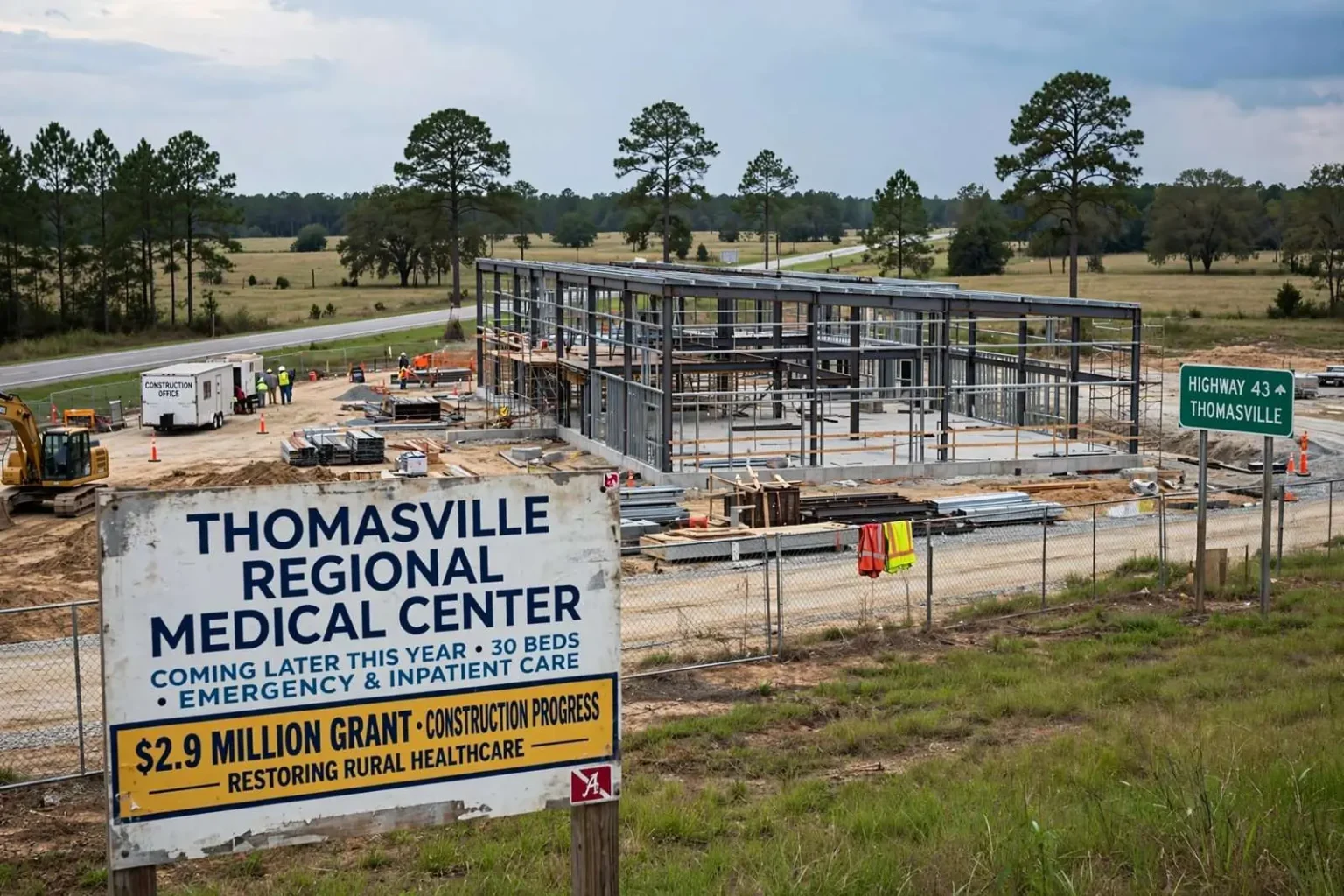
THOMASVILLE, Ala. — Construction is moving ahead on the new Thomasville Regional Medical Center, and Mayor Sheldon Day shared photos of the site’s progress as the city works to restore hospital service it lost eight years ago.
Thomasville was awarded a $2.9 million grant last week to support the new facility, which will rise off Highway 43 and feature nearly 30 beds. The grant adds to the funding package behind a project city officials describe as the most consequential piece of healthcare construction in the region in years, with the building’s frame now visible from the highway as work continues toward an opening.
City officials expect the new hospital to open later this year, returning emergency and inpatient services to Clarke County and the surrounding area. When that happens, Thomasville will regain a service its residents have done without since 2011 — a stretch that has forced patients to travel to hospitals in other counties for everything from emergency room visits to routine admissions.
The project has been billed as a milestone for rural healthcare across south Alabama’s Black Belt region, where small towns have watched hospitals close at a steady pace. Thomasville’s effort to rebuild its own facility has drawn attention across the region as an example of what a determined small city can do about a problem that has overwhelmed many of its neighbors.
Eight Years Without a Hospital
The town has been without a hospital since 2011, when its only medical facility closed — a gap that forced residents to travel for emergency care and strained the rural community’s access to treatment. The closure followed the pattern that has played out in small towns across Alabama and the country: a rural hospital operating on thin margins, unable to keep pace with reimbursement rates and patient volumes, shutting its doors and leaving a hole that no clinic or urgent-care operation can fully fill.
The consequences of a hospital closure are felt most sharply in emergencies. In the years since Thomasville lost its facility, residents facing a heart attack, a serious injury, or an obstetric emergency have relied on ambulance transport to hospitals outside the county — time and distance that clinicians universally describe as the enemy in trauma and cardiac care. Routine care shifted too, with patients traveling for imaging, lab work, and admissions that a community hospital once handled locally.
For an aging rural population, the burden compounds. Residents without reliable transportation depend on family, neighbors, or volunteer arrangements to reach care that residents of larger cities take for granted, and every mile added to a trip to the doctor weighs heaviest on those least able to bear it.
The New Facility and the $2.9 Million Grant
The new Thomasville Regional Medical Center will rise off Highway 43, the north-south artery that runs through the heart of the city, with the building designed around nearly 30 beds. The bed count places the facility firmly in the category of small rural hospitals — institutions that cannot match the specialization of urban medical centers but that provide the services rural communities actually use day to day: emergency care, inpatient beds for common admissions, and stabilization for patients who need transfer to larger facilities.
The $2.9 million grant awarded last week strengthens the financial foundation for the project, joining the funding that city leaders have assembled to bring the hospital back. Grant support has become central to rural healthcare projects across Alabama, where the economics of small hospitals leave little room for private construction capital and where state and federal programs have increasingly stepped in to keep rural facilities viable.
Mayor Sheldon Day has been the public face of the effort, sharing site photos and project updates as construction progresses. Day’s long tenure has been built on economic development campaigns that have brought industry and investment to Thomasville, and the hospital project sits at the intersection of that work — a piece of infrastructure that serves residents’ health and the city’s ability to attract and keep employers and retirees alike.
Where that grant ranks among the funding sources behind the project was not detailed in the announcement, but its timing — in the final stretch of construction — ties new public support to a project that has become a point of civic pride. The photos Day released show work advancing on schedule, with the building taking shape on a site chosen for its visibility and its access to the highway corridor.
The Black Belt’s Hospital Crisis
Thomasville sits on the eastern edge of Alabama’s Black Belt, the band of south-central counties named for their dark soil and defined for generations by small towns, agricultural roots, and some of the state’s most persistent economic challenges. The region has been at the center of Alabama’s rural hospital closure crisis, with facilities in county after county shutting down as populations shrink, Medicaid and Medicare reimbursement lag, and the patients who remain are older and sicker than average.
When a Black Belt county loses its hospital, the effect ripples well beyond the emergency room. Hospitals are among the largest employers in many of these towns, and their closures strip away jobs that cannot be replaced in communities with limited industry. The loss also weakens the case for doctors, nurses, and pharmacies to stay, accelerating a cycle in which healthcare access and economic vitality pull each other downward.
That is the backdrop against which Thomasville’s project has been framed as a milestone. A reopened hospital in Clarke County would restore services not just for Thomasville’s residents but for surrounding communities whose own facilities have closed or curtailed, effectively re-creating a regional healthcare anchor in a part of the state that has been losing them.
What a Regional Medical Center Means for the Area
The name on the building — Thomasville Regional Medical Center — describes the ambition. A regional facility draws from a catchment area far wider than the city limits, serving patients from neighboring towns and counties who would otherwise face longer drives for emergency and inpatient care. The nearly 30 beds planned for the facility represent the capacity for the common admissions a rural hospital sees: pneumonia and flu seasons, fall injuries among older residents, childbirth, and the stabilization cases that must be treated quickly before a transfer is possible.
Emergency service is the piece residents have missed most acutely. An emergency department in Thomasville changes the response map for a wide swath of rural Clarke County, cutting the time between injury and treatment for a population spread across farms, small towns, and country roads. Rural emergency care also functions as the front door to the healthcare system — the place where a patient having the worst day of their life is first seen, stabilized, and directed to the next level of care when needed.
The economic dimension runs alongside the medical one. Hospitals anchor recruitment for physicians and allied health professionals, support local pharmacies and clinics, and signal to prospective employers that a town can take care of its workforce. Thomasville’s leaders have treated the hospital as economic development infrastructure as much as healthcare infrastructure, a view Day’s updates on the construction have reinforced.
Looking Toward Opening Day
Staffing will be the next benchmark to watch after construction. A hospital is only as functional as its clinical team, and rural facilities across Alabama compete for a limited pool of nurses, technicians, and physicians. The Thomasville project’s regional ambition — and the recruiting power of a brand-new facility — is expected to shape that effort, with the opening timeline giving administrators room to build the roster before the first patients arrive.
Patients who have spent years planning their healthcare around out-of-town trips will face an adjustment of their own once the doors open. Local emergency care changes the habits formed during the closure years: where to go for an after-hours scare, how to handle follow-up appointments, and which services can finally be handled at home. Hospital openings of this kind typically ramp up service by service, with emergency operations first and specialty offerings added as volume and staffing allow.
With construction visible from Highway 43 and the $2.9 million grant now in hand, the project’s focus shifts from funding to outfitting — completing the building, equipping the beds and emergency spaces, and hiring the medical staff who will run the facility. City officials’ expectation of an opening later this year keeps the timeline aggressive by the standards of rural healthcare construction, where projects often stretch for years between announcement and doors-open.
The photos Day has shared chart the progress for a community that has waited through eight years of traveling for care. When the facility opens, the return of emergency and inpatient service to Thomasville will mark the reversal of one of the region’s most-watched hospital closures — and, its backers hope, a demonstration to other Black Belt towns that the losses of the last decade are not necessarily permanent.