Poarch Creek Veterans Memorial Planned as Tribe Spotlights Native Americans’ Deep Record of Military Service
The Poarch Band of Creek Indians is planning a circular memorial for tribal veterans near Atmore as tribal leaders highlight Native Americans' outsized record of military service.
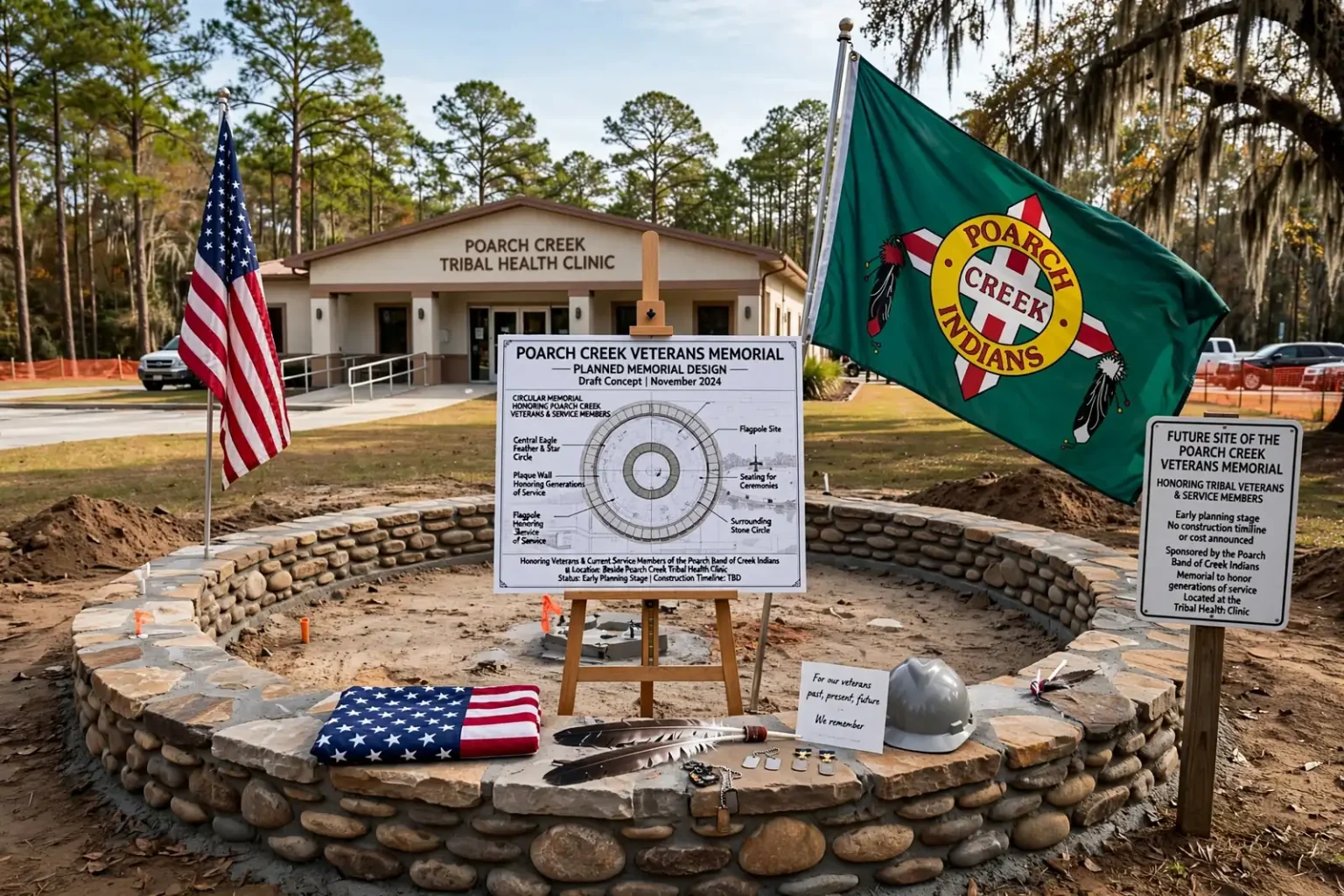
ATMORE, Ala. — A circular memorial honoring tribal veterans and service members is in the early planning stages on the Poarch Creek reservation, a project tribal leaders say is meant to give long-overdue recognition to a remarkable record of Native American military service. The planned Poarch Creek veterans memorial will stand next to the tribe’s health clinic in the central part of the reservation near Atmore, and it comes as tribal leaders use Veterans Day to call attention to a chapter of American military history many people have never heard.
For members of the Poarch Band of Creek Indians, Alabama’s only federally recognized tribe, service in the armed forces is often a family tradition stretching across generations. Tribal leaders said the memorial is intended to honor that service and sacrifice and to make sure younger generations know the history.
A Memorial Taking Shape on the Reservation
The memorial remains in its early stages, and no construction timeline or cost has been announced. What is known is its general form and setting: a circular design placed beside the tribal health clinic, near the center of the reservation.
The project joins a growing number of efforts across the country to honor Native American service members in places that hold meaning for their communities. Tribal leaders said the goal is to bring more recognition to what members of the tribe have given in uniform, calling it a history the community is proud of.
Key details
- Who is honored: veterans and current service members of the Poarch Band of Creek Indians
- Design: circular memorial
- Location: beside the tribe’s health clinic in the central part of the reservation
- Status: early stages; no timeline announced
Generations of Service in Poarch Creek Families
In some Poarch Creek families, nearly everyone has a connection to the military. Tribal leaders described growing up moving from base to base while a parent served a full career in uniform, with uncles, cousins and other relatives also serving or still serving today. One family’s record includes a Marine who served 20 years, completed two tours in Vietnam and received the Purple Heart after being wounded in combat, and a Navy veteran whose service spanned two wars, World War II and then Korea.
Tribal leaders said that, in their families, military service simply felt normal. They pointed to two main motivations: the opportunity the military offers to build a better future, and a desire to defend the country.
Reconciling service with a painful history
The depth of Native American military service can seem surprising given the history of how the federal government treated tribes, a history that includes the use of the U.S. military in removals and violent campaigns against Native peoples. Tribal leaders said many in their community see the question through the lens of sovereignty. Tribes are sovereign nations within the larger United States, they said, and protecting the larger country helps protect tribal sovereignty as well.
The Numbers Behind Native American Military Service
Tribal leaders have been working to spread awareness of just how deep Native American military service runs. Among the figures they highlight:
- Native Americans serve in the military at about five times the national average, despite making up a small share of the U.S. population.
- During World War I, about 12,000 Native men signed up for service, even though Congress did not grant Native Americans citizenship until 1924.
- The Vietnam War drew more than 42,000 Native American service members, and roughly 90% of them volunteered rather than being drafted.
- At least 29 Native Americans have received the Medal of Honor, the nation’s highest military award for valor.
The citizenship detail stands out. The Indian Citizenship Act of 1924 extended U.S. citizenship to Native Americans born in the United States who were not already citizens. That means thousands of Native men stepped forward for World War I service at a time when many of them were not considered citizens of the country they were prepared to defend.
An Alabama Creek at West Point and a Marine at Iwo Jima
Alabama has its own place in this history. In 1822, David Moniac, a Creek born in what is now Alabama, earned his diploma from the U.S. Military Academy at West Point, the first Native American to do so. He later served as an officer and was killed in 1836 during the Second Seminole War.
Tribal leaders also point to one of the best-known images in American military history as an example of Native service: the raising of the U.S. flag on Iwo Jima in 1945. Among the six Marines in that famous photograph was Ira Hayes, a member of the Gila River Indian Community in Arizona.
The battle for Iwo Jima was among the deadliest of World War II in the Pacific. Nearly 7,000 Americans were killed, and Japanese losses numbered around 20,000. The photograph turned the flag raisers into national heroes, though that fame was something Hayes struggled with in the years after the war.
Code Talkers and Congressional Recognition
For many Americans, what they know about Native American military service begins and ends with the code talkers. During World War II, Navajo code talkers serving with the Marines in the Pacific used their language to send messages that enemy forces were unable to decipher. Their story reached a wide audience through the 2002 film Windtalkers. Tribal leaders said that while the movie placed the Native characters in supporting roles behind a lead played by Nicolas Cage, it still helped raise awareness of Native contributions.
Navajo speakers were not the only code talkers. Members of numerous other tribes used their languages in the same way during both world wars. Recognition came slowly. In 2000, Congress passed legislation awarding the Congressional Gold Medal to the original Navajo code talkers. In 2008, Congress approved a broader law recognizing code talkers from other tribes. Tribal leaders from Poarch were involved in pushing for both measures.
A National Memorial in Washington
In 2020, the National Native American Veterans Memorial opened on the grounds of the Smithsonian’s National Museum of the American Indian in Washington, D.C. It honors American Indian, Alaska Native and Native Hawaiian service members and tells the story of their service across the nation’s history.
The memorial’s designer, an enrolled Cheyenne and Arapaho tribal member who also served in the Marine Corps, has described his hope that it would become a sacred place of healing, including a gathering spot where mothers of warriors could comfort one another. He has said the memorial is meant to honor warriors of the past, present and future.
The planned memorial at Poarch would bring a similar kind of tribute closer to home for families in south Alabama.
About the Poarch Band of Creek Indians
The Poarch Band of Creek Indians are descendants of Creek people who remained in their homelands in what is now Alabama rather than being removed west in the 1830s. The tribe’s reservation is centered near Atmore in Escambia County, about an hour northeast of Mobile. After decades of effort by tribal leaders, the tribe received federal recognition in 1984, which affirmed its government-to-government relationship with the United States.
Today the tribe operates its own government, health services, education programs and economic enterprises. Its members have served in every branch of the armed forces.
Why the History Matters on Veterans Day
Veterans Day, observed each year on Nov. 11, traces its roots to the armistice that ended fighting in World War I in 1918. It honors everyone who has served in the U.S. armed forces, living or dead, in wartime or peacetime.
Tribal leaders said Native contributions in uniform have gone unrecognized for many years, largely because the history has not been widely taught. They said keeping these stories alive and honoring what Native veterans did is important, and that changing how the history is told is part of the work ahead.
November is also National Native American Heritage Month, a federal observance that recognizes the history, cultures and contributions of Native peoples. The overlap gives communities a natural opportunity to reflect on the role Native service members have played in defending the nation, from the earliest conflicts through today’s all-volunteer force.
Supporting veterans year-round
Honoring veterans does not have to end when the Veterans Day ceremonies are over. Veterans organizations often encourage residents to volunteer with local veterans groups, attend memorial dedications and ceremonies, support programs that help veterans find jobs and housing, and simply take time to listen to veterans’ stories. Families can also help preserve history by recording the experiences of relatives who served, along with photographs, letters and other keepsakes, before those memories are lost.
Veterans who need help with health care, disability compensation, education or other benefits can contact the U.S. Department of Veterans Affairs or the Alabama Department of Veterans Affairs, which has service officers who assist veterans and their families with claims at no cost.
Ways to learn more
- Visit the National Museum of the American Indian, in person or online, to learn about the national memorial and Native military history.
- Ask local veterans, including tribal veterans, about their service and their families’ traditions.
- Watch for updates from the Poarch Band of Creek Indians as plans for the reservation memorial move forward.