Army veteran’s Port of Mobile internship becomes a supply-chain management career before graduation
An Army veteran who returned to college through the GI Bill turned an internship at the Port of Mobile into a full-time marine operations job before finishing his degree at the University of South Alabama.
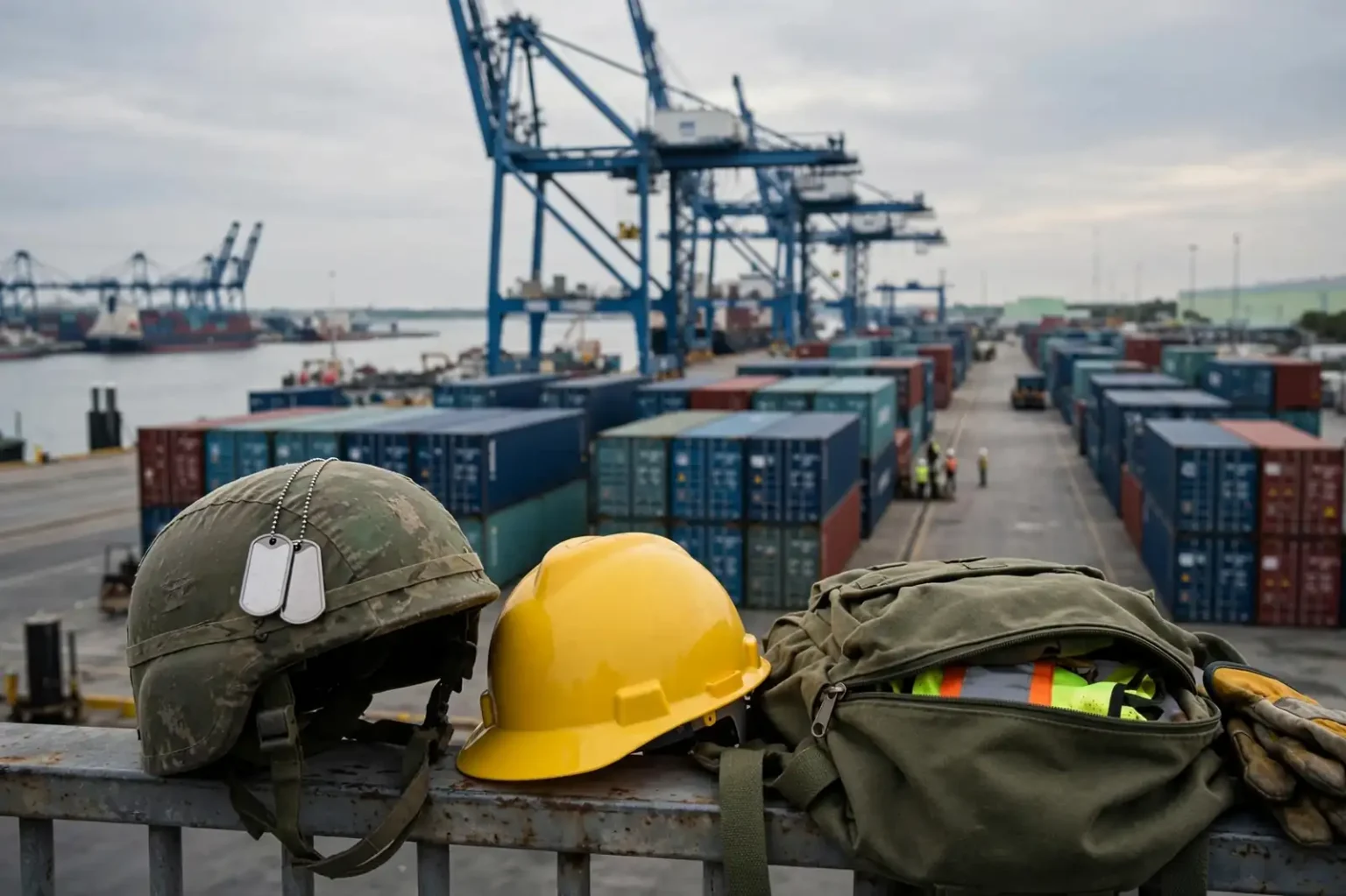
MOBILE, Ala. — A Port of Mobile internship with APM Terminals gave one recent University of South Alabama graduate, a former Army soldier who returned to college after nearly 20 years away from the classroom, a full-time job in the shipping industry before he had even finished his degree. The graduate now works as an assistant operations manager in the company’s marine department, where he helps plan and oversee the flow of shipping containers through the port.
His path from military service to the waterfront highlights how veterans’ education benefits, campus support services and local employers can combine to open doors to new careers on the Gulf Coast. It also comes as the university prepares to give its military-affiliated students a larger, more visible space on campus.
From the Docks to a Desk in Marine Operations
The graduate’s current role places him at the center of one of the region’s most important economic engines. As an assistant operations manager in the marine department, he is part of the team responsible for planning and supervising how containers move through the terminal.
That opportunity grew directly out of an internship. While still enrolled as a student, he completed an internship at the Port of Mobile with APM Terminals. The internship turned into a permanent job offer, and he began working full time before completing his coursework. He went on to earn his degree from South in 2025.
The graduate said he is very proud to hold a degree from South and credited the university with creating a long list of opportunities for him.
What a container terminal does
Container terminals are where ocean-going cargo ships are loaded and unloaded. Standardized steel containers carrying everything from consumer goods to industrial parts are lifted on and off vessels by large cranes, stacked in yards, and transferred to trucks or rail cars for the next leg of their journey. Marine operations staff coordinate vessel arrivals, berth schedules, crane assignments and the sequence in which containers are handled, so that ships can be worked quickly and safely.
APM Terminals is the port and terminal operating company affiliated with the Danish shipping group A.P. Moller-Maersk, and it operates the container terminal at the Port of Mobile. The Port of Mobile, overseen by the Alabama Port Authority, is Alabama’s only deepwater seaport and handles a wide variety of cargo, including containers, coal, steel, forest products and other bulk goods.
A Career Change Sparked by Sept. 11
The graduate’s road to the port began more than two decades ago. He was in his senior year of high school when the terrorist attacks of Sept. 11, 2001, reshaped his plans. Motivated to serve, he enlisted in the Army after finishing high school and remained in uniform for a decade.
He left the Army in 2014 and went home to Oklahoma, where he worked as an electrical lineman. In 2023, he relocated to Mobile to help look after his father, expecting to keep working in the same trade. When the right job in that field did not come together, a fellow veteran suggested a different option: enrolling at the University of South Alabama and paying for it with his GI Bill education benefits.
Back in the classroom after a long break
Going back to college after so many years was intimidating. He turned to the campus office then known as the Office of Veterans Affairs, which has since been renamed the Office of Military Services. Staff there walked him through the steps needed to enroll, and he was ready to begin classes that fall. He said the office was easy to approach and that staff laid out every step he needed to take.
Once he began classes in the Mitchell College of Business, his doubts about the career change faded quickly. He discovered the field of supply chain management, and it was an immediate fit.
Why Supply Chain Management Fits Veterans
Supply chain management covers the planning, sourcing, production, warehousing, transportation and delivery of goods from their origin to the final customer. Professionals in the field work in logistics companies, manufacturers, retailers, ports, railroads, trucking firms and government agencies. Common responsibilities include forecasting demand, managing inventory, scheduling shipments and solving problems when deliveries are delayed.
Many veterans find the discipline familiar. Military service often involves moving people, equipment and supplies under tight deadlines, following detailed procedures and coordinating across teams. Those experiences can translate well to logistics roles in the private sector, where planning, accountability and calm decision-making under pressure are valued.
The Mobile area offers a concentration of logistics-related employers because of its port, its interstate highway access along Interstate 10 and Interstate 65, its rail connections and its inland waterway links. That makes internships with port operators and related businesses an especially practical stepping stone for students in the field.
South Expands Its Home for Military-Affiliated Students
Before he graduated, the former soldier was one of over 1,000 students at South with ties to the military. The university uses that term to describe a broad group that covers service members on active duty, members of the National Guard and Reserve, veterans and military family members.
To better serve that population, the university is planning a 7,200-square-foot addition to its ROTC Building, which opened in 2024. Once built, the addition will become the home of the Office of Military Services, giving the program a more prominent location on campus.
What the Office of Military Services does
The office recruits military-affiliated students to South, helps them obtain financial aid and the benefits they have earned, and supports them from enrollment through graduation. In 2024, the university bolstered those efforts by appointing a retired Army sergeant major to lead the program.
Offices like this one can be a vital resource for veterans returning to school. Navigating education benefits, transferring military training credits, managing housing allowances and adjusting to a campus environment can all be challenging for students who have been away from academics for years. Having a single point of contact staffed by people familiar with military life can make the transition smoother.
The Gulf Coast’s Large Military Community
The university’s investment reflects the size of the military population in Alabama and along the Gulf Coast. Alabama is home to about 13,500 active-duty service members, more than 26,700 members of the National Guard and Reserve, and roughly 339,300 veterans. Major military installations sit both east and west of Mobile, which means many service members and their families live within reach of the university.
For those individuals, a nearby university with dedicated support services can serve as a bridge from military life to a civilian career, whether they are leaving active duty, serving part time in the Guard or Reserve, or are family members pursuing their own education.
Understanding the GI Bill
The GI Bill refers to a set of federal education benefit programs administered by the U.S. Department of Veterans Affairs. The best-known version for recent service members, the Post-9/11 GI Bill, can help cover tuition and fees and may include a monthly housing allowance and a stipend for books and supplies, depending on the length of qualifying service and other factors.
Veterans considering college can generally take several steps to get started:
- Confirm eligibility: Apply for education benefits through the Department of Veterans Affairs and obtain a Certificate of Eligibility, which shows how much benefit remains.
- Contact the campus military or veterans office: School certifying officials report enrollment to the VA so that benefits are paid correctly.
- Request military transcripts: Prior training and experience may count toward college credit, depending on the school’s policies.
- Explore career paths: Academic advisers and career services offices can help match a veteran’s interests and experience with degree programs and internships.
Tips for Students Seeking Logistics Internships
Students interested in following a similar route into the logistics industry can take some general steps to improve their chances:
- Start early: Many employers recruit interns months ahead of the term in which the internship takes place, so visiting a campus career center early in a degree program can help.
- Connect coursework to industry: Classes in operations, transportation and data analysis give students a vocabulary that employers recognize.
- Highlight transferable experience: Veterans and adult learners can point to leadership roles, safety training and experience managing equipment or schedules.
- Treat the internship like a job interview: Reliability, curiosity and a willingness to learn on the floor or on the dock often lead to full-time offers.
Internships as a Launch Pad
The graduate’s experience underscores the value of internships, particularly for career changers. An internship lets a student test a field in a real workplace, build professional relationships and show an employer what they can do. For companies, internships offer a chance to evaluate potential hires before making a long-term commitment. In this case, the arrangement led to a full-time offer before the student had even crossed the graduation stage.
For other veterans and adult learners weighing a return to school, his story offers a practical model: lean on campus support services, explore fields that build on existing strengths and look for hands-on work experience with local employers. In a region anchored by a busy seaport and a strong military presence, those connections can lead to lasting careers close to home.