Potter Tract Road closure begins Nov. 30 for 10-month Mobile County bridge replacement
Potter Tract Road shuts in both directions Monday, Nov. 30, for a bridge replacement expected to last about 10 months. A signed detour uses Highway 188, Henderson Camp and Turkey Farm roads.
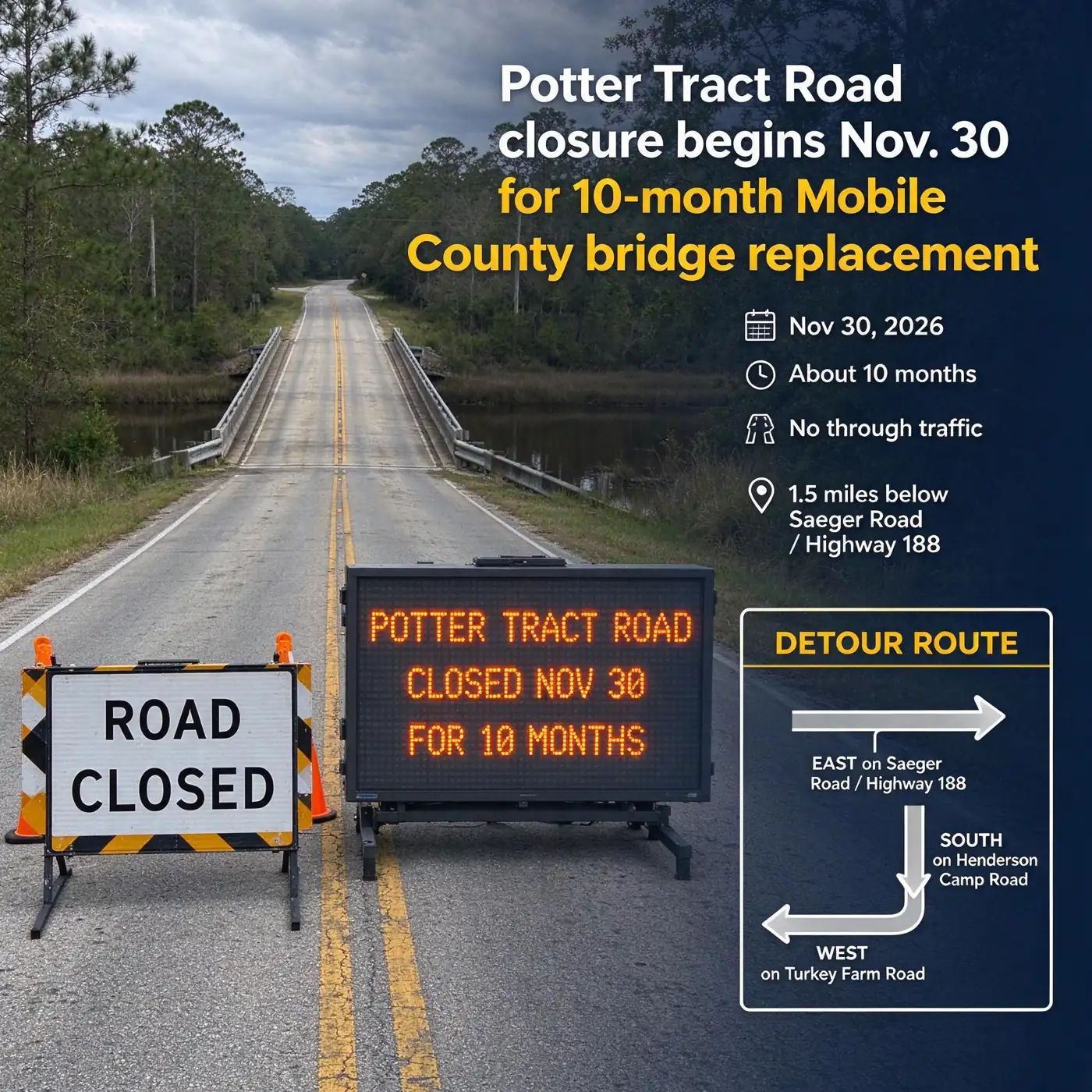
MOBILE COUNTY, Ala. — Drivers who rely on Potter Tract Road in south Mobile County will need a different way around starting the Monday after Thanksgiving. The Potter Tract Road closure takes effect Monday, Nov. 30, 2026, shutting the road to all vehicles, northbound and southbound alike, so crews can replace a bridge.
The work zone lies roughly 1.5 miles below the intersection with Saeger Road/Highway 188. Mobile County expects the road to stay closed for roughly 10 months, though officials caution that the timeline depends on the weather.
Potter Tract Road closure: the essentials
- What: Full closure of Potter Tract Road for a bridge replacement.
- Where: Roughly 1.5 miles below Saeger Road/Highway 188.
- Starts: Monday, Nov. 30, 2026.
- Traffic impact: No through traffic in either direction.
- Expected length: About 10 months, subject to weather.
- Detour: Saeger Road/Highway 188 east, Henderson Camp Road south, Turkey Farm Road west.
- Funding: Construction paid for entirely through Rebuild Alabama; preliminary engineering and design paid for by Mobile County.
- County Commission district: District 3.
Following the posted detour
Detour signs will steer drivers around the construction. The marked route relies on three roads, and drivers should take them in this order:
- Step 1: Take Saeger Road/Highway 188 heading east.
- Step 2: Turn and head south on Henderson Camp Road.
- Step 3: Turn and head west on Turkey Farm Road.
That sequence describes the signed route for drivers starting from the Highway 188 side of the closure. Motorists approaching from the opposite direction should follow the posted signs, which guide traffic around the work zone over the same network of roads.
Electronic message boards are already in place to alert drivers to the upcoming shutdown. Anyone who uses Potter Tract Road regularly may want to drive the detour once before the closure begins to get a feel for the added distance and travel time.
Plan for extra time
The county is urging motorists to plan alternate routes and give themselves additional time while the bridge is being built. Detours on rural road networks often add several minutes to a trip, and the delay can feel longer during morning and afternoon commutes.
A few simple steps can make the change easier. Consider these tips:
- Leave earlier than usual during the first weeks of the closure, while traffic patterns settle.
- Update any saved routes in navigation apps, which may take time to reflect the closure.
- Let family members, caregivers and regular delivery services know about the change.
- Watch for slower traffic and turning vehicles on the detour roads, which will carry more cars than usual.
- Never drive around barricades or try to cross a closed work zone.
Because the closure begins right after the Thanksgiving holiday weekend, travelers heading home from family gatherings should keep the new route in mind. The road will still be open through the holiday itself, with the shutdown starting Monday.
How long the work is expected to take
The county estimates the project will take about 10 months. Counted from Nov. 30, that schedule would carry the closure into roughly the early fall of 2027, though no specific reopening date has been announced.
Officials noted that construction schedules depend on the weather. Along the Gulf Coast, heavy rain, high water and the summer storm season can slow bridge work, particularly tasks such as excavation, setting foundations and pouring concrete.
Drivers should keep an eye on message boards and county announcements for any changes to the schedule as the project moves forward. Any shift in the timeline would most likely be shared through those same channels.
Paid for by Rebuild Alabama
Rebuild Alabama, the state program that pays for road and bridge improvements with fuel tax revenue, is covering the entire cost of building the replacement bridge. The construction phase carries project number RA49-05-26.
The Alabama Legislature passed the Rebuild Alabama Act in 2019 during a special session. The law raised the state’s fuel tax by 10 cents per gallon, phased in over three years, and tied future adjustments to changes in highway construction costs.
The first 6 cents took effect in September 2019, followed by 2-cent increases in October 2020 and October 2021. Since then, the rate has been eligible for small adjustments every two years based on a national index of highway construction costs, with each adjustment capped at 1 cent per gallon.
Supporters argued at the time that Alabama’s previous fuel tax rate had gone unchanged for decades while construction costs climbed and vehicles became more fuel-efficient. The new revenue was intended to help close the gap between road needs and available funding.
Money raised under the program is set aside for transportation infrastructure and is shared among the Alabama Department of Transportation, counties and cities. The law also includes requirements meant to make spending public, so residents can see which road and bridge projects the money supports.
The program has helped pay for road and bridge work in counties and cities across Alabama, including Mobile County. For local governments, it offers a dedicated stream of money for projects such as bridge replacements and resurfacing that might otherwise compete for limited local dollars.
Two project numbers, two phases
The bridge job carries a second project number as well. Mobile County paid for the preliminary engineering and design work under project number MCP-004-22, while Rebuild Alabama money covers the construction itself under RA49-05-26.
Preliminary engineering on a bridge project generally includes surveying the site, studying the waterway or ground the bridge crosses, gathering soil information and preparing the detailed plans that contractors follow. Splitting the work this way is common in public road projects, with design completed first so that construction can be bid and scheduled once funding is secured.
The two numbers allow the county and the state to track spending on each phase separately. They also make it easier for the public to see which government paid for which part of the job.
Why bridges are replaced
Across the United States, public bridges are inspected on a regular cycle under federal standards, generally at least once every two years. Inspectors look at the condition of the deck, the supporting structure underneath and the foundations, and they flag bridges that are aging, deteriorating or no longer suited to modern traffic.
When repairs would be costly or would only extend a bridge’s life for a short time, replacing the structure is often the more practical choice. Replacement projects usually require closing the road because crews must remove the old bridge and build the new one in the same location.
Inspection results feed into the National Bridge Inventory, a federal database that tracks the country’s public highway bridges. Bridges in that system are commonly classified as being in good, fair or poor condition based on the ratings of their main components, which helps state and local agencies decide where to spend limited repair money.
The county has not released details about the condition of the existing bridge on Potter Tract Road or the design of its replacement. Those specifics were not part of the closure announcement.
Safety in and around the work zone
Even with the road closed to through traffic, the area around the bridge will be an active construction site with heavy equipment and workers on the ground. Drivers approaching the barricades should slow down, obey all signs and follow the detour rather than attempting to reach the bridge.
Pedestrians and cyclists should also stay out of the closed section. Construction sites can contain open excavations, unstable ground and moving equipment that are not always visible from the road. Heavy trucks may also be entering and leaving the site throughout the workday. Parents in nearby neighborhoods may want to remind children to keep away from the barricades and equipment while the project is underway.
Quick answers for drivers
Will the road be open for Thanksgiving?
Yes. The closure is scheduled to begin Monday, Nov. 30, so Potter Tract Road remains open through the Thanksgiving holiday on Thursday, Nov. 26, and the weekend that follows.
Can I drive through the work zone?
No. Traffic will not be able to pass the bridge site from either direction. Drivers should use the signed detour.
When will the road reopen?
The county estimates about 10 months of work, but no firm reopening date has been set. Weather could move the schedule in either direction.
Where the project sits
The project falls within District 3 of the Mobile County Commission. Residents with questions about the project, the detour or the schedule can reach out to the Mobile County Commission or the county’s public works staff.
The Mobile County Commission is a three-member governing body, with each commissioner representing one of the county’s three districts. The county is responsible for maintaining a large network of roads and bridges outside city limits, and projects like this one are planned and overseen through its public works operations.
Highway 188 is a key east-west route across the southern part of the county, which is why it serves as the first leg of the detour. Once the new bridge is finished and Potter Tract Road reopens, drivers can return to their usual route.